
Recently I discovered an absolutely amazing online tool for making fantasy maps called Inkarnate. I was so impressed by the free version I paid for a year of subscription the very first night. I’ve always loved drawing fantasy maps, but I lack the artistic talent to do them with any quality. Inkarnate lets even someone like me make fantastic looking maps.
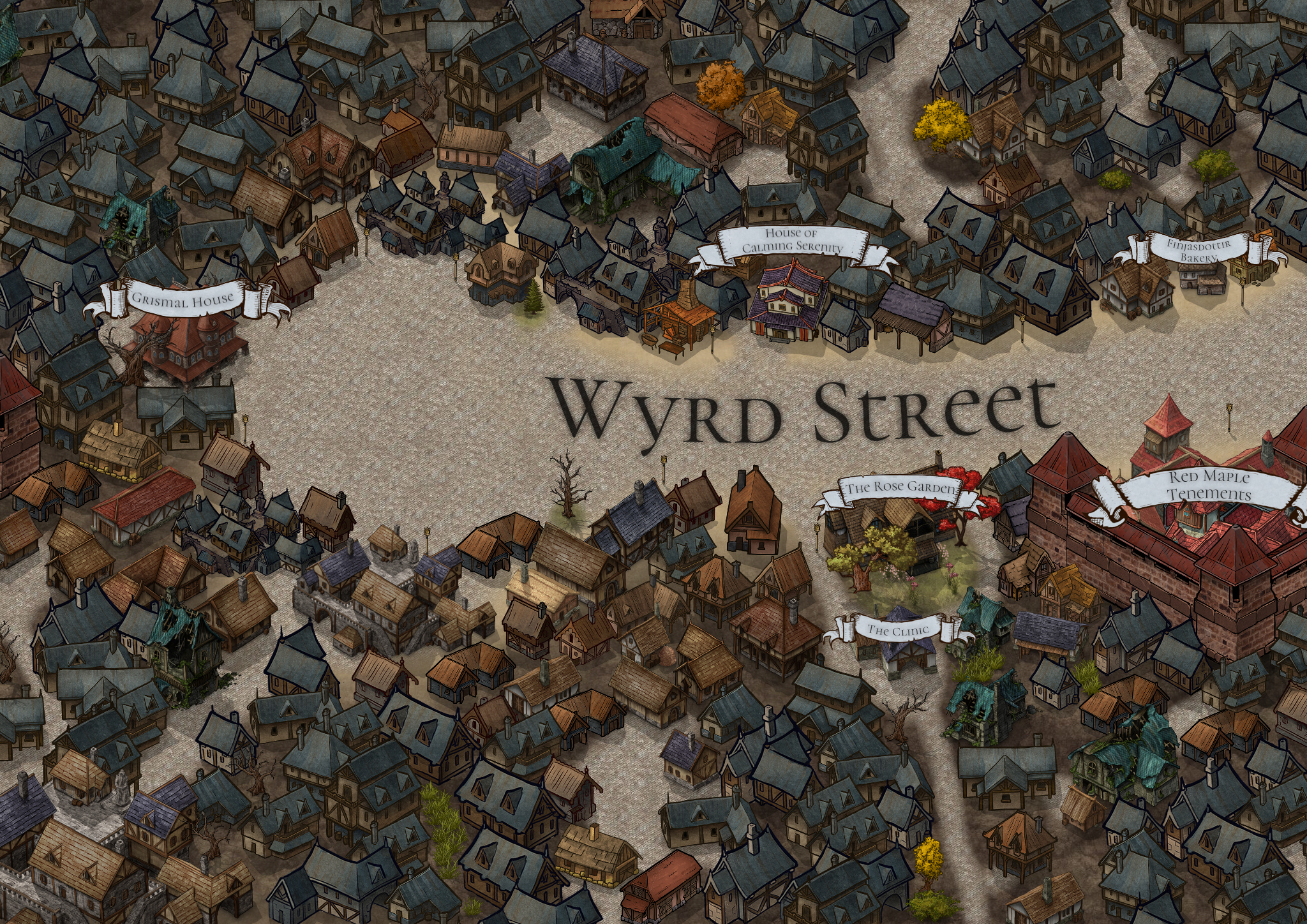 I swear they aren’t paying me to promote them. I just really, really love this tool.
One of the first maps I made was a map of Wyrd Street, the titular setting of the table-top RPG I’ve been designing for about a year now.
I’ve mentioned Wyrd Street in passing before, but it occurs to me I’ve never really taken the time to go into any depth. Now seems as good a time as any.
It’s still a work in progress — it’s more or less “feature complete” in terms of races, classes, and core systems, but it still needs a lot more content — so I don’t want to say too much about it right now, but I can give a general overview.
My two favourite ways to describe Wyrd Street in a nutshell are “if that bit at the start of Dragon Age 2 where Hawke iss a nobody just trying to feed their family was the whole game” or “if the song What It’s Like by Everlast was a fantasy RPG.”
Or if you want the long version, here’s the blurb I have at the start of the core rulebook:
The world moves toward war. The armies of the Seven Holy Kingdoms of Tiahn move south, subjugating all in their path in the name of their divine law. Xandria and the Rusty Peaks have already fallen, and now the Holy Kingdoms turn their attention to the Free Holds. On both sides, legendary heroes rise to determine the fate of the world.
You are not one of them.
In the slums of Morhold, refugees from the war mingle with the city’s own poor. Here, a small haven has been carved out among the desperation and the gangs. Here, all outcasts and rejects have a home.
In this place walks a different class of hero. Brawlers and Scoundrels, Drifters and Fortune Tellers, Quacks and Street Preachers, Dreamers and Heretics. No songs will be sung of them, but it is they who bring hope to the hopeless, who defend the innocent from those who would exploit them. Not everyone can save the world, but anyone can save someone’s world.
This is Wyrd Street. This is your home, and you will do anything to protect it.
It’s a game of (relatively) ordinary people doing their best to protect those close to them. While the option to create your own characters exist, the game is built around the idea of playing pre-made “Iconic” characters who have close ties to each other and the world around them. You’re not fighting to save the world; you’re fighting to feed and protect the people you love.
Mechanically, it’s a fairly standard D20 system, but with some tweaks. I wanted to fix some of the things that frustrate me when I play Dungeons and Dragons.
For example, in D&D, I don’t like the wild disparity between classes when it comes to decision-making during combat and the action economy.
Personally I can’t play a D&D character without spell slots. I like making choices between casting a spell or not, and if so which spell. As a more physical character, you just attack nine times out of ten.
In Wyrd Street, every class uses focus, a resource analogous to spell slots, to activate their most powerful abilities. Class identity is established by how each class interacts with focus.
For example, Fortune Tellers and Scoundrels have very low maximum focus pools, but they have multiple ways to quickly regain focus, so they’re encouraged to spend it almost as fast as they earn it. Meanwhile, a Street Preacher has a larger maximum focus pool but doesn’t get focus back as quickly, so while they can use a lot of focus-spenders, they have to be a little more strategic about it. And a Brawler has a low focus pool and low regeneration, but they have access to a lot of powerful passive bonuses, so they don’t necessarily need focus to be a terror.
The unbalanced action economy is also something I find frustrating in 5E D&D. A monk will use a bonus action almost every turn, but paladins almost never have any use for their bonus actions.
To address this, in Wyrd Street the concept of bonus actions has been eliminated entirely in favour of simply giving every character two actions per turn by default.
Other features of Wyrd Street include a unified system of buffs and debuffs for greater clarity and eschewing traditional subclasses in favour of giving every class a choice of multiple new abilities at each level. You can still build towards certain specialties — a Drifter can focus heavily on their pets, or split their abilities between improving themselves and their pets, or not use pets at all — but it’s more flexible.
The exceptions are Quacks and Vigilantes. Uniquely, those classes each have a choice of two distinct subclasses that define their playstyle from level one. Quacks can specialize as an Anatomist (a melee burst damage build) or a Chemist (a ranged support build), whereas Vigilantes may gain some support abilities by choosing the Pursuit of Justice and wielding the Beacon of Hope, or maximize their damage and terrorize the wicked with the Brand of Hatred by choosing the Pursuit of Vengeance.
Even racial abilities are based on choice. Everyone can choose one of three abilities unique to their race once they hit level three.
There are other unique features too — like missed attacks being converted to more of a glance system so turns are never fully wasted — but I think that covers the broad strokes.
But at the end of the day, Wyrd Street is about the stories and the people more than the mechanics. It’s about outcasts doing their best in a hard world.
Before I go, I’ll leave you with another excerpt from the core rulebook:
Wyrd Street is different from other popular table-top RPGs in that the focus is less on grand heroics or world-changing events and more on intimate stories of ordinary people doing their best to protect their homes and the people they love. The heart of the game is found in the bonds between characters and the intricate details of the setting.
An effort has been made to make the cast of Wyrd Street as inclusive as possible in the hopes that anyone can feel represented within this world. If there is one rule in Wyrd Street that trumps all others, it is this: Anyone can be a hero.

 Superior Realities