
I didn’t know what to expect from this book.
Most Warcraft novels to date, barring a few exceptions, have been written by Richard A. Knaak or Christie Golden. These are both writers with their share of flaws, but you know what you’re getting, and they’ve got a lot of experience with the Warcraft universe, so they tend to capture it very well.
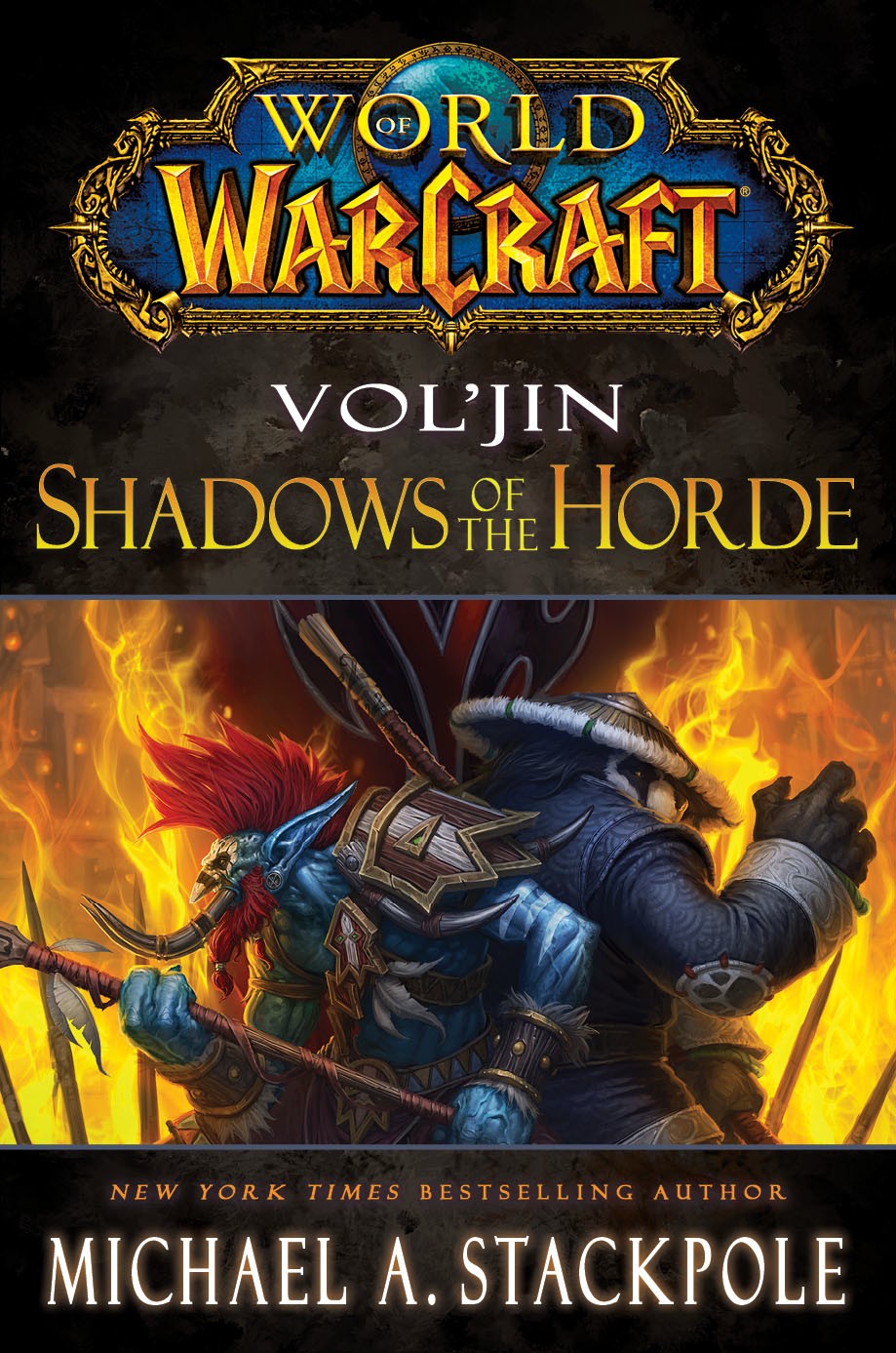 Vol’jin: Shadows of the Horde is the first Warcraft novel in a long time to be written by a new (to Warcraft) author: Michael A. Stackpole. I admit I was a bit concerned this newbie might not handle the Warcraft universe as well as his more experienced counterparts.
I was pleasantly wrong.
Shadows of the Horde picks up almost immediately after the events of Mists of Pandaria’s Dagger in the Dark scenario. Mortally wounded, Vol’jin washes up in Binan Village and is rescued by Chen Stormstout. Seeing no other way to save his old friend, Chen brings Vol’jin to the peaks of Kun-Lai Summit, to the Shado-pan Monastery.
Much of the rest of the book deals with Vol’jin’s recovery amidst the monks. A little extra spice comes from the fact that Vol’jin is not the only guest — there is also an Alliance soldier recovering amongst the Shado-pan. And just to keep things interesting, there’s a Zandalari invasion brewing on the horizon, too.
What I found interesting about this book is how thoughtful and introspective it is. It’s not the brawling roller-coaster that most recent Warcraft novels have been, but I mean that as a positive. There is fighting when the story calls for it, but much of the novel is given to quiet meditations on Vol’jin’s identity, the true nature of the Trolls, and the purpose of the Horde.
I like this because it capitalizes on the strengths of books as a medium. The advantage of a novel over telling stories in the game is that you grant greater depth to plots and characters, and Shadows of the Horde does this excellently. Instead of constantly trying to one-up his own epicness like Knaak does, Michael Stackpole tells a deceptively simple story focused almost exclusively on Vol’jin, Chen Stormstout, and their Alliance companion.
 In fact, if I have one complaint about this book, it’s that it sometimes — though thankfully not too often — gets a little too thoughtful, to the point of navel-gazing. If I had to sit through one more arcane Pandaren parable from Taran Zhu…
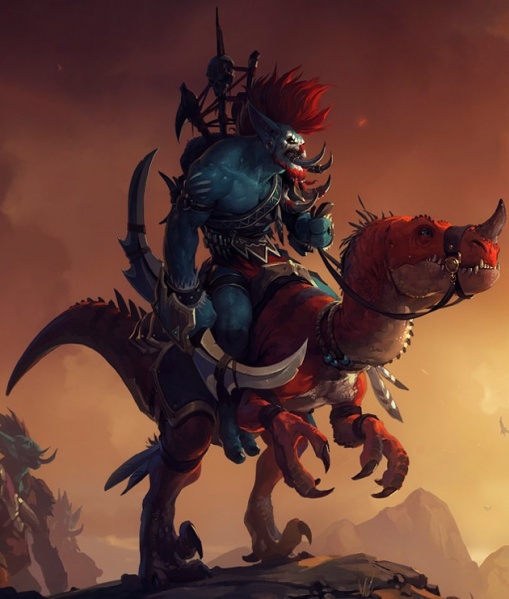
The other thing that I greatly enjoyed about this book is that, contrary to my concerns, Michael Stackpole seems to understand the cultures of the Warcraft universe very well. I very much liked how Vol’jin is shown to be honourable and wise figure, but still undeniably a Troll. He has a very vicious and feral side to him. His fondest memories are of breaking the bones of his enemies and smelling their “delicious” blood.
There’s a great balance struck where Vol’jin is neither a mindless, bloodthirsty savage nor a blue human with tusks and a bad accent.
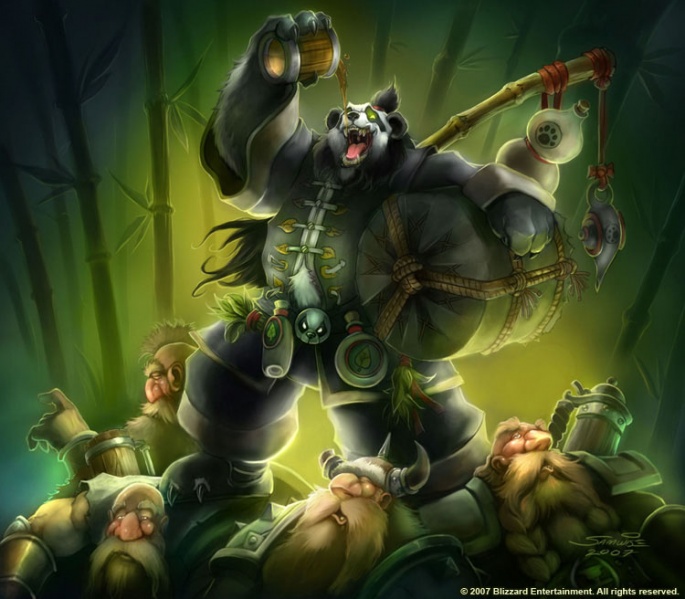
Similarly, the Pandaren are very well-presented. They are shown as a very intricate and thoughtful people, with layer upon layer of complexity hidden behind their seemingly simple personas. Chen Stormstout, for example, is very much the jolly fellow we know from the games, but he is also shown to be quite wise and worldly underneath all his jokes and love of beer.
I found the quality of the prose very high compared to other Warcraft novels, as well. It’s a well-written book even beyond the story and the characters, and some of the dialogue is quite clever and snappy. My only complaint would be that the Trolls’ language is sometimes a little too sophisticated, seeming at odds with their pseudo-Caribbean patois.
 And while there isn’t a huge amount of action, the fight scenes that do exist are quite gripping. They’re frenetic, but never confusing, and they pull no punches on the goriness and brutality of battle. I also quite liked that the author seemed to take inspiration for Vol’jin’s combat abilities more from Warcraft III’s shadow hunters than modern World of Warcraft classes. Sweet nostalgia!
Warcraft novels have been in a bit of slump recently — not bad, just not as good as some of classics like The Last Guardian or Lord of the Clans — but between Shadows of the Horde and Dawn of the Aspects, things seem to be turning around.
Overall rating: 8.7/10 It got di righteous groove.
New article:
My latest article for WhatMMO talks about gearless progression.
I really wish game developers would rid themselves on their tunnel vision on gear as the only way to offer players advancement. It’s not very satisfying, and there are so many other ways to keep people engaged.
Part of the reason I’m so hooked on The Secret World is that it has much less emphasis on gear, and there are plenty of other ways to advance your character. Doing that also allows what gear does exist to be much more meaningful. On my Dragon, I used my sword from the first Mayan event for the lion’s share of a year.


 Superior Realities