
I keep wanting to call this episode, “Trek Yourself Before You Wreck Yourself.”
 So the speculation was correct: Following a malfunction with the spore drive, the Discovery has arrived in the Mirror Universe. This puts not only the ship in danger, but all of the Federation, as Discovery is the only ship with the intel needed to defeat Klingon cloaking. Desperate to return home, the crew hatches a daring scheme to infiltrate the Terran Empire and gain information crucial to finding a path back to their home universe.
Meanwhile, Lieutenant Tyler’s mental state continues to deteriorate, putting the mission in jeopardy.
I was a little suspicious of Discovery going to the Mirror Universe so soon in the series, and it seems I was right to be concerned. Really, is rehashing old TOS plots all this show can do?
More importantly — and this is a weird thing to say, but it’s true — Discovery is way too dark to make the Mirror Universe work. Yes, it’s the evil universe, but it’s always been the goofy, cartoony vision of evil. The Mirror Universe is supposed to be Star Trek at its campiest. It’s a silly “what if” with no consequences. It’s just for fun.
Discovery’s grim tone sucks all of the fun out of the Mirror Universe. Its lost its all its colour and personality.
 But the problems don’t stop there. “Despite Yourself” is a great summation of everything wrong with Discovery.
First, we got plot holes. Of course we have plot holes. It wouldn’t be Discovery without them. Sure, Stamets can’t run the spore drive in his current condition, but what’s stopping them just bio-engineering someone else to pilot it? Yeah, there’d be risks, but is it any less risky than going deep cover in an empire you know next to nothing about?
And why didn’t Discovery just transmit its findings on the cloak to Starfleet? And why is Tyler still on duty despite his obvious mental instability?
Next, we’ve got Discovery continuing to treat its non-white crew members as expendable. This show started with a great diverse cast, but at the current rate it’ll soon just be Burnham lost in a sea of white people. Nice infinite diversity you got there, Discovery.
The next issue is a big one, and it’s a spoiler, so if you haven’t seen the episode yet, you may want to skip the rest of this review. Though at this point you can hardly call it a surprise.
This is a dummy paragraph to give you time to leave if you don’t want to be spoiled.
Okay? Okay.
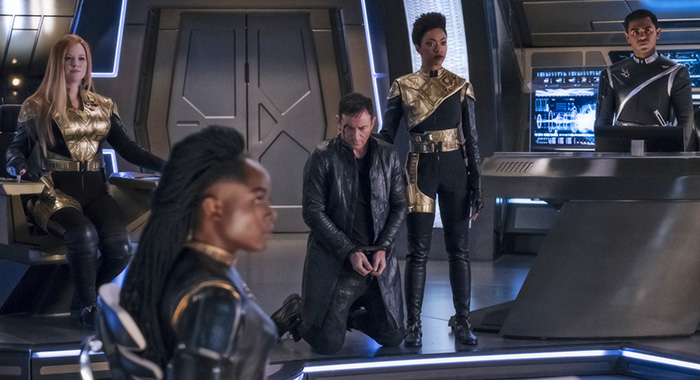
 So, yeah, Tyler’s a Klingon.
Damn it.
Let’s enumerate all the ways this is a terrible idea, shall we?
Well, first, it completely ruins all of Tyler’s character development to date. He was one of Discovery’s more layered and compelling characters, but now he’s just a villain with some screws loose. Either he gets killed off later, or he gets somehow redeemed and goes back to being a part of Discovery‘s crew, which would make no sense on any level. Either way, it’s a waste.
Also, his seeming sexual abuse at L’Rell’s hands is now revealed to be a lie (albeit a lie he himself believed for a time). Considering how actual victims of sexual assault are continually doubted and accused of lying, this is a deeply problematic decision, and breathtakingly tone-deaf in the current climate. It’s stupid, it’s insensitive, and anyone with half a brain should know better.
And oh, yeah, let’s not forget that the only character of South Asian descent has turned out to be a sinister sleeper agent from a violent religious sect. I’m sure that kind of narrow-minded stereotyping is exactly what Roddenberry had in mind.
Frack me.
 As for good news? Well, there isn’t much.
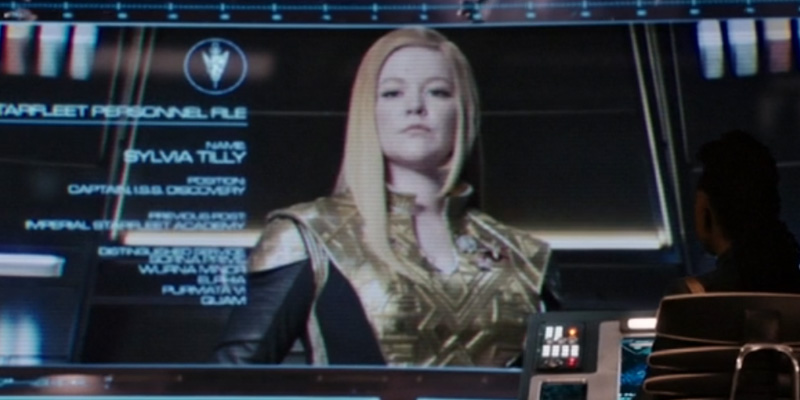
Tilly is still a delight. She is the only one evoking some of the traditional lightheartedness of the Mirror Universe as she attempts to impersonate her ruthless counterpart, “Captain Killy.”
Also, the art design continues to be impeccable. Those Mirror uniforms are sexy as all hell. CraveTV has improved its video quality since last I used the service, too, so I can now appreciate Discovery’s sumptuous visuals without it looking like I’m viewing the show through a thick fog. That’s nice.
I am a little curious who the “faceless emperor” turns out to be. It’s kind of reminding me of the Imperial stories in SWTOR, actually. Wouldn’t it be fun if it turned out Valkorion was leading the Terran Empire? I’d feel much better about this arc if that turned out to be the case.
I really wouldn’t past the slimy bastard, honestly. What are the barriers between realities (and sci-fi franchises) to one such as he?
Someone needs to write a fan fic of that. Should include Burnham shouting “KNEEL BEFORE THE DRAGON OF ZAKUUL” at least once.
Ahem, anyway…
 In the end this is a very disappointing episode. I’m really starting to think Discovery’s writers just don’t understand anything about what Star Trek is supposed to be, and if I hadn’t just paid money to watch the rest of the season, this might have been the final straw for me.
Overall rating: 4/10 It seemed okay while I was watching, but the more I think about it, the less I like it.
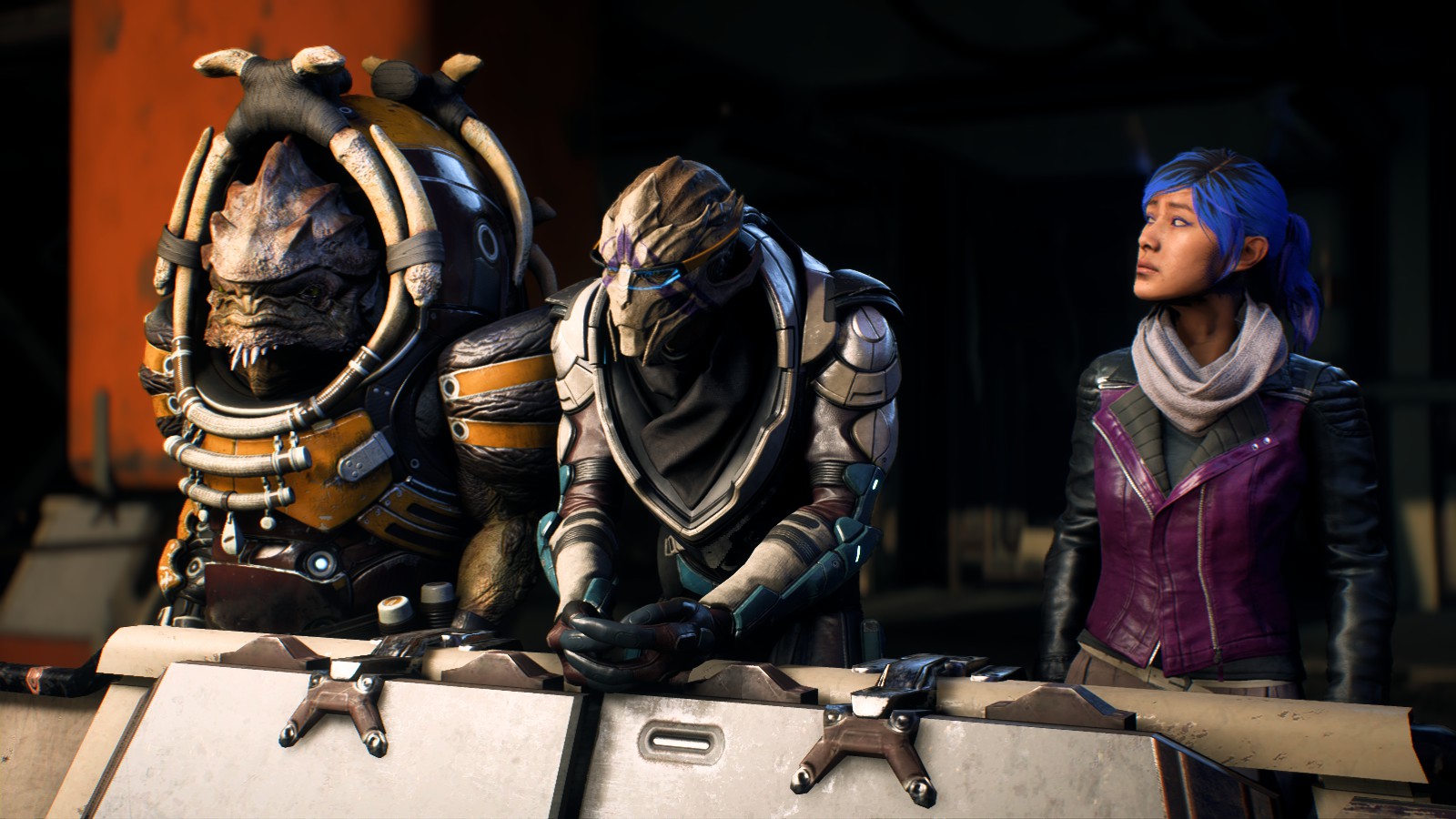
I really wish they hadn’t cancelled the DLC for Andromeda.

 Superior Realities