
I’ve somehow managed to contract yet another flu, so forgive me if I’m a bit less coherent than usual.
Review: Starcraft, Ghost: Spectres:
 “Spectres” by Nate Kenyon is the latest novel based on the cancelled but not forgotten Starcraft: Ghost game. It follows up on Keith R.A. DeCandido’s “Nova” novel and the “Ghost Academy” manga series, and also serves as a prequel to the Tosh arc in Starcraft II: Wings of Liberty.
The story follows former spoiled rich girl and current elite assassin Nova Terra as she investigates a string of disappearances among her fellow ghost agents, while also struggling with the sudden return of the terrible memories she joined the ghost program to erase.
I’ll say right out of the gate that I liked this book. Part of this is because I have always been a huge fan of Nova. There’s just something innately charming about a sweet, innocent teenage girl who can blow up a skyscraper with her brain.
But there’s more to it than just my fanboy love of Nova. This is a very dark, ethically murky, and intriguing story in the finest tradition of the Starcraft universe. Nova finds herself caught between two different factions, the Dominion and the spectres, both of which seek only to use her as a means to their own selfish ends, and neither of which offer much in the way of redeeming qualities.
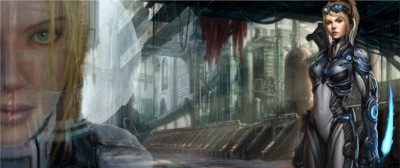 “Spectres” is a very grim tale, but it’s kept from being too depressing by Nova’s innate goodness as a person. No matter how wicked everyone around her is, Nova is always able to keep to noble intentions. Which is an odd trait for one of the universe’s most lethal assassins.
Along the way, we also learn a great deal of the origins of the renegade spectres, a familiar group for those who have played Starcraft II, as well as their leader, Gabriel Tosh. Tosh is portrayed in a very poor light in this book, and I expect this may anger his many fans, but as someone who falls on the Nova side of the Tosh V. Nova debate, I feel nothing but vindication.
And, of course, “Spectres” is filled with the kind of adventure and excitement we’ve come to expect from a Blizzard tie-in novel.
All that said, there are some problems with this book. My biggest is not so much a complaint with the book itself as with how Blizzard is running their tie-in novels.
Once upon a time, there was a kind of logic to which authors were assigned what novels for Blizzard. Richard A. Knaak handled the Dragons and the Alliance, and Christie Golden did the Orcs and Horde books, and there wasn’t much crossover between the domains of the various authors. The Starcraft novels were less consistent, but there weren’t as many of them, so it didn’t much matter.
 Now, though, at least three different authors have handled Nova’s books, and I find the story is suffering as a result. Nate Kenyon does a very admirable job of replicating what was done by past authors, but I can’t help but compare his work to that of the author of the original Ghost book, Keith DeCandido, and Kenyon falls short in that comparison.
I guess I just wish Blizzard would be a bit more consistent in who writes what.
It’s also worth noting that Kenyon did totally butcher one character, Kath Toom, but since she was never a particularly important character or one I particularly enjoyed, I’ll let that slide.
Finally, the ending did leave a little something to be desired, but it wasn’t lacking enough to cast a pall over the entire book.
Still, taken all in all, this was a very enjoyable book that I would recommend to any Starcraft fan.
Overall rating: 8.7/10 One of the best Blizzard books I’ve read in a while.
“Spectres,” as well as “Nova” and all three volumes of the “Ghost Academy” series, is available to buy on my Amazon Affiliate.
Bad Writerly News:
I recently received word that Massive Online Gamer, easily the best and most enjoyable of my writing jobs to date, will be shutting down after their next issue.
I find this terribly saddening. Never before in my life had I so looked forward to work as when I was writing for MOG, and now it’s over, just three issues after I started with them.
Between that and my getting sick for the second time in as many months, I’m having a truly depressing week.


 Superior Realities