Lord of the Rings and the Emotional Cadence

Recently, I’ve started rereading Lord of the Rings once again. I forget exactly how many times I’ve read these books now, but it has been quite a few years since the last time. Importantly, this is the first time I’ve read them since I became a writer, so although I’ve read them many times, this is the first time I’ve studied them.

A map of Middle EarthI notice a lot of interesting things by looking at Lord of the Rings through my WriterVision™ — such as how big the physical world of Middle-Earth feels compared to modern fantasy settings, likely a side effect of rapid transit effectively making the world smaller for people in the modern era.

However, what strikes me the most is what I like to call the emotional cadence of the books.

This is something I noticed even when I was much younger, but now that I’m looking at Lord of the Rings through a writer’s eyes, it’s even clearer.

If you lay out the story of Lord of the Rings, it could seem almost crushingly bleak. An almost omnipotent dark lord plans to cover the entire world in darkness. Ancient races and civilizations are mere shadows of their former selves, and there is little strength left to resist the shadow. The only hope comes in the form of a fat, spoiled rich kid with no knowledge of combat or adventure who is slowly being driven mad by the evil artifact he carries.

But it doesn’t really feel that oppressive when you’re reading it, does it? It’s a dark, intense story, but you never feel it start to weigh on your mind the way such stories can.
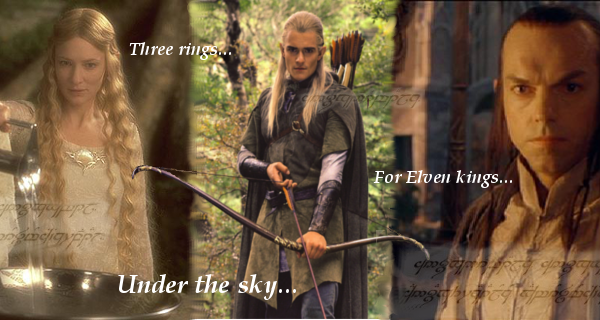
A Lord of the Rings image created for a graphics contest at GalacticaBBSThis is because Tolkien made sure to regularly interrupt the peril and the impending doom with moments of peace and levity: staying with Tom Bombadil, recovering in Rivendell, resting in Lorien, smoking in the ruins of Isengard, even stewing rabbit on the borders of Mordor.

It is this balance between joy and sorrow, peace and peril, that makes Lord of the Rings the brilliant story it is. The balance between the darkness and the light allows the reader to feel each more keenly. A candle shines so much more brightly in a darkened room.

This is something few other authors seem to be able to replicate — save perhaps J.K. Rowling with the Harry Potter books, and is it a coincidence those became monstrously successful instant classics? Too few seem to realize that “emotional rollercoaster” means you have ups as well as downs.

A lot of authors seem to struggle to strike this balance. They just keep ramping up the tension endlessly with no relief until the reader becomes depressed or simply desenitized, or else they offer little to no tension at all, creating a bland and flavourless story of basically nice people doing basically nice things with no excitement.

Even my literary idol, Ian Irvine, has occasionally struggled with this, notably with the Tainted Realm books, which at times delved too heavily into darkness without offering the reader a chance to catch their breath.
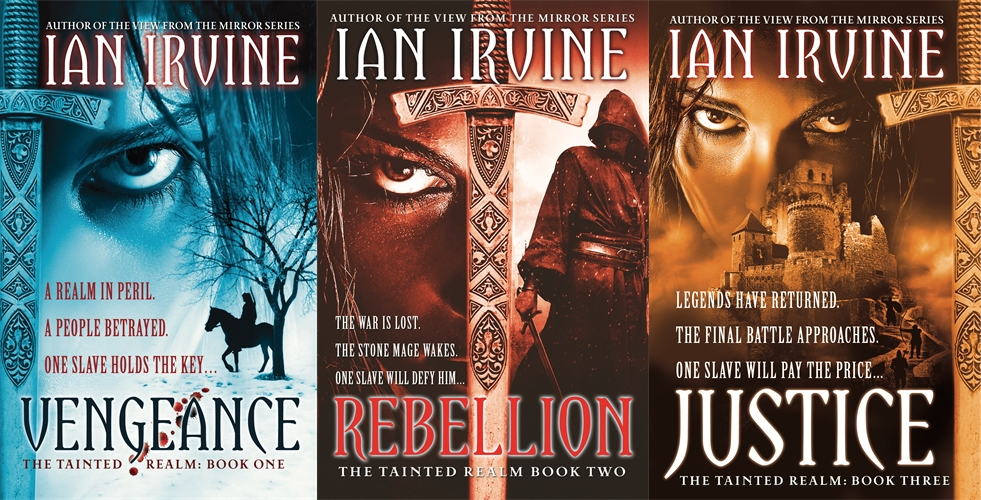
The covers for the "Tainted Realm" trilogy by Ian IrvineNow, there is room for some variety in how one interrupts the balance of light and darkness. Some stories are very dark, and will rarely offer the opportunity for peace and calm. Others are light-hearted and never let the fear or the sorrow become too intense.

But regardless, that cadence still needs to exist. You need to have some highs, and some lows, and they need to spaced out with some degree of regularity. Go too long without some positivity, and readers will become emotionally exhausted and lose interest in the story. Go too long without some intensity, and you’ll bore people to tears.

This is something I’m very conscious of in my own writing. I work very hard to keep the darkness and light balanced in my fiction. This is why Leha almost freezing to death is followed by her befriending Benefactor, and why the quiet comfort of Leha and Tyrom keeping each other sane on the streets of Tallatzan is followed by the crushing realization that humanity is in its waning hours.

Pointless Nostalgia: Mainframe Entertainment

I mostly use this blog to discuss my current interests — my recent writing projects, the books I’m reading, the shows I’m watching, and so forth. However, my love affair with speculative fiction has been a lifelong thing. I thought it might be interesting* to turn back the clock a bit and look at some of the sci-fi and fantasy I loved as a child, and which started me on the path to become the nerd I am today.

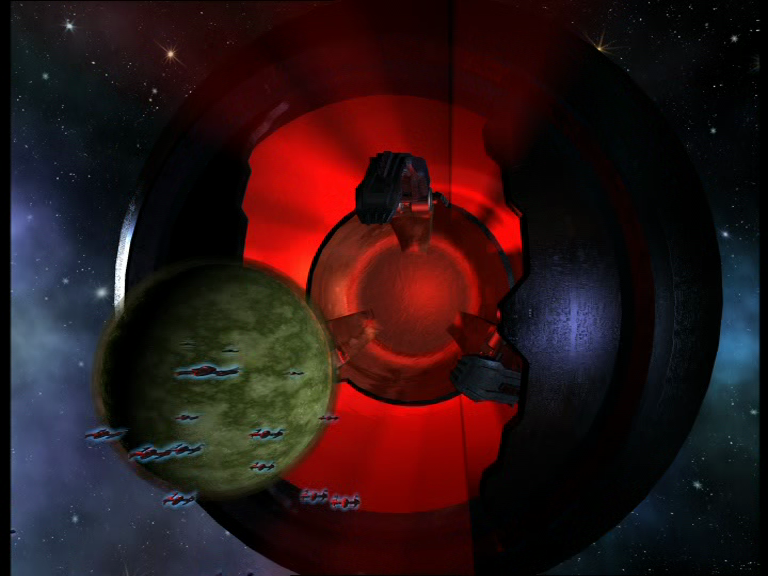
Graveheart and Tekla on Planet Ice in Shadow Raiders*(By which I mean that I wanted an excuse to look through a bunch of nostalgic YouTube clips.)

Originally, this was just going to be one post, but it got long enough that now I’m thinking I might make a whole series out of it.

Mainframe Entertainment:

When I think about things I loved as a kid, the shows produced by the Canadian company Mainframe Entertainment (now known as Rainmaker Entertainment) jump to mind almost immediately.

It all started with ReBoot. The first ever computer-animated television series, ReBoot was a piece of history, and while I loved it at the time, I think I have an even greater appreciation for ReBoot now that I’m an adult.

ReBoot was, above all else, wildly creative. It was a story set inside a computer, where each character is an anthropomorphized program. For example, one of the main heroes was Bob the Guardian, essentially an anti-virus program.

The city of Mainframe, setting of ReBootBut what was so clever about ReBoot was that they never actually came out and said, “This is a story about life inside a computer.” They just sort of left you to figure that out on your own. And they created this brilliantly deep and bizarre mythology and cosmology of life inside cyberspace that was just so completely original.

There were of course times when ReBoot devolved into pure, pointless absurdity as kids’ shows tend to, but on the whole, it was remarkably smart for a show aimed at children, and the later seasons wound up being surprisingly dark.

ReBoot also featured one of the greatest characters in human history: Mike the TV.

There’s been talk of a continuation of ReBoot for a long time, but the future remains uncertain. There was supposed to be a feature film trilogy, but I believe it’s been cancelled. Now just recently there’s word that Rainmaker is working on a new TV series called ReBoot: The Guardian Code.

I don’t generally want to be one of those adults who still watches kids’ shows… but I’d probably watch a ReBoot revival.

Bob the Guardian in ReBootReBoot was far from the only Mainframe show I loved, though. There was also Shadow Raiders (AKA War Planets).

Shadow Raiders was, if anything, even more bizarre than ReBoot, featuring a star system of warring elemental worlds forced to band together for survival against an all-consuming void planet.

Like ReBoot, Shadow Raiders had a surprising maturity once you looked past its odd outer trappings. The show went to some dark places, with entire worlds destroyed and civilizations brought to the brink of extinction. It’s not often you see a kids’ show deal with ideas like ingrained racial hatred and genocide.

Shadow Raiders was perhaps my first exposure to one of my favourite themes in fiction: the idea of old enemies banding together for mutual survival. The show repeatedly hammered home both how much the different worlds hated each other, and how utterly doomed they would be if they didn’t work together.

Shadow Raiders was also my first experience of a show I loved being cut down before its time, as it lasted only two seasons and didn’t really have a satisfying conclusion. This would become a regular theme in my life: Star Trek: Enterprise, Stargate: Universe, Terminator: The Sarah Connor Chronicles…

The Beast Planet consumes Planet Jungle in Shadow RaidersBut of course, the most famous of Mainframe’s shows, and the one I most loved at the time, was Beast Wars (and its sequel, Beast Machines), a spin-off of the Transformers universe.

Here’s a show to win the heart of any young boy. What’s better than a giant killbot? A giant killbot who turns into a truck. But what’s better than a giant killbot who turns into a truck? A giant killbot who turns into A MOTHER****ING DINOSAUR MOTHER****ER.

To say I was obsessed with this show would be a colossal understatement. I adored it with an almost religious fervour, and I wince to think of how much money my parents wasted getting me the toys.

My favourite characters were Rattrap, because rats and because I always gravitate towards the geeky characters, and Silverbolt, because I like lawful good types. Also, he was a wolf cross-bred with an eagle. Badass.

I especially enjoyed the episodes dealing with the alien Vok, who I found fascinatingly mysterious and creepy. In this, we see the earliest signs of my fascination with the concept of alien and unknowable beings, still present today in my fondness for things such as World of Warcraft’s Old Gods or The Secret World’s Dreamers.

The Maximal Silverbolt in Beast WarsIronically, while it was my most beloved Mainframe show at the time, Beast Wars is the one I have the least respect for as an adult. It was the most overtly childish, and the need to support the toy line forced the storyline to go in odd and often unnatural directions. It did not have the same wild originality as Shadow Raiders or ReBoot.

Still, it does deserve credit for once again being darker and more mature than one would expect from children’s programming, albeit to a lesser extent than its contemporary shows by the same company.

Something that amuses me to this day is how they were able to get away with putting such hideous acts of violence in a kids’ show simply because robots don’t bleed.