
Orphan Black left me a bit disappointed, but the hunger for new sci-fi remains. Defiance is good, but it isn’t enough on its own. So when I discovered that Showcase has the full series of another Canadian sci-fi show, Continuum, I decided I’d give it a try. I knew even less about Continuum going in than I did about Orphan Black — something something time travel — so I had no idea what to expect.
 These reviews will follow roughly the same format as my Orphan Black reviews — that is, somewhat truncated and a little more loose with the spoilers than usual.
“A Stitch in Time” (pilot episode):
Continuum begins in Vancouver in the year 2077. The world’s governments have collapsed, and corporations have stepped in to restore law and order, but this has come at the cost of virtually all personal liberty.
So really not much different from the real world.
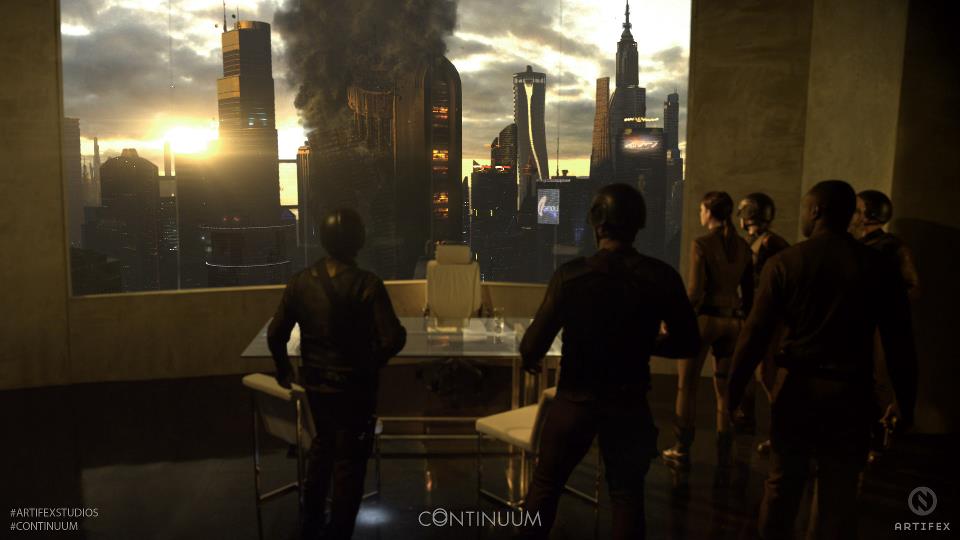
Not all accept the new order. In the show’s opening scene, the leader of the terrorist organization Liber8 makes a pirate broadcast calling for an uprising against corporate tyranny. He is tracked down and arrested by the local law enforcement, led by the show’s protagonist, Kiera Cameron (Rachel Nichols). As he is put in chains, he tells them they are too late, and one of the massive skyscrapers in the background implodes, killing thousands.
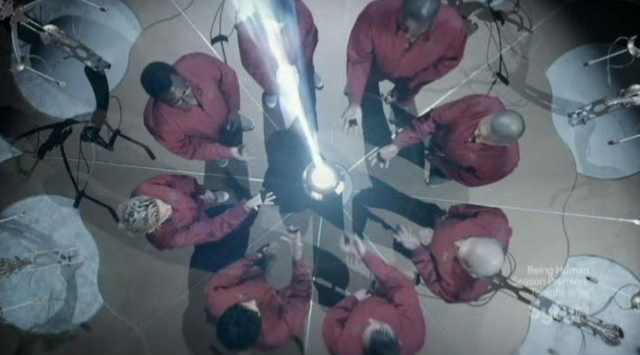
Flash forward a few months, and the core leadership of Liber8 have been arrested and are facing execution. At the last moment, they activate a smuggled time travel device, opening a rift that hurls them back in time. Kiera tries to stop them, but is caught in the blast and also thrown back in time.
 They wind up in the year 2012. Kiera attempts to apprehend the escaped Liber8 ring leaders, while they seek to continue their war against corporate oppression, attempting to stop the future’s oligarchy before it can begin.
Along the way, Kiera picks up some unlikely allies. While trying to contact her superiors via her cybernetically implanted communications device, she accidentally makes contact with a young man named Alec Sadler (Eric Knudsen). As it turns out, he invented the communications technology she relies on. In her time, his company is one of the world’s most influential, the Apple of its time, but in 2012, Alec is just a greasy kid working out of his parents’ attic.
In a twist bizarrely reminiscent of Orphan Black, Kiera also begins to impersonate a modern day police officer in order to gain the cooperation of the Vancouver police department. Of course, it’s much less hard to swallow on Continuum, because Kiera actually is a cop — albeit one torn out of time.
The fact that I’ve already spent so many words on the synopsis should tell you that this was an eventful pilot. And that’s probably my favourite thing about Continuum so far: It is not wasting any time. It’s full of all the action you could want, and it moves at breakneck pace. The hour flew by, but it doesn’t feel rushed.
Continuum does have its rough spots. It can be a bit cheesy at times, and it’s not very believable, even if you put aside all the sci-fi techno-magic. Once again, TV cops are nothing like real cops.
 I’m also a bit underwhelmed with Kiera as a character. The actress is a little stiff, and her character could only be more cliche if she had been one day away from retirement before being pulled backward in time.
On the other hand, she is very entertaining as an action hero, if not necessarily as a person. Between her extensive cybernetic enhancements and her seemingly all-powerful combat suit, she’s basically the combination of Inspector Gadget and the Predator.
And that’s the other thing I like about Continuum: It’s entertaining. Maybe not the most thought-provoking piece of television, but a very fun action-adventure story.
I suppose Continuum also deserves some credit for portraying a kick-ass action hero who is also a working mother. That’s a bit different.
There are a few other things that I find interesting about Continuum out of the gate.
One is how many actors I recognize. The leader of Liber8 is played by Tony Amendola, who is one of those people who’s in pretty much everything but is especially noteworthy for playing Master Bra’tac on Stargate: SG-1. The head of Vancouver’s 2012 police is played Brian Markinson, another omnipresent actor I know from his roles in Caprica, Sanctuary, and Blood and Chrome. Lexa Doig, who played the titular character on Andromeda, appears as a Liber8 lieutenant, and according to the Wikipedia page, Magda Apanowicz (Lacy Rand on Caprica) and Tahmoh Penikett (Carl “Helo” Agathon on Battlestar Galactica) will be appearing later on.
 The other is how many parallels there are between Continuum and Orphan Black. Both sci-fi shows filmed and set in Canada. Both feature a tough, dark-haired woman as the protagonist — and you know how much I love my tough, dark-haired heroines. In both cases, the protagonist ends up impersonating a cop.
However, it’s not a comparison that reflects kindly on Orphan Black. Continuum is (so far) far faster paced, far more focused in its story, and just better in almost every way. The only thing that Orphan Black can claim superiority in is the acting chops of its lead — Tatiana Maslany does a very good job considering the weak material she’s given to work with, but I am thus far uninspired by Rachel Nichols as Kiera.
Overall rating: 7.5/10 A little rough around the edges, but lots of fun.
“Fast Times”:
In the second episode, the fugitive Liber8 commanders seek to repower their time device in an attempt to return to their own time, or something near to it. Which is something of a contradiction of their stated goals in the pilot.
Kiera is hot on their trail, hoping she might be able to hitch a ride back to the future as well and thus be reunited with her husband and son, but she comes across a rather nasty complication: The cops discover she is not who she says she is.
Like the pilot, “Fast Times” moves at a breakneck pace. I was quite pleasantly surprised to see Kiera’s false identity torn apart so quickly. It was something that was bound to happen eventually, and I’m glad they didn’t string us along — a stark contrast to Orphan Black’s glacial pacing.
I’m sorry to keep knocking Orphan Black, but it’s so hard not compare these shows, giving that I’m watching both around the same time and their many similarities.
 Despite once again providing plenty of action and plot twists, “Fast Times” serves more to advance character arcs than anything else. Kiera struggles to come to terms with being marooned in the past, and to find her place in 2012. But that’s okay; it helps lay the groundwork for how the show will play out going forward.
Overall rating: 7.2/10
“Wasting Time”:
As the name might imply, “Wasting Time” starts out a bit slower than the previous episodes. This is fine; a little respite from the breakneck pacing is welcome.
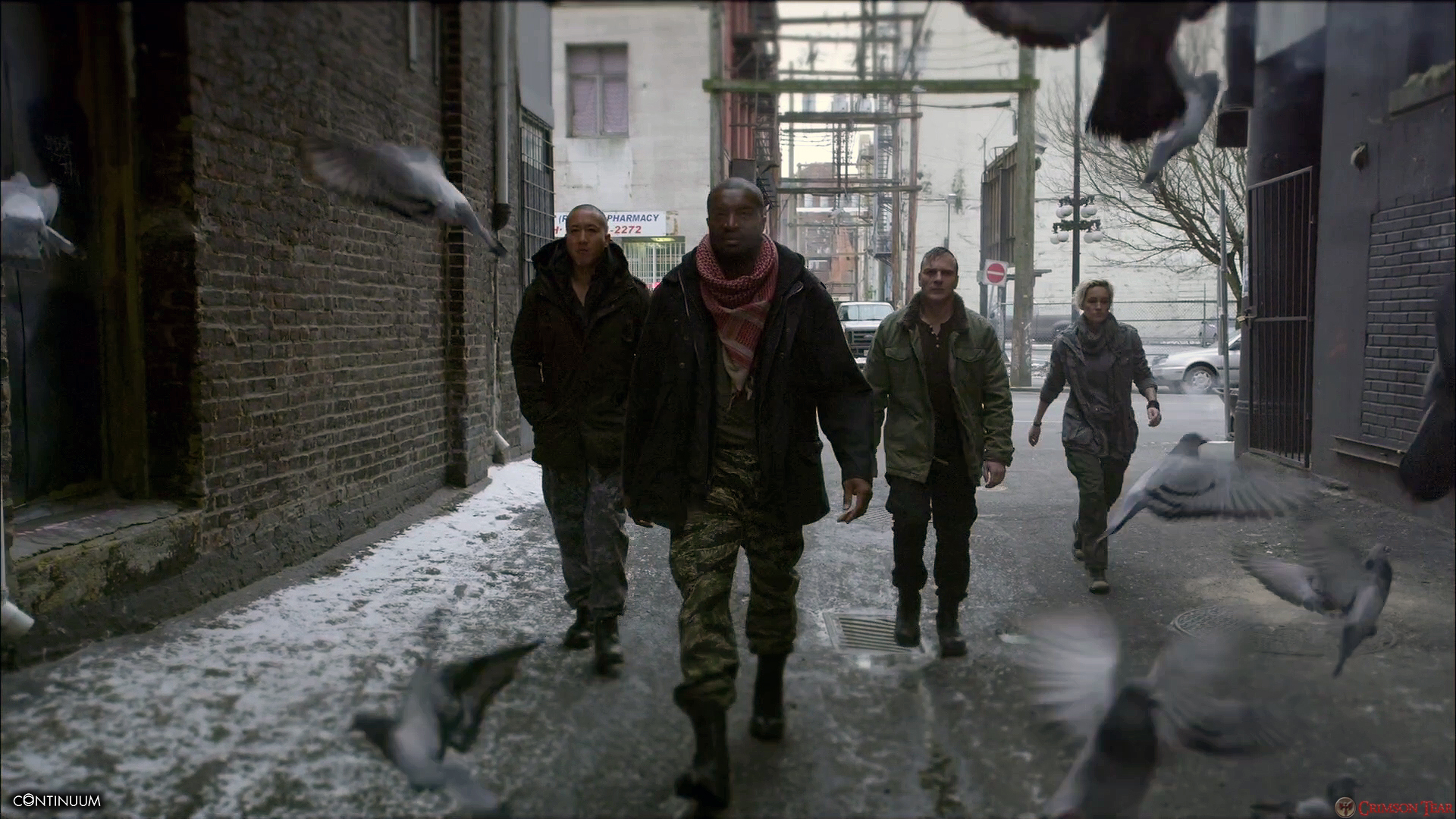
Mostly, this episode seems to serve the flesh out the identities of the various Liber8 terrorists. Since Continuum is in the odd place of having a larger cast of villains than heroes, this is a worthy pursuit.
I find I’m growing to like Kellogg. He’s pretty amusing, but he has the potential to be more than just comedy relief. Interesting potential for a trickster/double agent style character here.
As “Wasting Time” progresses, the action ramps again. I’m starting to worry that this show is going to be rather formulaic; seems like the bullets start flying at almost exactly the same time every episode. On the other hand, there’s something to be said for consistency, and I’m not sick of the fights yet.
Overall rating: 7.6/10
* * *
So far, I find myself pleasantly surprised by Continuum. It’s not terribly deep or intellectually stimulating, but it’s a lot of fun, and a great show to veg out and relax with.
 Lyf is a sympathetic villain, to the point where it almost feels unfair to call him a villain. I had to keep forcibly reminding myself of all the horrible things he’s done, because it’s so hard not to feel for him. He has suffered so much for so long, and he loves his people with all his heart. Despite all his crimes, he wound up becoming one of my favourite characters.
 Superior Realities