Despite misgivings, I’m continuing my binge watch of Orphan Black’s first season. After three more episodes, my opinion of the show has improved significantly, but there’s still a lot to take issue with.
 “Effects of External Conditions”:
For me, this is the episode where the series really starts. The first three episodes were clogged with filler and could have easily be condensed into a single episode without losing anything important, but with “Effects of External Conditions,” things finally start moving forward.
This episode focuses on Sarah and the police attempting to track down Helena, the clone who has been killing all the other clones.
Yo dawg, we heard you had too many clones, so we sent a clone to kill some of your clones.
Ahem.
Cosima identifies religious iconography on Helena’s dagger and theorizes that Helena represents a group of fanatics who see the existence of the clones as an affront to God. Sarah comes to believe that Helena is under the impression she was the original of them all, and is trying to eliminate those whom she sees as perverse copies of herself.
Interestingly, Sarah notices that the symbol on Helena’s dagger matches a tattoo on the body of Maggie Chen, the woman Beth gunned down before her suicide.
 There are still a fair few aspects of this episode that feel unnecessary. There’s still too much of what feels like filler involving Sarah’s life as a pretend cop and her relationship with Paul, Beth’s husband.
I’m on the fence about Sarah’s troubles with her daughter. It is an important part of Sarah’s arc as a character, but on top of everything else, it’s another distraction from the only interesting thing about this show: the clone mystery.
The best part of this episode is that it apparently puts an end to Orphan Black’s existence as a pseudo cop show. The clone story can now get the full attention it deserves.
Overall rating: 6.9/10
“Conditions of Existence”:
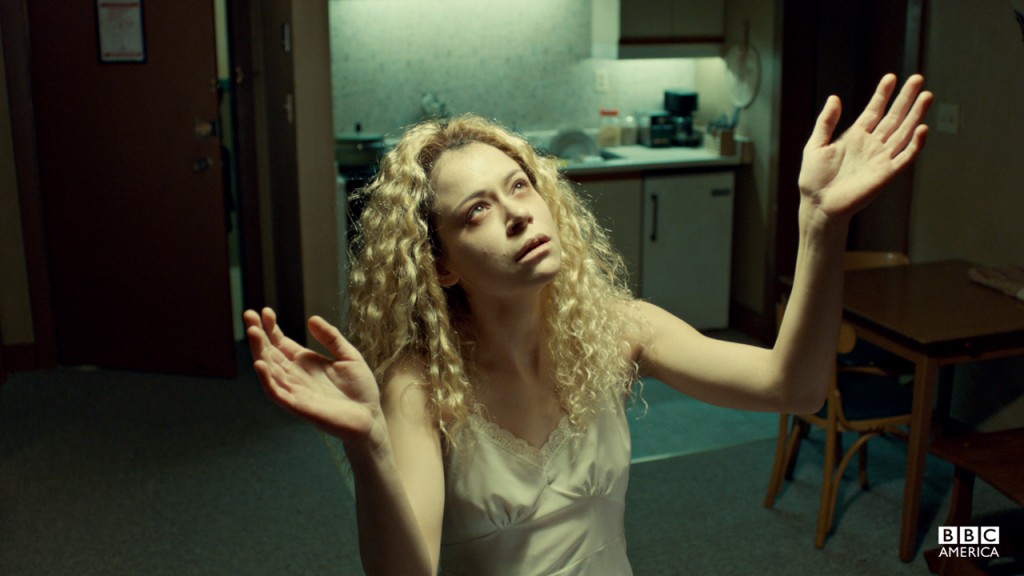
“Conditions of Existence” begins with Sarah realizing that doctors have been coming to examine her in her sleep, further reinforcing the idea that the clones are all part of some bizarre and far-reaching scientific experiment.
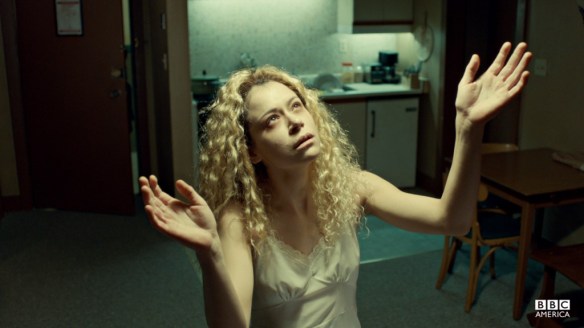 This is, unfortunately, another prominent example of how far-fetched this show can be. We’re expected to believe that all of those clones have been being regularly examined in their sleep for God knows how long, and none of them have noticed it before now.
Orphan Black tries to present itself as an intelligent thriller, but it’s just not. It’s one of those shows that’s only good if you do your very best not think about anything.
“Conditions of Existence” also sees the very unwelcome return of Vic, Sarah’s deranged ex-boyfriend. While Orphan Black has by this time done a lot to cut down on unecessary side plots, Vic clings on with all nine of his fingers. It’s just not an interesting story, and the sooner he’s gone for good, the better.
But it’s not all bad news by any stretch of the imagination. For the most part, “Conditions of Existence” puts the clone mystery front and center, and that makes this the best episode of the series to date.
Sarah’s discovery of the nocturnal experiments causes Cosima to speculate that every clone has a monitor in their life whose purpose it is to observe them and report the results of the experiments to whoever is behind them.
 Suspicion immediately falls on Beth and Allison’s husbands, Paul and Donnie. Meanwhile, Cosima encounters a new student at her school, Delphine, who seems eager to become fast friends. There is a conspicuous lack of plausible options for Sarah’s monitor.
The race is then on to determine who these monitors are working for, while trying not to arouse suspicion.
Despite still suffering from significant problems already mentioned, this is an example of Orphan Black starting to live up to its potential. This episode is full of intrigue, mystery, and suspense, and the closing scene is downright intense.
Overall rating: 7.3/10
“Variations Under Domestication”:
This is a really weird episode.
Orphan Black suffers from this constant clash where it seems to be trying to be an intelligent thriller, but it’s actually quite ridiculous a lot of the time. “Variations Under Domestication” is a great example of this — I honestly can’t tell if I’m laughing with this episode, or at it.
Much of this episode deals with Allison as her paranoia boils over. Convinced her husband, Donnie, is her monitor, she proceeds to duck tape him to a chair and torture him with a glue gun in an attempt to get him to confess.
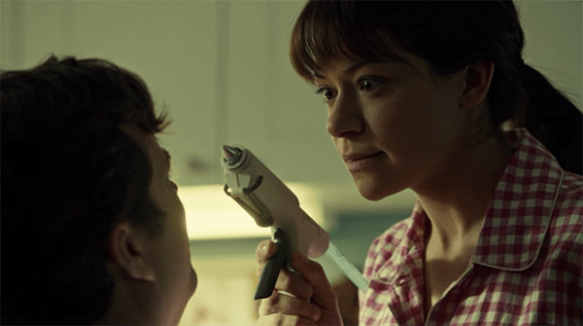 Of course, she happens to pick the day she’s supposed to be hosting the neigbourhood potluck. She has to enlist Sarah to help her keep order, while desperately hoping no one notices there’s two of her running around or that her husband is screaming for help in the basement.
Cue insanity.
Then add to that appearances by Paul and Vic, and things just get increasingly screwed up.
I don’t quite know how to rate this episode. It’s not bad, and it’s got a lot of interesting story developments, but it’s a complete farce, and it feels way out of place with the deadly serious tone Orphan Black seems to be shooting for.
I will grudgingly admit that Paul is starting to get pretty interesting as a character. I didn’t like him at first as he wasn’t contributing much, and I find the actor a bit stiff, but his role is getting increasingly ambiguous, and that’s interesting. Just whose side is he on? Even he doesn’t seem to know anymore.
Also, while I’m still utterly sick of Vic, at least he didn’t feel like such a distraction from the important story this time.
And it is a bit amusing how much he’s become the show’s whipping boy. He’s had his face bashed in by Sarah, he lost a finger to a drug dealer, Allison tasered and maced him, and Paul beat the snot out of him and nailed his hand to a chair. How much more punishment can this guy take?
 “Variations Under Domestication” is also noteworthy for giving Cosima by far her biggest role to date, but unfortunately, this had the effect of her losing her crown as the only clone capable of common sense or good judgement.
Cosima is not only aware of monitors, she’s the one who suggested they existed in the first place. So when some mysterious stranger suddenly comes along to sweep her off her feet, you’d think she’d be suspicious. Not only does she not see anything odd about Delphine’s behavior, she becomes very testy when Sarah suggests something fishy might be going on.
What is going on with these clones? Donnie’s obviously not a spy, and Delphine couldn’t be a more obvious spy if the 007 theme played every time she walked on screen, but yet it’s the former who finds suspicion falling on him.
As an aside, I think the writers are playing with fire a little by making Cosima a lesbian when the other clones all appear to be heterosexual. That seems to be making a firm statement on the nurture side of the nature versus nurture debate, and that’s treading dangerously close to saying being gay is a choice.
It doesn’t bother me. I don’t think the writers had any ill intent in mind — I don’t think they even think that hard. But I could see some people getting pretty offended by it, rightly or wrongly.
Overall rating: 7/10
* * *
I’m starting to enjoy Orphan Black, and I’ll probably keep watching, but I can’t say I’d recommend it to others. It takes entirely too long to get started, and even once the plot is rolling, there’s a lot that just doesn’t hold up under any kind of scrutiny.

 I’ve got you covered, though, as I’ve done up a list for Nexopia on some of the most interesting diamond in the rough titles on Steam. Any of these games are definitely worth your time, and with all of them heavily discounted during the Summer Sale, it’s a perfect time to try them.
 But it’s a peace forced at gunpoint, and a deeper inspection shows plenty of evidence of the E-Rep’s brutality. Rafe McCawley and his miners are being literally worked to death, and dissenters like Datak Tarr, Doc Yewll, and many others languish in a savage prison camp outside of town. Some trouble-makers simply meet with “accidents.”
 Overall, it’s a classic example of what makes Defiance worth watching: A little action, a little tension, a lot of intrigue, and just enough humour to keep it all from getting too heavy.


 Superior Realities