World Spectrum Inspirations: Story and Themes

In the past, I’ve talked about the inspirations behind the more tangible aspects of the World Spectrum series. Today, I’d like to discuss what inspired the broader aspects of the books, the overall feel of the world and the stories.
Books of the World Spectrum bannerBattlestar Galactica:

These days, my feelings toward Ron Moore’s Battlestar Galactica reboot are decidedly mixed. My view is that it was three seasons of pure brilliance… and then the fourth season.

But when I started on the World Spectrum books, I was deep in the throws of BSG fandom, and I think it shows in my writing. Apocalyptic danger, killer robots, the fate of humanity on the line, a reckless female protagonist.

Now which am I describing there? BSG, or the World Spectrum?

By the way, in the unlikely event these books ever get turned into movies, Katee Sackhoff is probably my first choice to play Leha.

I really loved the apocalyptic feeling of BSG. The idea that humanity is teetering on the brink, and every single life is precious. It allows you to ratchet up the tension so much more than you could in a story where worlds and nations are still thriving.
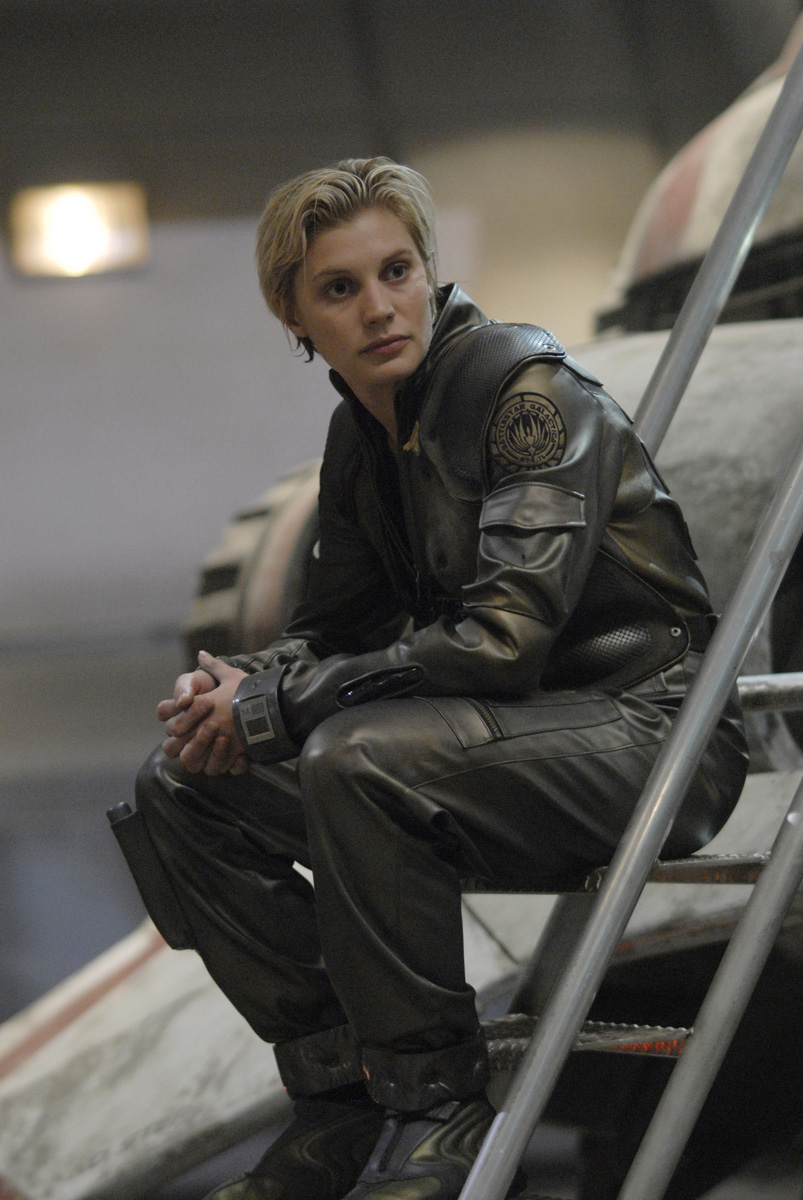
Kara "Starbuck" Thrace in Battlestar GalacticaBut I think what I admired even more about BSG was the message that survival alone isn’t enough. One needs to be worthy of survival.

So that became one of the main dramatic questions of the World Spectrum series. Not just will humanity be saved, but is it worth saving? Can we create a world where we live in peace, or are we doomed to forever be our own worst enemies? This theme runs throughout the entire series, and if I’ve done my job right, there isn’t a clear answer. This is something I want readers to decide for themselves.

I’m not the biggest fan of clear moral messages in fiction. It has its purpose, but I think it’s more valuable to raise questions and leave it the consumer to decide what to make of them. It’s easy to agree with an inspiring message without really thinking about it — I believe this is why there are so many bigoted Star Trek fans despite its message of tolerance. I think, at least in theory, you can achieve more by making someone reexamine their beliefs than by simply telling them what to think.

The Three Worlds:

I’ve talked before about my great admiration for Ian Irvine’s Three Worlds Cycle. They’re an absolute masterpiece of epic fantasy.

I’ve already mentioned how the spectrum of worlds draws a lot of inspiration from the three worlds of Irvine’s work, but his books had other influences on my writing. In particular, the overall look and feel of the World Spectrum universe, as well as the way magic is treated, are very much inspired by the Three Worlds books.
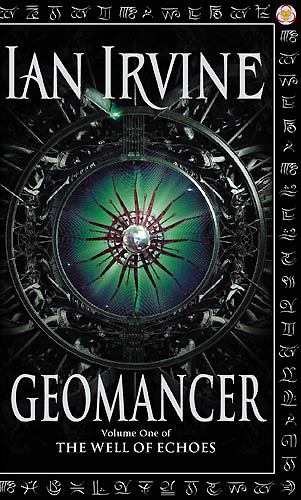
Cover art for "The Well of Echoes, book one: Geomancer" by Ian IrvineYou see, before he was a professional writer, Ian Irvine was a scientist — a biologist, to be specific, though he also studied geology a fair bit — and this shows in his writing. He has what I can only describe as a scientific approach to fantasy. Instead of just falling into the “because magic” trap, he’s thought in great detail about the biology, technology, and culture of his worlds, and it makes his works feel so much more real than other fantasy books.

Magic, in particular, is treated more as a science than an art in the Three Worlds novels, often being assisted or facilitated through complex apparatuses.

His books aren’t exactly steampunk, but they do feature a lot of spectacular mystical technologies. In particular, I recall the multi-legged war machines called clankers, which served as inspiration for the Quadramatons and Sextamatons of the World Spectrum.

I’ve tried to replicate this feel of science fantasy in my books. Truth be told, I’ve always tended to think of fantasy worlds from the perspective of real world scientific logic. I was a bit of a science geek growing up, and I can remember pondering things like why Elves evolved pointed ears even at an early age.

Ian Irvine showed me how awesome scientific fantasy could truly be and inspired me to run with the idea.

Retro Review: The Three Worlds Cycle + Writerly News

Welcome to the first in my series of “Retro Reviews,” in which I will be reviewing books, movies, and TV that are not necessarily new or current. I’m doing this because I don’t think something needs to be new to warrant attention. Some of the best books I’ve read have been decades–or, in some cases, over a century–old. I hope to bring attention to works that are of a high quality but not necessarily well known.

My first Retro Review topic is the Three Worlds Cycle, a massive fantasy saga by Australian author Ian Irvine. It is a series so amazingly good that I half-jokingly made it my mission in life to preach its brilliance to everyone who will listen in the hopes they will pick it up and read it.

The Three Worlds Cycle is comprised of eleven books divided into two quartets and a trilogy: “The View From the Mirror,” including “A Shadow on the Glass,” “The Tower on the Rift,” “Dark Is the Moon,” and “The Way Between the Worlds”; “The Well of Echoes,” including “Geomancer,” Tetrarch,” “Alchymist” (also called “Scrutator” in some markets), and “Chimaera”; and “The Song of the Tears,” including “The Fate of the Fallen” (also called “The Torments of the Traitor” in some markets), “The Curse on the Chosen,” and “The Destiny of the Dead.” (God, I love his titles.) Each series has its own plot, but they all form a greater arc, and I strongly recommend reading them in the order I put them.

I don’t often set much store by originality. As someone who has studied story-telling, I am well-familiar with the fact that an original story is an oxymoron. Those who do attempt to be original often try too hard and create something bizarre and unpleasant, ignoring the often reused but time-tested tenets of good story-telling. But that said, that doesn’t mean that creativity is completely impossible, or that I don’t appreciate it when someone does a good job of it.

This is what is so brilliant about the Three Worlds. It is a brilliantly original take on the fantasy genre, yet it still preserves all the action, adventure, deep history, and epic scale that makes fantasy so great.

Don’t expect to see Elves, Dwarves, and Dragons in the Three Worlds. Irvine utterly rejects the old fantasy archetypes and creates an entire universe of his own unique non-human races, such as the majestic Charon, the melancholy Aachim, and the wretched Whelm. Although, admittedly, the Faellem–a slight, nature-loving race–do bear a certain resemblance to Elves.

Nor should you expect another carbon copy of feudal Europe. On Santhenar, the world upon which most of the events take place, it is an accepted fact that women are equal to men, and religion and spirituality are virtually non-existent. Most mysticism is removed from magic; it is treated more like a craft, a science. It often feels more like reading sci-fi than fantasy.

The struggle of good and evil is also something Irvine has little interest in. He described “The View From the Mirror” as–I’m paraphrasing–“A Darwinian tale of four species struggling to survive, in which each believes they have more right to survival than the others.”

With a lot of prolific writers, their work all tends to seem to the same after a while. (I’m looking at you, Terry Brooks.) Not so Ian Irvine. Each series within the Three Worlds has a very distinct flavour and feel, to the point where it can be rather jarring to start a new one and find yourself reading a completely different (but equally awesome) kind of story.

“The View From the Mirror” is a globe-trotting adventure focusing primarily on two or three characters. It’s a similar kind of story to “The Hobbit” or Frodo’s trials in “The Lord of the Rings.” A brilliant move he made in this series was to choose a historian as one of his main characters, giving an easy way to provide large amounts of information on his universe’s rich and detailed history without it seeming awkward or out of place. It also has the single greatest opening chapter I’ve ever read. There is more emotion and epic story in the first few pages of “A Shadow on the Glass” than in some entire trilogies I’ve read.

“The Well of Echoes” is a dark, intense war story. It strongly reminds me of Ron Moore’s reimagined Battlestar Galactica, right down to the bitchy, mortality-obsessed, daredevil blonde woman. It’s probably the low point of the Three Worlds in terms of plot, but it is where he introduces all his greatest characters.

“The Song of the Tears” is the closest he’s come to traditional fantasy. For the first time, Irvine depicts a battle of good versus evil. The first two books are roughly equivalent to “The Well of Echoes” in quality–great, but not as good as “The View from the Mirror”–but “The Destiny of the Dead” was a masterpiece and may be the best of his books.

He plans a final trilogy to wrap up the story, tentatively titled “The Fate of the Children,” but to my great anguish, he hasn’t gotten around to writing it yet.

Most good authors I know excel at one particular thing. Christie Golden writes amazing characters, Terry Brooks does action like no one else, and Mercedes Lackey is a world-builder without compare. Ian Irvine excels at everything. His characters, his action, his plot twists, and his world-building are all excellent. His prose is perhaps nothing special, but there’s nothing wrong with it, either.

I have only one consistent complaint about the Three Worlds, and that’s that Irvine’s names are wacky, and the rules for pronouncing them are even wackier. To make matters worse, he stopped adding pronunciation guides after the first four books. I’ve just plain given up on trying to pronounce “Tiaan Liise-Maar.”

Overall rating: 9.8/10

The entire Three Worlds Cycle is available on my Amazon Affiliate. If you have even the slightest interest in sci-fi or fantasy, I strongly encourage you to give it a try–and not just because I could use the money.

This post has become terribly long-winded, but I would like to include some news briefly.

If you’re wondering why I haven’t covered patch 4.2 yet, it’s because I may have landed a deal to do an article on it for a gaming magazine, and I want to save my efforts. The short version is the Thrall quests were the Best Thing Ever, the new dailies are absurdly grindy but also absurdly fun, and I have gotten into raiding T11 since the nerfs, but it turns out these things are still damn hard. Or maybe I just suck.

Also, my long-running Star Trek fan fiction series, Dispatches from the Romulan War, will soon be coming to an end due to a lack of interest. I do plan on doing a final arc to wrap up the story, though. If you haven’t read it before now, I encourage you to check it out before it’s done for good.