
I finally got a bit burnt out on Legion, so I’m taking a break before I tackle the last few class stories. In the interim, I’ve been bouncing around between a few different games, which means it’s time for another multi-topic gaming post.
 Back in the Republic:
Long-term, I want to give some serious time to SWTOR. Catch up on the story and maybe finish the last two class stories. However, there’s supposed to be a major content patch soon, so I figure I should wait for that before I get too heavily invested, and as a result I’ve just barely dipped my toes in.
Despite my obscure tastes, I did lose a couple of character names during the recent server merges. I’m rather pissed to have lost my bounty hunter’s name, as it was already my second choice for her name, and now she’s down to like my sixth or seventh choice. The others I don’t mind, but boy is it hard to find a new name now. Absolutely everything is taken. Who the hell even knows what “Bagrada” is other than me?
I did eventually think of a name for my knight that wasn’t taken, and I actually really like it. I should use it more. And thankfully my main characters — agent, warrior, and consular — all got to keep their names. The reign of Empress Maigraith Numin continues undisputed.
Another mild annoyance is that SWTOR apparently stores UI data client-side rather than server side, so I had to set everything up again since I’m playing on a different computer now.
Unlike most MMO players, I’m not fussy about my UI. I’m usually happy to play with the default settings of any given MMO. Even ESO’s much maligned interface is fine by me. But for whatever reason the default UI in SWTOR makes me want to punch kittens, so I have to rekajigger it a fair bit.
 On the good news front, I am delighted to be able to customize the armour of my KotFE companions. Well, Lana, anyway. I never much bother with the others. I put together an outfit based around the Protoss-looking armour from the new light side vendors, and she is now the glorious space paladin of my dreams.
Mr. and Mrs. Horner:
In other news, this week saw the hotly anticipated (by me) release of StarCraft II’s latest co-op commander(s), the husband and wife team of Matt Horner and Mira Han.
My early experiences with them were actually something of a baptism by fire. I was struggling even on normal — something I haven’t done since I first started on co-op. I’ve come to the conclusion they’re a bit like Karax, despite having a totally different playstyle: They have a very steep learning curve, and they’re highly dependent on leveling upgrades.
I’m getting the hang of them now, but I would definitely say they’re one of the most challenging commanders in co-op.
The thing is that Matt’s units are extremely strong, but also extremely expensive. Meanwhile, Mira’s are pretty much just trash. The goal, then, is to mass up a large force of Matt’s air units while using Mira’s mercs only as a mineral dump. The trouble is getting to that point. You simply can’t afford Matt’s units in the early game, but you can’t spend too much on Mira’s or you’ll never get ahead.
 Thus, while the Horners are a force to be reckoned with late game, the early game is a nerve-wracking ordeal.
Their one saving grace in that regard is the Assault Galleon. These are Mira’s main production structure, but they’re also powerful capitol ships. They’re a lot like Tempests — long range, high damage — but with much more health, and you can build them right off the bat, and they only cost 200 minerals. And later on you can upgrade them to also be Carriers.
Galleons are kind of amazing.
My strategy therefore is max out on Galleons (you can only have a maximum of five) ASAP, lean on them to survive, and try to fast tech to the truly valuable units: Wraiths and Battlecruisers.
As far as Mira’s units go, my preference is for the Hellion. Their range means they don’t die quite as quick as her other stuff, and their damage is quite respectable. A lot of people seem to like Reapers, and that can work, but they die so much you end up replacing half your army after every battle.
The good news is the Horners definitely scratch my itch for an air-focused commander. Five Galleons plus their fighter bays plus Wraiths plus Battlecruisers is the unstoppable doom fleet I’ve spent all my life longing for.
 Also, dropping a space station on people is every bit as hilarious as I dreamed.
Overall I do think they’re a fun commander, but you definitely need to bring your A game. You have to work for your wins.
One final thing to note on the subject of StarCraft: I recently managed to solo a brutal mutation for the first time ever. My ally DCed on the load screen, and I was left to fend for myself. It was very challenging, I had to base trade with Amon, and there were only 21 seconds left on the clock when I killed the final objective, but I did it.
Considering I normally struggle to solo even standard matches, and that brutations are generally the toughest thing in the game short of PvP, I feel pretty proud of myself.
Nova OP.
Favoured of Skadi:
On top of that, I also played through a single-player RPG I got cheap on a Steam sale, Vikings: Wolves of Midgard. It’s a Diablo clone inspired by Norse mythology, which also neatly explains why I bought it.
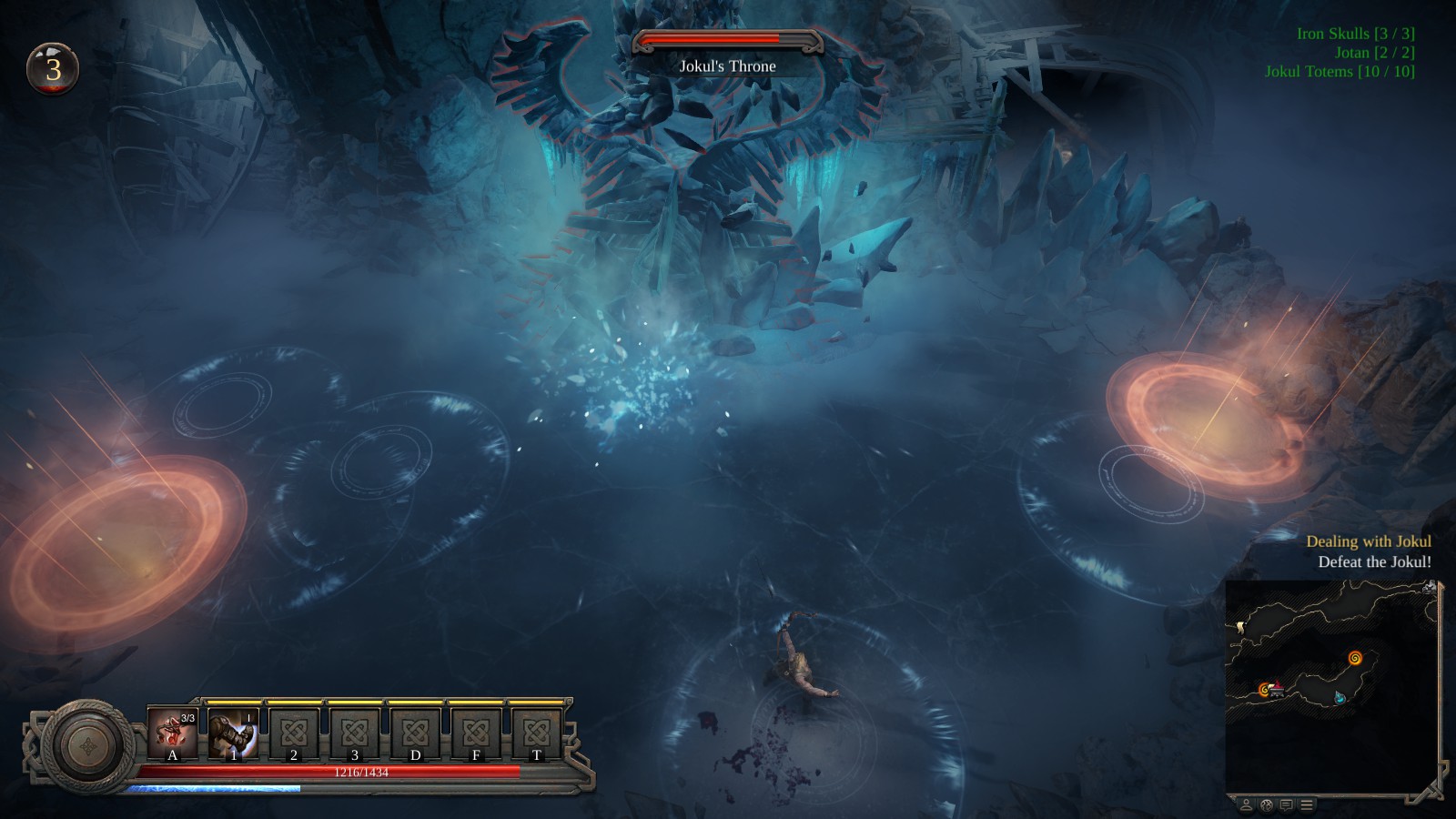
Most folk’ll never lose a toe, but then again some folk’ll, like Cletus the slack-jawed Jokul…
Even after having finished it, I’m not entirely sure how I feel about it.
It has some neat ideas. One example is the exposure mechanic of environmental hazards. For example, if you’re traveling in a cold area, you’ll need to warm up by fires regularly or risk freezing to death. I really wish more games made the environment part of gameplay like this.
The combat is also very fun, and it does an admirable job of bringing the world of Norse mythology to life. It’s clear they actually did their research, even if they still take liberties in places. The story’s junk, but the strength of the setting carried it through, and the main character’s voiced by Alix Wilton Regan (if female), which is always a plus.
I did enjoy the class system, as well. Rather than traditional classes, you gain bonuses based on which of the Norse gods you follow, and it’s possible and even encouraged to put points into two skill trees at once, with the option to swap between them at will. I enjoy that level of versatility.
Most of the trees still more or less correspond to traditional RPG archetypes — Skadi, my main choice, is an archer class — but the Odin tree is a bit different. It’s the caster class, but it’s melee, focusing on acrobatic staff fighting. I suppose that might be bad for people who prefer traditional casters, but for my part I think “Gandalf + ninja” is a pretty awesome class concept.
But Wolves of Midgard a lot of rough edges. Despite some solid graphics, it’s nonetheless clear the game was done on the cheap, and it has many polish issues. That I could live with, but what really surprised me was how old school and unforgiving it felt at times. Save points, for example, are few and far between, so a single death can prove very punishing.
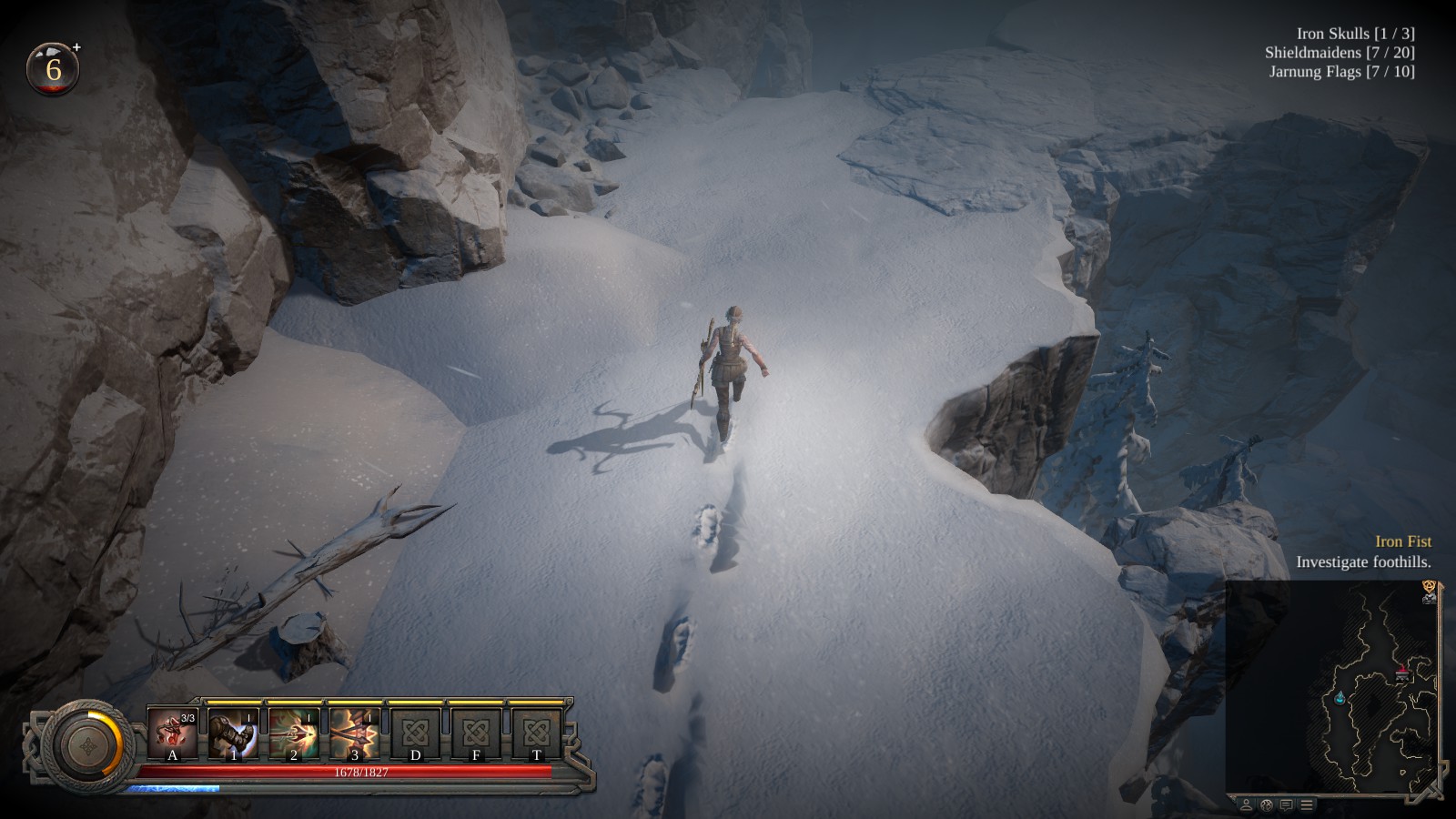
This is the first game I’ve played where the snow actually behaves like snow.
It got worse near the end. There’s a massive spike in difficulty in the last few levels. The intention seems to be to grind earlier content to level up, which is fairly awful. You can get around this by lowering the difficulty, but it’s just not a great situation all around.
So that put a damper on what had otherwise been a pretty fun game up until that point. If you really like Norse mythology and/or you want a more “hardcore” RPG, it might be worth a look, but otherwise I’m not sure how strongly I can recommend it.
And finally…
There’s actually one other noteworthy thing I’ve been playing lately, but that deserves it’s own post, so it can wait.
In the meanwhile, why not check out my latest article for MMO Bro? This time I’m pondering if and how the stories of MMOs can be given satisfying conclusions.


 Superior Realities