Review: Star Trek: Discovery, “Context Is for Kings”

To watch Discovery streaming in Canada, you have to wait until Monday for CraveTV to put the episode online. That meant that I was already hearing some buzz about “Context Is for Kings” before watching it. The main thing I heard was that this should have been the actual beginning of the series, and that the first two episodes felt unnecessary by comparison.

The official logo for Star Trek: DiscoveryHaving now seen it, I very much agree with that perspective.

“Context Is for Kings” is where the story of Discovery really gets started. Now a prisoner, Commander Burnham finds herself suddenly transferred to the newly launched starship Discovery, where she is pressed into helping them with their research.

It’s quickly clear that Discovery is no ordinary Starfleet vessel, and when disaster strikes its sister ship, Burnham begins to understand just how far the Federation is willing to go to win the war.

As I said, this is where the show’s story really begins. We’re introduced not only to the series’ titular ship, but also most of the main cast members, Burnham and Saru being the only significant carry-overs from the first two episodes.

Those new cast members have done a lot to improve my view of the show. They add a lot of depth to what has so far been a pretty shallow story.

It’s too early to be picking favourites, but one who especially impressed me out of the gate is a scientist called Paul Stamets. He’s a bit prickly, but it’s clear he’s a true believer in Starfleet’s ideals of peaceful exploration, and his resentment at having been asked to fight a war is a great angle. He does a lot to bring the feeling of true Star Trek that Discovery has previously lacked.

Burnham’s roommate, the over-eager Cadet Tilly, is also an interesting case. Her awkward goofiness could potentially get old with time, but right now she provides a welcome dose of warmth and humour to counterbalance the show’s otherwise grim tone.

The titular ship in Star Trek: DiscoveryI was also pleased to see a familiar face: Rekha Sharma of Battlestar Galactica fame, who plays Discovery‘s chief of security. Always liked her.

I still don’t like Burnham, but her portrayal is softening. At least we can see that she regrets her mistakes, and that there is a limit to how low she’s willing to sink. Although she’s still reckless to the point of foolishness.

I’m also intrigued by the arc that is beginning to form around Discovery‘s mission. Again, it’s starting to feel a bit more like Star Trek, with some very inventive (if implausible) sci-fi concepts.

That’s not to say I’ve been fully converted as a fan. The show still seems to favour spectacle over logic more often than it should — that brawl in the mess hall was totally unnecessary — and as I’ve said, I’m still not very keen on Burnham.

But this is a big improvement over the first two episodes. If you haven’t tried Disovery yet, start with “Context Is for Kings.” This is a much better introduction to the series than the actual pilot.

Overall rating: 7.6/10 I’m actually looking forward to the next episode now.

Some random speculation before I go:

I don’t think Lorca is going to be Discovery‘s captain forever. I see him eventually being replaced. Probably with Burnham.

Also, who else thinks we got a Section 31 series without realizing it? Because at this point I’ll be very surprised if it doesn’t turn out that Discovery is a Section 31 project.
Review: Star Trek: Discovery, “The Vulcan Hello” and “Battle at the Binary Stars”

Well, it’s here. The first new Star Trek TV series in more than ten years. I’ve had pretty significant reservations about Discovery from the outset, due to my complicated relationship with the Star Trek franchise, but as I’ve said many times, I have far too much franchise loyalty for my own good, so of course I’m giving it a shot.

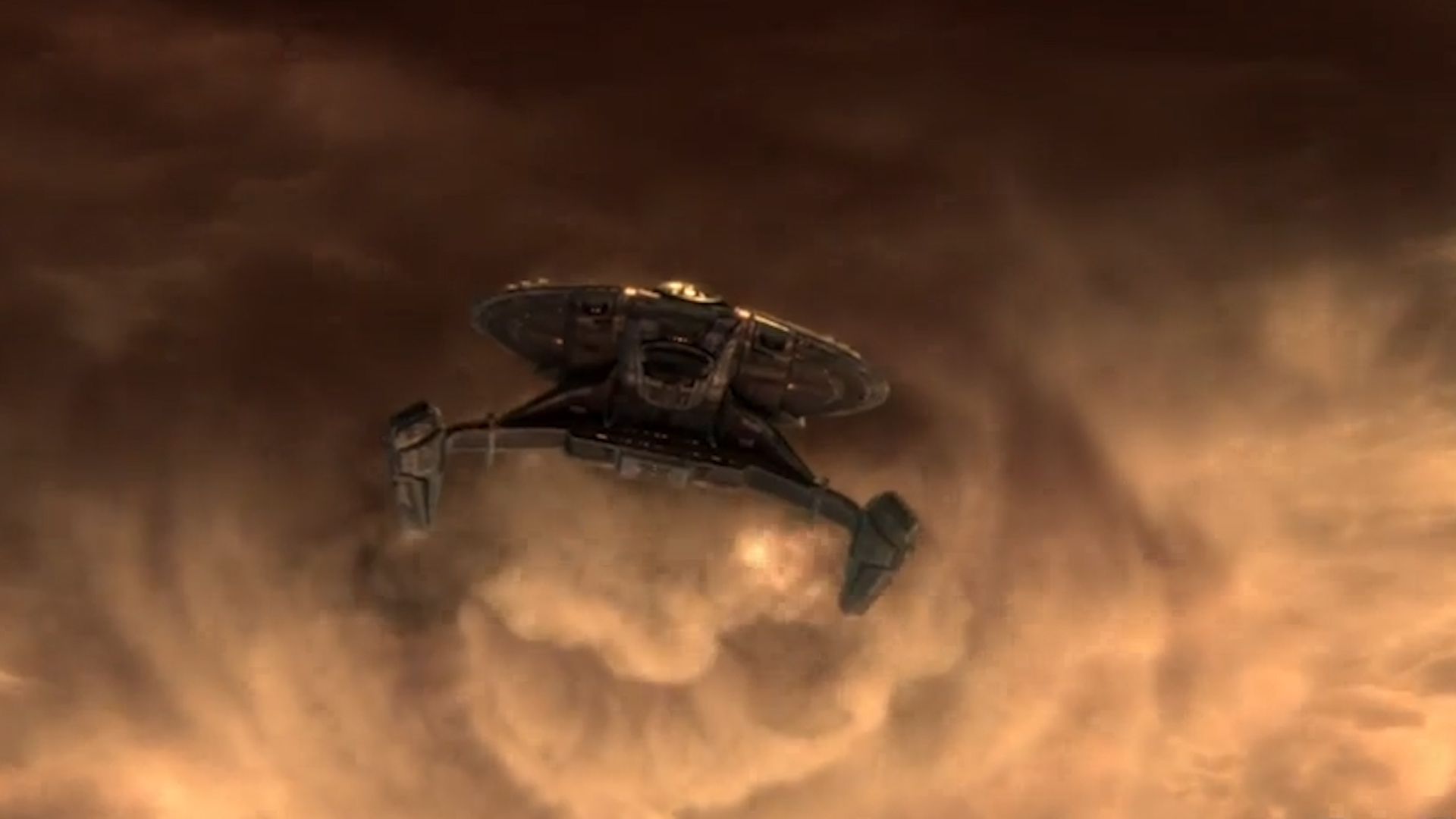
The starship Shenzhou in Star Trek: DiscoveryI actually did something a bit different for the premiere. Instead of watching at home on my own, I went to a meet-up at a local sci-fi gaming establishment. Before the show, we played a sort of video game/simulation where we played as bridge officers on a starship. I was at tactical, and my team won, so I feel pretty good about myself.

But I digress. Enough about my lackluster attempts at a social life. Let’s discuss Discovery, shall we?

Since the first two episodes — “The Vulcan Hello” and “Battle at the Binary Stars” — were shown back to back and form a continuous story, I’ll just review them together.

There are two ways one can judge Discovery. One is as the heir to the grand ideals and great potential of Star Trek as thought-provoking science fiction. The other is as just an entertaining TV show.

It’s succeeded at one of those.

Discovery takes the odd route of not introducing us to the titular ship out of the gate. Instead, the story focuses on the Federation starship Shenzhou (which is gorgeous, by the way), and especially its first officer, Michael Burnham (Sonequa Martin-Green).

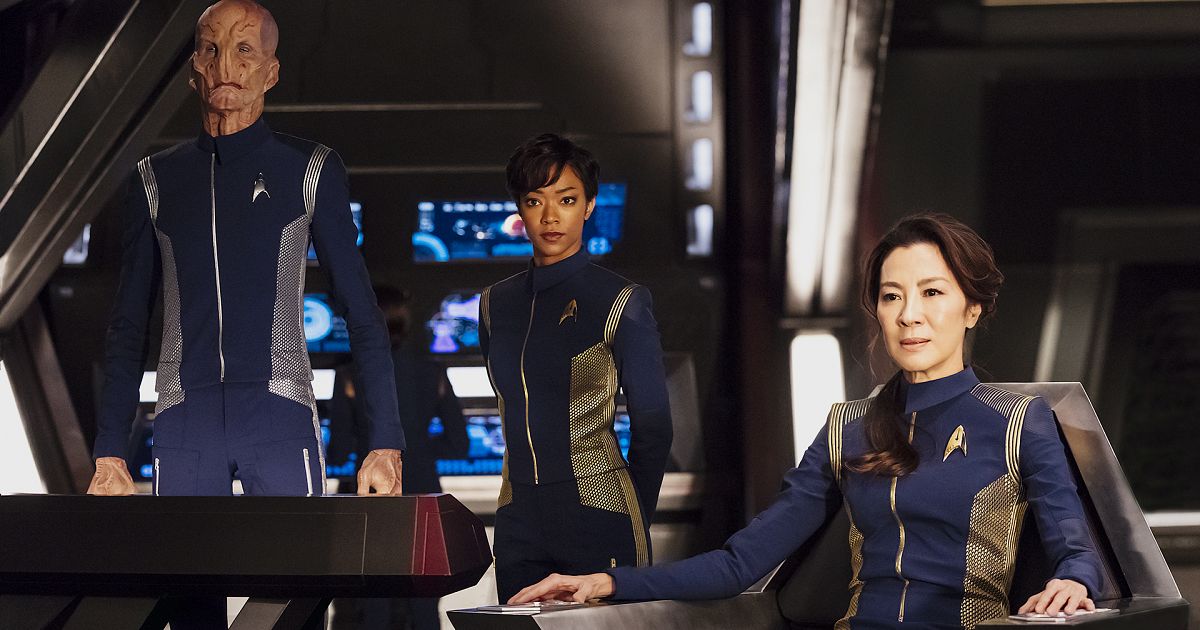
The bridge crew of the Shenzhou in Star Trek: DiscoveryThe Shenzhou is on a routine mission to investigate a communications relay that’s gone offline, but a run-in with a faction of fanatical Klingons soon sees them at the flashpoint of a potential interstellar war.

It’s very fast-paced, maybe a little too much so. It feels rather rushed at times, and there isn’t a lot of opportunity to explore the characters. There’s also a few things that didn’t seem to make a lot of sense, but it all went by so fast I can’t recall a lot of specific examples.

There are two issues that are really bothering me about Discovery right now.

Number one is, well, Number One. I have rapidly developed a strong dislike for Commander Burnham. She’s exactly the sort of undisciplined hothead that I never liked to begin with and have only become more resentful of due to the archetype’s over-use. How do loose cannons like this keep getting put in positions of power in Starfleet, anyway?

The other is the portrayal of the Klingons.

I had my reservations going in based on the radical redesign of their appearance. I know it may seem a petty thing, but given that Klingons already had a well-known and iconic appearance, and given that their look has already been retconned once, and given that a lot of effort was put towards explaining the previous retcon, it’s just change for the sake of change. I have a high tolerance for retcons, but even I can’t defend something so unnecessary.

The Klingon T'Kuvma in Star Trek: DiscoveryAnd no, there’s no explanation given for why they look so different. A wizard did it, I guess.

Their culture has also changed quite a lot — again, no explanation as to why. In Discovery, the Klingons are religious fanatics obsessed with racial purity. They come across as some weird hybrid of Al Qaeda and the KKK.

The end result is that they have once again been reduced to one-dimensional villains. There is no sympathetic angle to Discovery’s Klingons, no nuance. They’re just evil.

The Klingons deserve better. Star Trek deserves better.

Based on the trailers, I had the impression that Discovery might be bringing back the cerebral, thought-provoking style of story-telling that put Star Trek on the map. Based on the first two episodes, that doesn’t seem to be the case.

I actually have a theory to explain all these inconsistencies, but it’s a little spoilery and gets far into the weeds of nerdery, so I’ll save it for the end of the post.

It also doesn’t help that Michelle Yeoh was merely a guest star. I was really enjoying her character. I would have preferred to see her as the show’s focus.

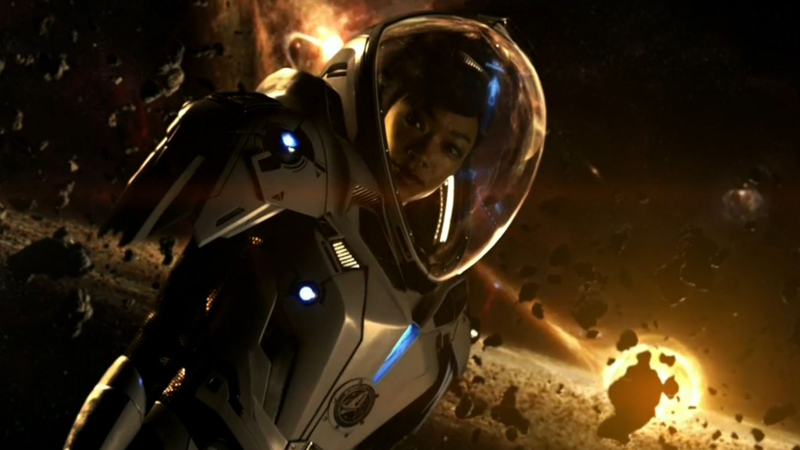
Sonequa Martin-Green as Commander Michael Burnham in Star Trek: DiscoveryThat’s a lot of criticism, but I don’t want to send the impression that I hate Discovery so far. I don’t.

I think a lot of the problem is the weight of expectation from the Star Trek name. If not for that, I’d probably enjoy Discovery more. It may not be all I want Trek to be, but it’s not without its charms.

For one thing, it’s a very nice looking show. The special effects are cinema-quality, and the art design is brilliant. I love how the technology and uniforms feel like a very natural evolution from Enterprise.

It’s also very exciting. The space battles are great, and it does a good job of keeping you on the edge of your seat.

My gripes about Burnham aside, the cast shows some promise, too. I already quite like Doug Jones’ Saru, an alien with a heightened sense of self-preservation. His species seems like an interesting new addition, and I look forward to learning more about their culture.

There it is! Death!So Discovery doesn’t entirely work as a Star Trek show, but as just another sci-fi action-adventure, it’s not bad. It’s not great, but it’s not bad.

I’ll keep watching. It’s good enough. And lots of sci-fi shows — and Trek shows — have rocky starts, so maybe it will improve. Maybe the Klingons will get some depth, and maybe Burnham will grow on me.

Maybe.

Overall rating: 6.9/10

Okay, so here’s my headcanon for the retcons right now:

I know it’s been said this is the prime timeline, but I don’t think it is. I think this is an alternate timeline spawned by the Temporal Cold War.

In Enterprise’s premiere, the Cabal are trying to start a civil war between the Klingon houses. In Discovery, the Klingon houses have been at war for a hundred years — roughly the length of time that’s elapsed since the events of Enterprise.

If this is a timeline where for some reason Captain Archer and his crew never thwarted the Cabal’s plans, that explains why the houses have been warring. And if the Klingons’ attention was turned inward, they would not have had the subsequent interactions with the NX-01. Phlox would never have helped cure the Augment virus, and flat foreheads would not have spread throughout the Klingon race.

A Klingon in Star Trek: DiscoveryThe other changes to Klingon appearance in Discovery could be explained by an alternate cure for the virus, or by some other biological modification resulting from the decades of war.

This almost certainly wasn’t what the writers intended, but it does a very good job of filling Discovery’s plot holes, doesn’t it?