Review: Sanctuary, “Tempus” (Season Premiere)

Review: Sanctuary, Tempus:

Warning: the following review contains vague spoilers.Watching Sanctuary is a bit like being friends with Doctor Jekyll (no pun intended considering most recent episodes have focused on that character). You never know what you’re getting: the good, the bad, or the ugly.
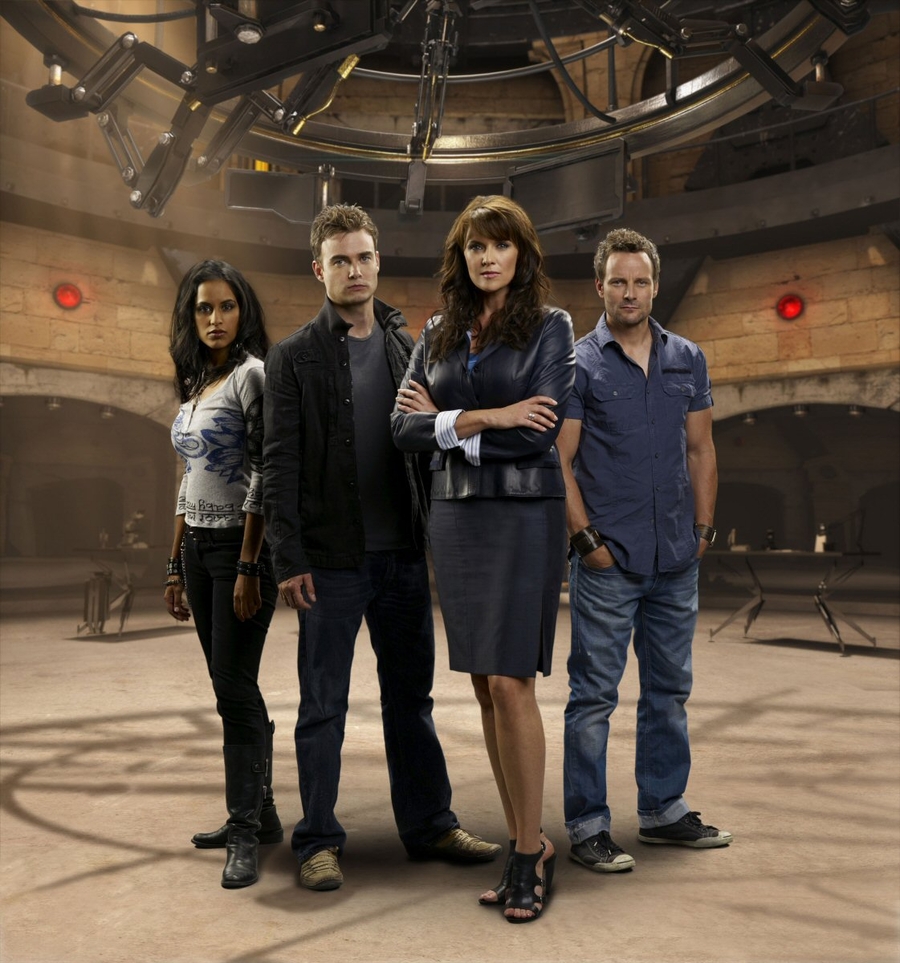
This episode, I’m pleased to report, falls under the “good” category.

The episode picks up immediately from where the last one left off, with Adam Worth (Dr. Jekyll) traveling back to the 19th century to attempt to cure his terminally daughter, and the series’ protagonist, the immortal Helen Magnus, following him to prevent corruption of the timeline.

“Tempus” has Magnus simultaneously struggling to stop Adam, who plans world conquest once his daughter is cured, and to prevent herself from contaminating the timeline while interacting with fellow Five members John Druitt and Detective Watson and the past version of Adam Worth.

Things are complicated by the fact that they have arrived during the height of Jack the Ripper’s killing spree, which, as any Sanctuary fan knows, were committed by Druitt, who was Magnus’s fiance at the time. So while all the craziness with Adam is going on, we’re also treated to many interesting little moments between Druitt and Magnus (both her past and future selves), which give some very interesting revelations into their past relationship. Druitt is easily the most interesting character on the show, so this was a very welcome addition, in my view.

The entire episode takes place in the past, with no mention of the other difficulties taking place in the future (or present, depending on your perspective), which is frankly welcome. This show is always at its best when focusing on Helen and the Five at the expense of its far less interesting modern characters.Adam Worth, AKA Doctor Jekyll, from Sanctuary

Ultimately, the struggle to preserve time is a very common one in sci-fi TV shows, but this episode managed to set itself away from the pack, at least a little bit. It felt a bit more edgy and dangerous (words I would generally never use to describe Sanctuary). Normally, these episodes end with all problems being solved and all time changes turning out to be what was supposed to happen anyway.

“Tempus” didn’t end nearly so neatly. While it’s true that Magnus achieved her goals, it ended up feeling like a Pyrrhic victory in my view, and I found the ending rather heartbreaking.

Furthermore, the events of the past did end up being changed significantly.  We’ll have to wait until future episodes to see if these changes have any lasting impact. Given this show’s spotty history, I find myself doubting the possibility, but there’s always hope. This show could really use an ongoing crisis to keep it interesting, and a world irreparably changed by time travel seems like just the thing.

If I have any complaint about this episode, it’s that I would have liked to see the Adam Worth arc drag out a bit longer. But at the same time, they couldn’t really have given it a better ending than this, and the door is left open for more appearances by the character.

Overall rating: 9.1/10 A good start to the season. Let’s hope they keep this level of quality consistent for once.

If you’d like to get caught up on Sanctuary, you can buy the DVDs on my Amazon Affiliate–now includes the third season.

Review: Shadows of the Apt: The Sea Watch

Review: Shadows of the Apt: The Sea WatchCover for Shadows of the Apt: The Sea Watch

Although this is a very recent book I’m reviewing, I’m also tagging this as a retro review because, in order to properly review it, I’m also going to have to give a lot of info on the series to date, so you can also think of this as sort of a review of the series as a whole. I’m going to try to avoid spoilers, but a few vague ones are inevitable.

“Shadows of the Apt” is a fantasy/steampunk epic by Adrian Tchaikovsky consisting of six seven books (I’ve just discovered a seventh; more on that later): “Empire in Black and Gold,” “Dragonfly Falling,” “Blood of the Mantis,” “Salute the Dark,” “The Scarab Path,” and now “The Sea Watch.” To be honest, its plot, while adequate, has never been anything special. It compensates for this with a high quality cast of characters, and even more importantly, incredibly interesting world-building.

In Tchaikovsky’s universe, humanity is divided into subraces, called kinden, based upon certain totem insects the kinden draw powers and abilities from. There are dozens of kinden, each with unique physical and psychological traits, from the hardy and inventive Beetle-kinden, to the diminutive Fly-kinden, to the melancholy and bloodthirsty Mantis-kinden.

The kinden are further divided into two groups, the Apt and Inapt. The Apt are creatures of light, reason, and science, but the Inapt are creatures of darkness, mystery, and magic. The Inapt are completely unable to understand even the most basic machinery (like doorknobs), but the Apt are wholly ignorant of magic–most don’t even believe it exists. In the “Bad Old Days,” the Inapt ruled with their magic, but the light of reason eventually drowned out their old powers, and now the Apt have overthrown them — excepting the Spider-kinden, who, being Spider-kinden, were able to talk their slaves into believing they wanted to be slaves.

If I have one consistent complaint about this series, it’s that it focuses on the Apt, when the Inapt are clearly far more interesting. Mantids and Spiders are infinitely cooler than those dull, ordinary Beetles and Ants.Cover for Shadows of the Apt: Blood of the Mantis

The main plot of “Shadows of the Apt” centers around the conflict between the city-states of the Lowlands, particularly egalitarian Collegium, and the conquering armies of the Wasp Empire. The Wasps are fairly cliche and generic villains, with the exception of a few specific characters, but it gave the story purpose.

That story seemed to end with “Salute the Dark,” but “The Scarab Path” was quick to establish that the war had merely been postponed. There were many frightening descriptions of the new Wasp empress, who was even more psychotic than her predecessor and might have developed the ability to call on dark Inapt magics in addition to her armies of Apt soldiers and war machines. It was all very intimidating, and looked to add some much-needed spice to the Wasps.

But that brings us up to “The Sea Watch,” and here the series takes an odd left turn. Rather than renewing the Wasp war, Tchaikovsky suddenly pits Collegium against the fleets of the Spiderlands. But even that is just a plot device to (literally) pull the series’ protagonist, Beetle spymaster Stenwold Maker, beneath the ocean into the heretofore unknown world of the sea-kinden, a group of people based upon all the invertebrates of the waters.

Here, once again, he shows himself to be a brilliant world-builder. The underwater kingdom of the sea-kinden is incredibly detailed and well thought-out, and the aquatic kinden are just as diverse and interesting as their terrestrial counterparts. He also does an admirably job of not making the huge amounts of information about the sea-kinden dumped on the reader too overwhelming. For instance, to save time, he lumps most of the sea-kinden into broad groups–all crustacean kinden are labeled as Onychoi, and the various Squid, Cuttlefish, and Octopus-Kinden are classed as Kerebroi.

Unfortunately, as interesting as the sea-kinden are, it all just ends up feeling like a random and unnecessary detour from the main plot. The Wasps are barely even mentioned in this book. It feels like Tchaikovsky just let his love of world-building run amok at the expense of plot.

I’d like to see the sea-kinden prove crucial to the war with the Wasps in some later book, but based on the way this one ended, I don’t see it happening. So I’m left to wonder what the point was.

Also, at the risk of giving away too much, I really wish he’d stop killing off all my favourite characters.

As an aside, those of you who are Warcraft players may be interested to note that the story of “The Sea Watch” is eerily similar to the main storyline for Cataclysm’s Vashj’ir zone. The climax deals with trying to find a rightful monarch and restore him to the throne instead of defending the Abyssal Maw, and Ozumat is named Arkeuthys in this version, but otherwise, I’m hard-pressed to see a difference.Ozumat from Vashj'ir

Overall rating for “The Sea Watch”: 6.5/10 Good characters and excellent world-building fail to fully make up for a plot that seems to go nowhere in the long run.

Overall rating for “Shadows of the Apt”: 8.2/10 Despite recent stumbles, it’s still a very good series overall, and I recommend checking it out.

You can buy every book of “Shadows of the Apt” on my Amazon Affiliate, including a seventh book, “Heirs of the Blade,” which apparently is somehow available already. And I thought I was up to date…

* * *

Now, just watch: an hour after I post this, Blizzard is gonna release the official preview of the Raid Finder or announce Mists of Pandaria or some such.