
Review: Den of Thieves
“Den of Thieves” is the first book in a new trilogy by author David Chandler called “The Ancient Blades.” It’s a simplistic but enjoyable romp full of demons, dark wizards, and narrow escapes.
 The story focuses on Malden, a silver-tongued and clever young thief living in an over-crowded metropolis called the Free City of Ness. In order to pay his dues to a ruthless crimelord, Malden accepts an almost unthinkably risky assignment at the behest of a shadowy cabal: steal the crown of Ness’s ruler, the burgrave.
Malden faces any number of terrible challenges in his quest to get the crown, but once he does finally steal it, circumstances require him to accomplish an even more monumental feat: stealing the crown back from the people he gave it to.
Other main characters include Sir Croy, a ludicrously cliched fairy tale-style knight, and Cythera, a woman bound to serve a black magician by a terrible curse and a stereotypical damsel in distress.
I never quite figured out if Croy was a joke by accident or by design, but I lean towards the latter. In either case, he’s amusing in his dunderheaded insistence on living as if everyone follows the same code of chivalry he does. Cythera is not quite so much a cliche as Croy is, but she’s pretty close.
As you can see, none of the characters in this book have a lot of depth to them. But for what it’s worth, they’re mostly enjoyable, and they bring a lot of good chuckles. Cythera is the only truly weak link, existing as a little more than a prize for Croy and Malden to fight over.
I don’t think David Chandler ever intended for this book to be taken very seriously, and looked at from that perspective, this is a good book. What it lacks in depth or intellect, it makes up for with witty quips, chilling villains, and swashbuckling adventure.
I’m reminded of an interview with Raymond E. Feist that I once read, in which he described his books as “ripping good yarns.” This was his way of saying that he wasn’t trying to be Shakespeare. He intends his books to provide good entertainment — nothing more, nothing less.
That’s exactly what “Den of Thieves” is: a ripping good yarn. It’s fun light reading.
It’s also paced very well, with nary a dull moment from start to finish. I found myself racing through its 400+ pages in record time.
Overall rating: 7.7/10 “Den of Thieves” isn’t going to revolutionize the genre, nor will it earn praise for its intellectual stimulation or powerful emotion, but it is a great way to waste a few hours.
Further beta thoughts:
The Diablo 3 open beta has come to an end, but not before I managed to complete its content, slaying the Skeleton King in an epic and lengthy battle.
I may have come across a bit harsh on D3 in my last post, but I did find the beta got much better by the end. As both your character and the monsters gain more diverse abilities, combat gets much more tactical and interesting. Although I still don’t like the controls.
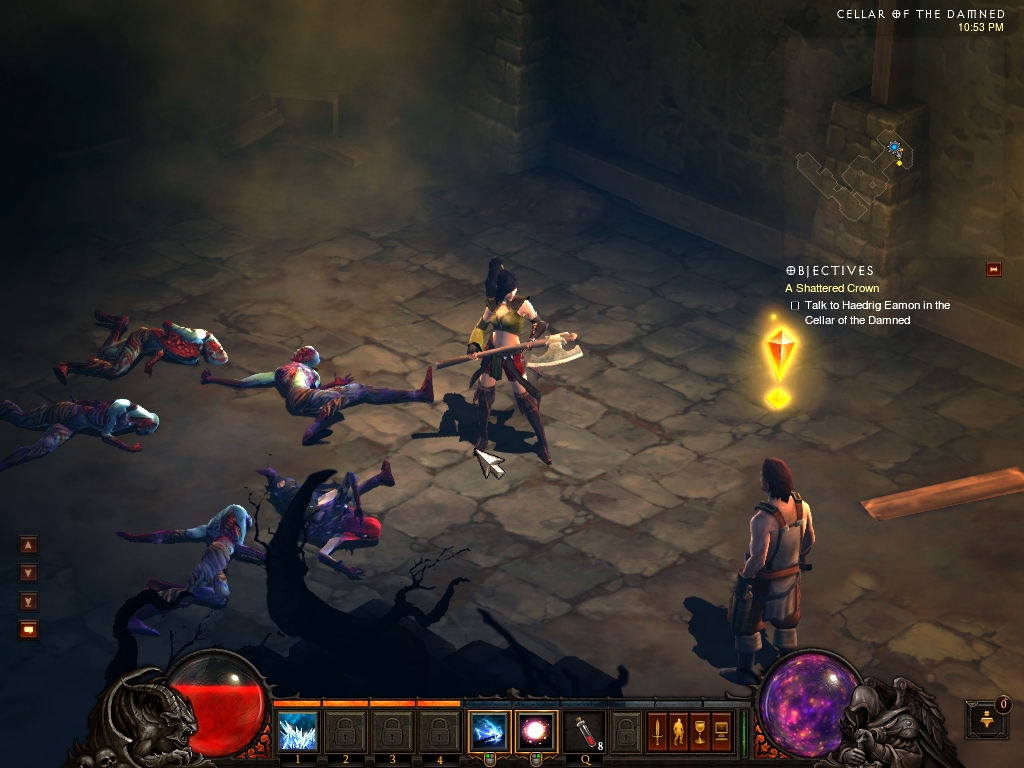 I also succumbed to temptation and made a wizard. While I was enjoying the monk more by the end, the wizard blew it out of the water in the fun department. Admittedly, it was a bit mindless, as I did nothing but spam arcane orb most of the time, but it was awesome to demolish everything in front of me with raw magical power.
On the Mists of Pandaria beta front, let me just say this to all those of you in the beta: do yourself a favour and do some low level PvP. I had the most absolutely hilarious Warsong Gulch match ever yesterday.
Picture two dozen pandas rolling around and hurling kegs of booze at each other like some demented Donkey Kong game on acid. It was ridiculous. It was glorious. It was — dare I say — pandemonium.
I should have thought to take more screenshots, but things were just too crazy most of the time. And I was having too much fun.
 “The Chronicles of the Necromancer” is an interesting hybrid of dark fantasy and high fantasy. The style of the story is very much in the high fantasy vein, full of wizards and epic conflict, but the setting is more dark fantasy. Instead of Elves and Dwarves, the land is populated by vampires (they’re called vayash moru in this series, and they do not sparkle), werewolves (called vyrkin), and various forms of vengeful dead.
 Unfortunately, the rest of the series has not lived up to the quality of its beginning. Once Jared was defeated, the series got progressively more domesticated. The epic struggle was gone, and more and more attention was given to more “soap opera”-type storylines, like Tris and Kiara wringing their hands over her pregnancy.
 Superior Realities