
I tried really hard to give this book the benefit of the doubt.
Oh, there were warning signs early on. Little things that were wrong, that showed an author who hadn’t done their research. Since when does Valerian Mengsk of all fekking people use casual slang?
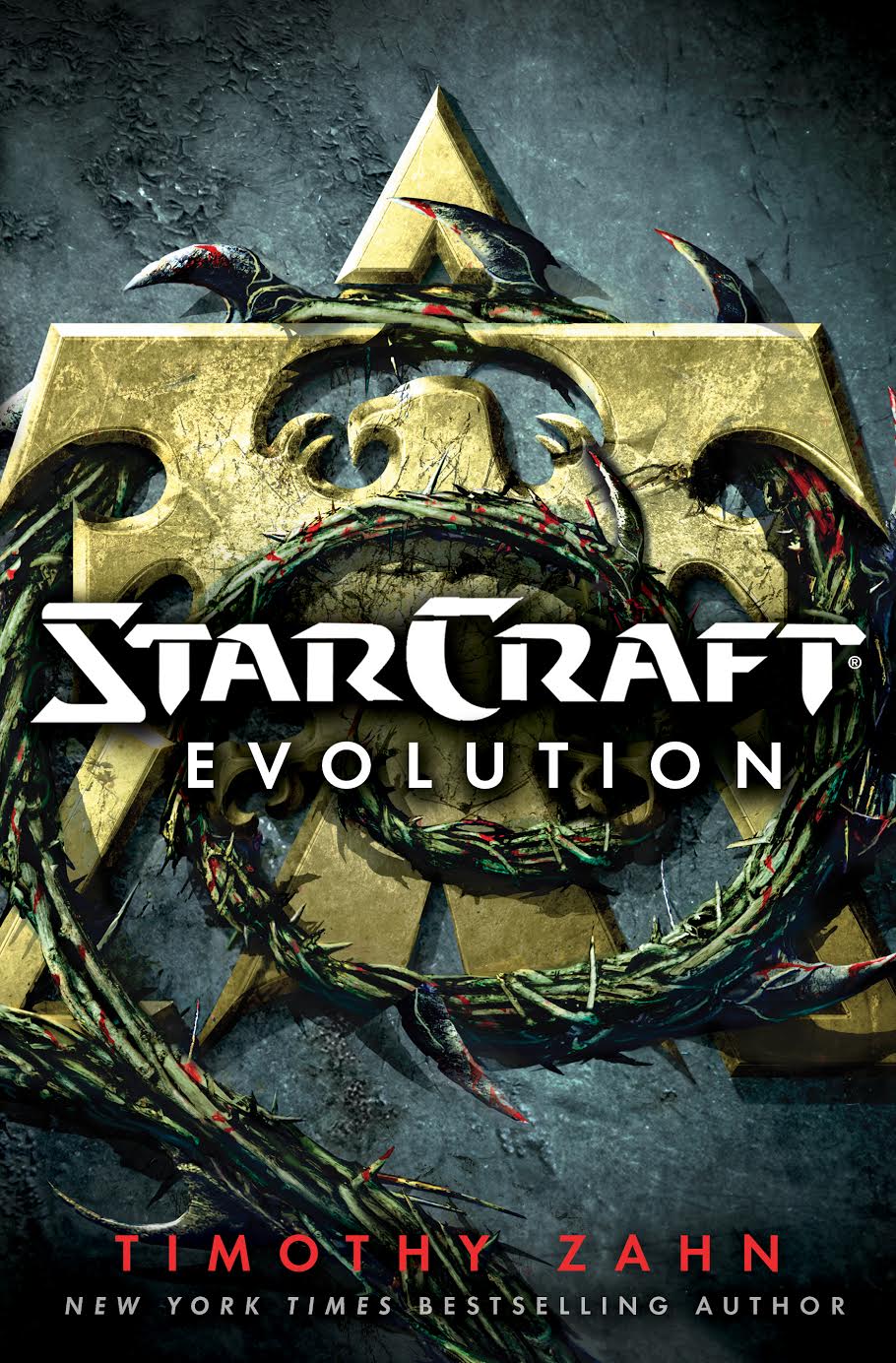 Still, I didn’t want to judge too harshly out of the gate. This was Timothy Zahn’s first book in the StarCraft universe, and besides, a few hiccups here and there aren’t the end of the world. Knaak’s writing can be a little rough, too, but I usually end up enjoying his stuff all the same.
I did a double-take when I realized that most of the new characters had received little to no physical description, forcing me to conjure my own images of them out of whole cloth. (I decided Tanya has red hair because she’s a ghost and, y’know, Kerrigan and all.) That should have been a pretty big red flag right there.
But StarCraft has had a really good run over the past year or two. Everything that’s been released in-game has been excellent, pretty much without exception, and it’s felt like the franchise has entered a golden age, like it can do no wrong.
So I pressed on. And I kept pressing on, until the end of the book, at which point I had no choice but to admit the truth: Evolution is a sloppy, dull book written by someone who appears to have little to no understanding of the StarCraft universe or its characters.
Evolution presents a rather bizarre scenario. It involves an attempt at a peace conference between the Swarm, the Dominion, and the Daelaam Protoss. What’s even more shocking is that the conference was orchestrated by the Zerg, by Zagara herself.
Zagara claims she wants to usher in a new era of peace in the Koprulu Sector, and to prove her intentions she’s used the Zerg mastery of bio-engineering to bring life to a formerly dead world. She promises do the same on Terran and Protoss worlds, to heal the scars wrought by the End War.
To test the truth of her claims, Emperor Valerian sends a survey team to the surface, including a surprisingly chill reaper, an underachieving pyrokinetic ghost, a scientist, a mysterious Protoss exile, and Generic Meathead Marine Dude #24601. It soon becomes clear to the survey team that sinister forces are at work on the newly green world, and tensions run high on all sides as a new war seems increasingly likely.
It’s a pretty weird premise, and a bit hard to swallow at first, but ultimately it’s the execution far more so than the concept that drags Evolution down.
And to be fair, it’s not entirely bad. Some of the new creatures and concepts introduced are pretty cool from a strictly sci-fi perspective, and if these plot threads are ever revisited (hopefully by a different author), they could go interesting places.
Some of the new characters aren’t bad, either. They’re no R.M. Dahl or Mike Liberty, but they’re not without their charm. Tanya, the ghost, is kind of cool, and I love the nickname the other ghosts gave her: Pyrokeet.
The pre-existing characters, though, are a mess. I’ve already said that Valerian’s speech pattern was all wrong, and Horner displayed basically zero personality through the whole thing.
Abathur, though, is the real travesty here. The author does not understand Abathur at all. He acts so wildly, absurdly out of character in this book that it’s just intolerable. I clearly remember dialogue in Heart of the Swarm that directly and completely contradicts all of Abathur’s behaviour in this book.
Artanis feels right, but really, how hard is it to write for Artanis? The man isn’t exactly complicated.
And there’s no shortage of things that are far-fetched, or just straight up don’t make sense. Like how an interstellar transport takes about eight hours just to cross one planet for some fekking reason.
The only real silver lining here is that Evolution doesn’t seem that relevant to the ongoing story. Normally this would be a bad thing, but this book is such a mess I’m glad it’s not super likely to have a lasting impact of the course of the StarCraft universe.
I wouldn’t mind seeing more stories about the adostra, but please, Blizzard, get Christie Golden to write them.
In the end, Evolution is a wreck, but it’s a pretty self-contained wreck. It’s not enough to spoil StarCraft’s current golden age.
Some of the StarCraft novels have been truly excellent, and are among the best sci-fi books I’ve ever read. This isn’t one of them.
At least it was better than Speed of Darkness.
Overall rating: 4.1/10

 Superior Realities