
Valor turns to Wrath:
Yesterday, as the culmination of the pre-release hype for Diablo III, Blizzard released a short animated film, Wrath, set in the game’s universe.
Directed by Peter Chung of Aeon Flux fame, the short depicts a battle between the Heavens’ ruling body, the Angiris Council, and the game’s titular Lord of Terror.
It’s pretty neat. I’m not a huge fan of the art style, but it’s a good way to help set up some of the story elements for Diablo III, and it ties in well with what I read in “The Book of Cain.”
Which got me thinking…
Multimedia storytelling:
Telling stories through multiple mediums is an increasingly popular idea. For example, bestselling fantasy author David Farland has recently produced “Nightingale,” an enhanced novel featuring a soundtrack, animations, and illustrations in addition to traditional prose.
 Now, I’m not really a fan of multimedia novels. It feels like turning them into something they’re not. And besides, a novel doesn’t need enhancement. It’s already the richest, deepest, and most versatile* storytelling medium.
*(Note: This does not mean “best.”)
But video games? Ah, that’s a whole other matter.
I think video games are a medium that lends itself well to multimedia storytelling. Video games themselves already blur the line between film, art, audio drama, and prose. Many games’ stories are told through a combination of the above. It’s not much of a leap to start advancing a game’s story outside of the game itself.
This is something Blizzard has become something of a master of, with its years of novel, comic, short story, and manga tie-ins to its games — as well as the World of Warcraft movie, assuming that ever gets made. WoW’s patch trailers also now serve as a way to continue the story outside the game.
A lot of people resent this, feeling they are required to spend extra money on books to experience lore that should have been put in the game.
I think this view is shortsighted. The fact is that the amount of story you can cram into a game is really quite limited. There’s only so many cinematics and so much quest text you can stuff in before it begins to bog down gameplay. Even now, any cinematic or RP event inevitably gets complained about by some people, no matter how little impact it has on their gaming experience.
So novels and other non-game sources for lore allow for worlds and storylines to be fleshed out much more fully than they could ever be in-game.
And frankly, if you view buying a giant book full of lore as something onerous, I question whether you’re really that much of a lore fan. But I digress…
I now come back to Diablo III and Wrath, as this demonstrates an entire new level of cross-platform storytelling from Blizzard. The backstory for Diablo III is the sum of:
- Multiple traditional prose novels published over several years.
- Multiple short stories on their website.
- Two separate comic mini-series.
- “The Book of Cain,” which is as much a physical piece of art as it is a book.
- The Wrath film.
- The previous two games.
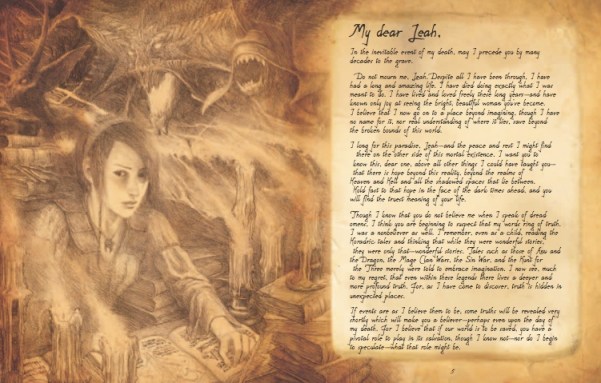 All this together culminate to create a rich and immersive story experience before I ever log into Diablo III.
Blizzard is not the only video game developer to experiment with multimedia storytelling, either. I just use them for my example because they’re what I’m most familiar with.
My point? Well, I suppose I don’t have one, except for maybe, “This is really frickin’ cool.” As someone who’s been interested in the art of storytelling for most of his life, I find this all quite fascinating.
I’m curious to see how this trend will continue, both for Blizzard games in particular and for video games in general.
What do you think? Is multimedia storytelling for video games confusing, or a great way to expand the fiction? Do you welcome cross-platforms stories for all mediums, or are you a bit more narrow in where you feel it is appropriate, as I am?
By the way…
Another of my articles has made it onto the WhatMMO: Six Ideas for Your Next Player Hosted Event. I’ve participated in several of these ideas myself. What about you?
 It brings us back to the time before the Third War — or Warcraft III, in real world terms — and focuses on Tirion Fordring, now famous for being the guy who shattered Frostmourne. While hunting, Tirion encounters a fugitive Orc squatting on his land. Naturally, they fight, each finding the other to be a worthy foe.
 I also loved the morality play aspect of the story. It harkened back to the slightly deeper, Warcraft III style of storytelling, and it was surprisingly intelligent for a Warcraft story. I especially liked how there was no clear right answer. Where does Tirion’s loyalty lie? With his nation, with his family, or with what he knows to be right in his heart? Which is the right one to stay faithful to?
 Superior Realities