
Blizzard has what I’m going to call an inconsistent history with its portrayal of women in its games. There’s been a lot of criticism thrown at them over the years, and a lot of is quite justified (some cases I may disagree with), but they’ve also created some pretty interesting female characters over the years.
 Today I want to look at how the StarCraft franchise in particular has portrayed its female inhabitants over the years, because I think that’s been a pretty fascinating evolution.
Before I go any further, I will offer the caveat that I am a dude and that my opinions on issues relating to women should be taken with a grain of salt. I try to be sensitive and understanding, but obviously I lack the level of perspective and investment a woman would have for issues such as the portrayal of female characters in the media. What follows is my viewpoint; you are welcome to disagree.
In the beginning:
The first StarCraft game had a grand total of one female character. Now, to be fair, she was a pretty huge part of the story, but I’m not going to pretend it wasn’t a heavily male-dominated game.
Similarly, there was only one female unit in the game (well, two if you count Zerg queens): the Terran dropship.
However, even as early as the Brood War expansion, things were starting to change, if only slightly.
The number of major female characters in the story doubled with the introduction of Raszagal, who was also the first female Protoss we encountered.
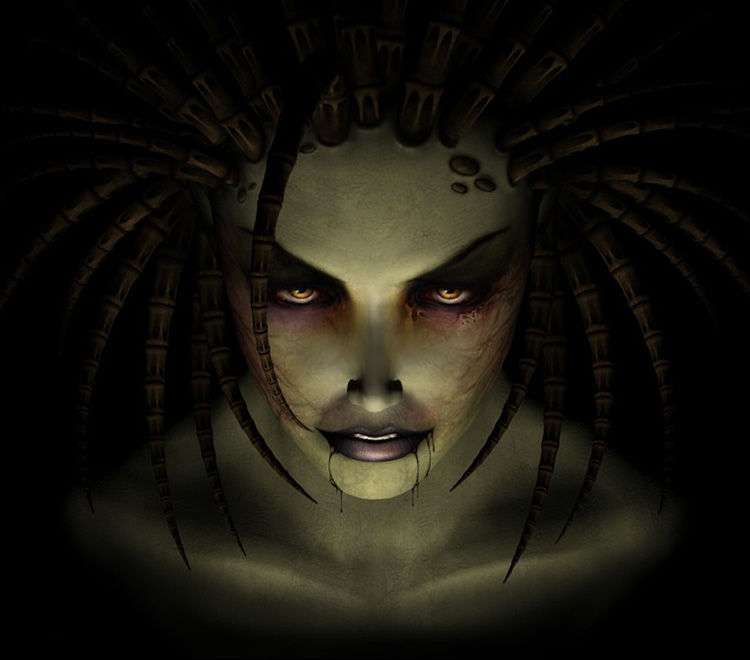 This is somewhat significant because video games have a bad habit of only ever showing us one sex of non-human races (the neglected sex almost always being female). After twenty years, we still haven’t seen a female Ogre in Warcraft, and even Mass Effect took until the third game to show us a female Turian, and then only in DLC.
Raszagal was ultimately something of a weak character, but Brood War as a whole was devoted almost entirely to building up Kerrigan as a character — albeit in a very poorly written way that did more to make the other characters look stupid than to make her seem impressive. But, still, she was the star of the game, however mishandled the story may have actually been.
Brood War also began introducing more female combat units, though it was only two — both Terran, and one just a cheesy collection of “sexy nurse” cliches. Valkyries were pretty badass, at least.
Brood War gave a lot more attention to women than the base game had, but StarCraft as a whole remained a game mostly defined by its male characters. It would take until much later for more significant changes to take place.
Between games:
Some mention needs to be made of Nova and her rather strange saga.
 Nova was to have starred in her own game, a shooter called StarCraft: Ghost, but it was cancelled before its release. However, she was not forgotten, by fans or by Blizzard.
Nova’s first appearance to be released to the public was the novel that bears her name by Keith R.A. Decandido. This established her as not only one of my favourite characters from the StarCraft universe, but also one of my all-time favourite characters in all of fiction, a complicated yet lovable and just downright cool person.
Nova would go on to star in quite a lot of tie-in fiction and become an icon for the franchise, though it would be a while before she took a major role in-game (more on that later). I’ve also previously pointed to her as a good example of sex appeal done right.
Also on the subject of tie-in fiction, I’d like to take note of R.M. Dahl of Christie Golden’s Dark Templar trilogy. Although she did not have any real appearances outside of the trilogy (bar her terribly ill-conceived cameo as a damsel in distress in Project Blackstone), R.M. is like Nova in that she became one of my most beloved characters. I always respect an author who can make me love a character I initially hated, and that’s R.M. in a nutshell. She’s a very complex person with a lot of layers.
Note to self: Reread those books sometime soon.
Hell, it’s about time:
 StarCraft II is where I start to see big changes taking place, though I’ll definitely grant it’s not a perfect track record.
Wings of Liberty was still mostly the guys’ story, I admit. And there’s the utterly cringe-worthy Ariel Hanson to consider. It was Nova’s first appearance in-game, but she didn’t exactly do much.
They did start including more female units, though. Still a minority, but more than the original game launched with. For some reason the banshee pilot seems to strike a cord with people especially.
Heart of the Swarm was a mixed bag. On the one hand, Kerrigan took center stage again, and there were some prominent female characters among the supporting cast — though I’m not sure Izha should count anymore the Terran adjutant does.
On the other, the ending of the game could be considered kind of problematic, with some of Kerrigan’s thunder stolen at the finish line. I have a strong recollection of the profane rant I got from one of my feminist friends after she finished the game.
I don’t think it’s quite as bad as she did, but I can sympathize with the perspective, and I have my own problems with HotS’ ending, so I’m not going to waste much energy defending it.
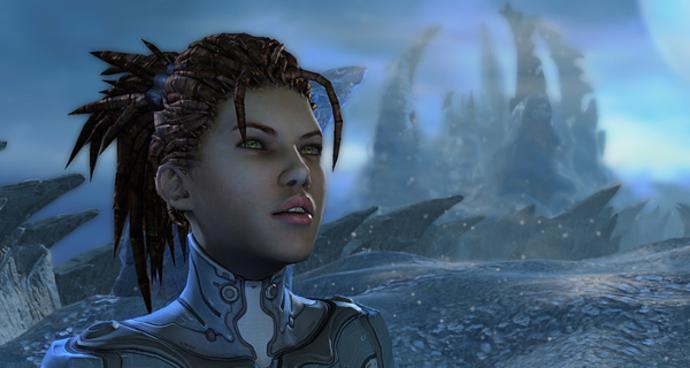 Heart of the Swarm did add another female unit to players’ armies, though, in the form of the Protoss oracle — which is good because Protoss females have traditionally been very underrepresented in-game.
And that brings us to Legacy of the Void, which saw an explosion in the number and prominence of Protoss women in the story. Selendis unfortunately did not get the big role I’d hoped to see for her since her small appearance in Wings of Liberty, but we were introduced to Vorazun, Talis, Rohana, and Ji’nara.
I really like how Protoss women are portrayed. So far as I can recall, at no point in the entire StarCraft franchise have Protoss females been treated in any way differently from their male counterparts. It would appear the Protoss have achieved — or always had — perfect gender equality.
[Edit: Upon rereading the Dark Templar novels, I have been reminded they showed the Templar as being something of a boys’ club. However, this is the only example of gender inequality we’ve ever seen from the Protoss, and frankly it seems out of place compared to the rest of the lore.]
They’re not treated differently by the writers, either. Protoss women are, without exception, every bit as proud and formidable as the men.
I’m also quite fond of their art design. There’s a definite feminine quality to their appearance, and you can readily tell the difference between Protoss males and females at a glance, but they haven’t been sexed up or otherwise made to appeal to human ideals of beauty. They still look decidedly alien.
 This stands in stark contrast to the ludicrous sexual dimorphism that you tend to find in the Warcraft universe — especially with the Draenei, whose males and females do not appear to even be from the same species.
I suppose you could make an issue of the fact that all these Protoss women are still largely playing second fiddle to the male characters — Selendis and Vorazun sort of share the role of Artanis’ sidekick, and Ji’nara is obviously second to Alarak — but they are all powerful and interesting characters in their own right.
Vorazun may be second to Artanis in the overall Hierarchy, but she is the sovereign ruler of her own people, and Artanis has been shown to trust her to lead the Daelaam in his absence. And frankly she’s a far more interesting character than Artanis ever was.
Meanwhile, Selendis is the commander of the Golden Armada, Ji’nara is a heartbeat away from ruling the Tal’darim, and Rohana is the only character shown to be strong enough to resist Amon’s direct influence.
There’s also a fairly credible fan theory that Selendis was the player character in Brood War’s Protoss campaign, similar to how Artanis was the player character in the base game. This isn’t confirmed, though.
We shouldn’t forget the ending of Legacy of the Void, either, which I think served as redemption for the mistakes of Heart of the Swarm.
 Outside the main story, LotV introduced more female units — the liberator for Terran and the adept for Protoss — and the co-op mode, which prominently features several women as playable characters or mission contacts.
Finally, there’s the Covert Ops DLC. That was, in fact, the main inspiration for this post, as it undoubtedly gave more attention to women than ever before in StarCraft – or arguably any Blizzard game.
Obviously Nova was the hero, and she did nothing but kick ass and take names the whole time, but the villain was also a woman. Not exactly unexplored territory for StarCraft, but it was interesting to see a story that was entirely about the conflict between two women. That’s not something Blizzard’s done a lot of.
It also struck me how many women there were in more minor and incidental roles throughout Covert Ops. The Defenders of Man pilot on Tyrador, Horner’s lieutenant on Borea, Kate Lockwell on the news, and so forth.
It’s certainly a milestone for a franchise that began its life with one solitary female character.
* * *
There are two main points I’m trying to make here.
 1: I really like StarCraft.
2: Blizzard has made a lot of mistakes in how it handles its female characters, and that deserves to be criticized, but I think they are making a genuine effort to do better, and I think that, too, deserves recognition.


 Superior Realities