On Pet Classes

Pet classes in RPGs tend to provoke strong reactions. Most people either love pet classes and play them at every opportunity, or hate pet classes and avoid them like the plague.

Fighting the undead in The Incredible Adventures of Van Helsing IIII’m a strange case in that both of those are true of me. Depending on the game, I either love or hate pet classes.

For example, you’ve probably heard me complain bitterly about pet classes in World of Warcraft. Yes, one of my most played characters is a warlock, but I started her as a leveling challenge to see if I could play a lock without pets, and once Grimoire of Sacrifice became a thing, I’ve used it as much as possible. The pets have always been my least favourite part of being a warlock.

Similarly, pets are one of the bigger reasons I haven’t spent much time playing a hunter, and it’s not entirely a coincidence I started losing interest in my mage around the time they made frost a pet spec.

On the other hand, when it comes to single-player games, I tend to embrace pet classes with open arms. When the Van Helsing games revamped their classes, I went straight for the Constructor and terrorized Borgovia with my army of dismemberbots.

I don’t have a lot of fond memories of the gameplay of Diablo II, but one of them is definitely having a posse of skeletons following my necromancer around. In D3, I never quite managed to click with the witch doctor, but I have done my level best to rekajigger my crusader into a pet class (a “zoosader”). At a maximum, he can be accompanied by three swordsmen, four archers, Kormac, and a demon minion summoned by his sword.

And let us not forget my zombie goons in Lichdom: Battlemage.

My zombie posse in Lichdom: Battlemage“…Zombie goons?”

Then there’s party-based RPGs to consider. We generally seem to separate companion characters from pets, but practically speaking, they’re pretty similar. AI minions who assist you in combat. And I definitely enjoy party-based RPGs — I prefer them to games where you only control a single character. In fact, my most common complaint about them is that the parties aren’t nearly big enough. Dungeon Siege spoiled me with its nine party slots.

So what accounts for this split?

Honestly I’m not entirely sure. I don’t think it’s necessarily one factor as much as a combination of them.

Broadly, it seems to be a difference between single-player games and MMOs.

For one thing, MMOs never really seem to take pets into account when balancing the difficulty in the open world, so while pet classes are at no particular advantage at endgame, they’re brokenly OP when soloing, and since most MMOs tend to make their solo content rather insultingly easy to begin with, it just makes the whole experience a snorefest.

On a related note, most tab target MMOs have incredibly stilted combat with little meaningful interaction between the player and their opponent. You kind of just ignore whatever the enemy is doing and mindlessly drill through your rotation. Having a pet tank hits for you exasperates the issue.

My party in Dragon Age: InquisitionMMOs also usually use an over-the-shoulder camera, which causes pets to take up an obnoxious amount of screen real estate. They mess up screenshots and cause all sorts of problems.

Meanwhile, a lot of the single-player RPGs I favour use an isometric camera, which makes pets far less of an encumbrance.

Perhaps due to less concerns about lag, single-player games also tend to allow you to control much larger numbers of pets, and I definitely prefer a swarm of minions to just one.

It could also have to do with the rigid threat mechanics that tend to exist in a lot of MMOs, but not in single-player games. Most MMO pets have taunt abilities that ensure enemies will focus on them almost 100% of the time. This, again, robs you of any meaningful interaction with your opponent.

In single-player games, pets usually don’t have taunts or threat modifiers. At best they’re a physical barrier between you and the enemy. Even in Dragon Age, where the warrior in your party will likely have taunts, it’s rare for them to hold aggro on every enemy. This means that you still have to look to your own defenses and survival at least a little.

Another divide is that MMO pets tend to require a lot of micro-management, at least in group content, whereas single-player pets and companions are almost always fire and forget. I definitely do not want to have to spend a lot of time baby-sitting my pets — that defeats the purpose as far as I’m concerned.

My Imperial agent and Lana Beniko in Star Wars: The Old Republic's Knights of the Fallen Empire expansionAll that said, I can still find exceptions that muddy the issue even further. I quite like the companion characters in SW:TOR, for instance, and they’re essentially pets. In that case I suspect it’s a combination of the fact they’re meaningful characters within the story and the fact I already dislike the combat in that game, so how much worse can the companions make it?

In ESO, also, I’ve leaned heavily on my Clannfear pet, perhaps because unlike most MMO pets it doesn’t require much management. Then again it’s also worth noting that I have been moving away from using it recently — it doesn’t fit my character’s RP very well, and it bugs out a lot.

It’s definitely a very muddled alchemy that determines whether or not I will appreciate pets. The one thing you can be certain of is that I will always have strong opinions on pet classes one way or another.

Review: Mass Effect: Andromeda

It’s funny to think I was so skeptical about a continuation of the Mass Effect series. For a while there are I was considering not trying Andromeda at all. But having now finished the game, I’m very glad to have kept an open mind.

Ryder and Jaal in Mass Effect: AndromedaI will be avoiding major plot spoilers as much as possible.

Exploring the unknown:

First of all, let me say that this is very much a Mass Effect game. A few things are different, but nothing’s radically changed. If you liked the previous ME games, you’ll like this one. It does have its flaws, but most of them are things you would naturally expect of any Bioware game.

That doesn’t entirely excuse the problems, of course. One of the biggest is that this is once again a game that has favoured side content to an unhealthy degree. In the end, it’s maybe not quite as obnoxious on this front as Inquisition was, but it’s still kind of obnoxious.

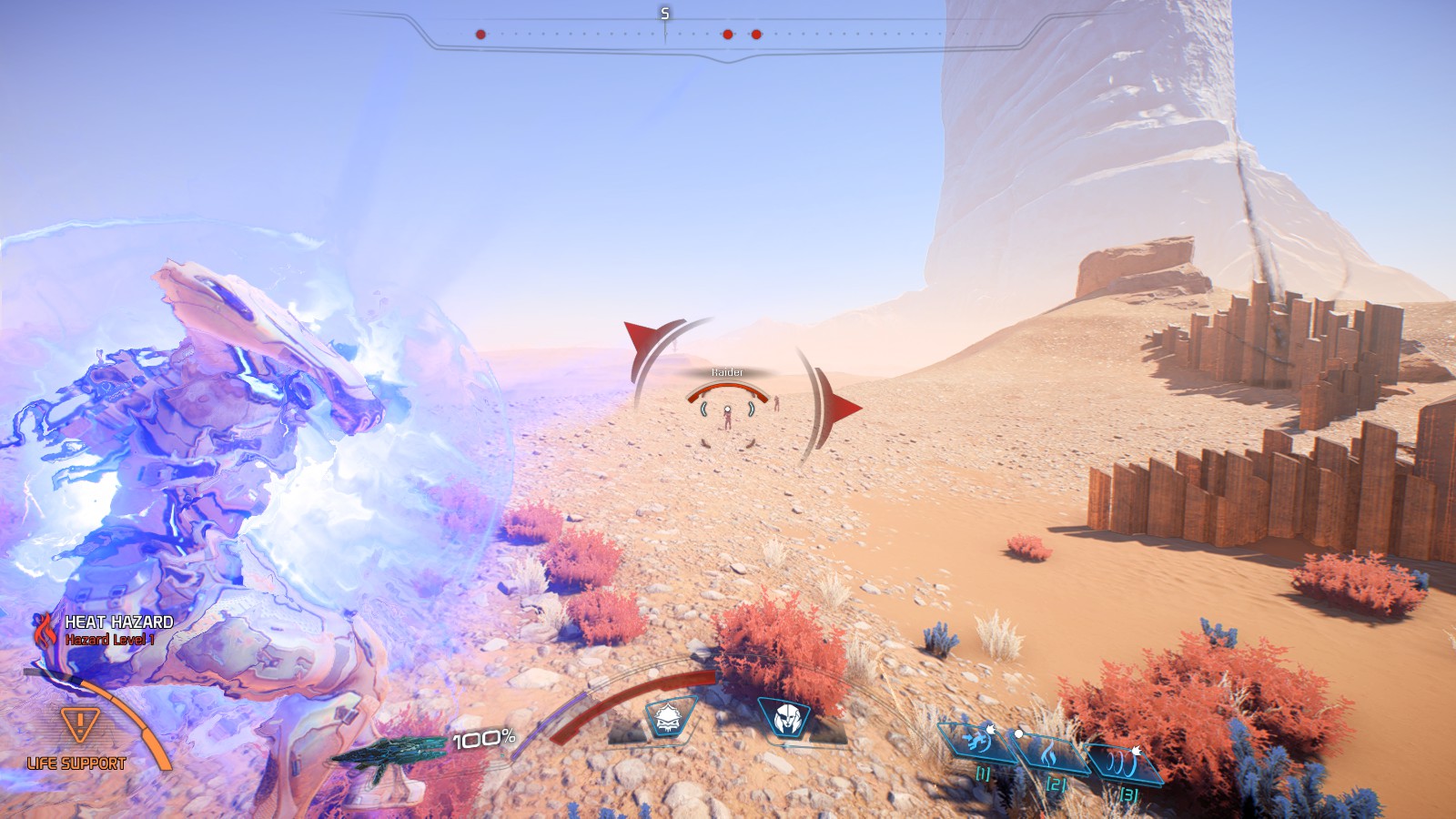
It’s not just the amount of side quests and exploration, but how repetitive a lot of it is. I think something that dragged Andromeda down is how little environmental variety there is. More than half the worlds you visit are empty deserts, and the monotony of the scenery really wears you down after a while.

It’s very disappointing in a game that is supposedly about exploring the unknown and discovering wonders, and doubly so when you contrast the endless wastes with the sections of the game that are more creative. One of the most memorable parts of the game for me was the planet Havarl, a bioluminescent jungle world that is absolutely breathtaking.

Planet Havarl in Mass Effect: AndromedaWe needed a lot more locations like that, and a lot fewer endless brown desert zones.

Something else that inhibited the game’s sense of exploring the unknown is how much time you spend fighting criminals elements of your own people, the Andromeda Initiative. I’m okay with the idea that some people went Lord of the Flies when confronted with the challenges of Andromeda, but it’s, like, half the game. How did so many immoral, unstable people even get admitted to the Initiative?

I know this much: I didn’t buy a game about exploring another galaxy so I could fight generic human crooks.

In general some more variety in threats would have been nice. Andromeda has a better variety of enemies than past installments, but it’s still mostly lacking boss fights. When they want to ramp up the difficulty, they just throw more of the same old trash mobs at you. Some more creativity would have been nice.

The one exception is the Remnant Architects, open-world bosses analogous to Inquisition’s dragons, but even these quickly become repetitive.

You see, every Architect fight is exactly the same. The mechanics never change at all. And their mechanics also happen to be virtually the same as those of Dark Matter Monoliths in Defiance, which made them feel even more repetitive for me.

A Remnant Architect in Mass Effect: AndromedaI have killed a lot of Monoliths.

But when those issues don’t apply, exploring the Andromeda Galaxy can be a real treat. You may spend too much time trekking through the desert, but you’ll also marvel over wondrous new worlds and delve into profound alien mysteries.

A few weeks ago I said that Andromeda is the best Star Trek movie in years, and while I was half-joking, there is a lot of truth to that. There is an incredible sense of mystery and discovery running through many parts of this game. Not as many parts as there should have been, but when it delivers, it really delivers.

It’s not just about the sights and the story, either. A wealth of puzzles and environmental hazards constantly remind the player that exploration is a difficult business. It makes the game world feel much more like a real place — it’s not always an easy road, but that’s what makes it rewarding.

The feeling of exploration even helps make the wealth of side quests a little more tolerable. It’s easier to justify wandering all over and investigating every little thing as a Pathfinder exploring a new galaxy than as an inquisitor in a race against time to stop the world from literally exploding.

Similarly, the combat has its repetitive elements, but fundamentally it’s still very fun, and it can offer some real thrills. Andromeda doesn’t change a lot about Mass Effect combat, but it changes enough to matter.

Unleashing biotic charge in Mass Effect: AndromedaCombat in Andromeda is a lot more mobile, a lot more dynamic, than in past installments. You can’t just camp out in cover and snipe enemies with impunity anymore — not all the time, anyway. It’s a little more challenging and a lot more exciting.

The build system helps with this. In Andromeda, classes are gone, and you can instead pick any skills you want from combat, tech, or biotics. You can even save multiple skill sets and swap between them in combat.

Now, this isn’t quite as much flexibility as advertised. It took me until relatively late in the game to unlock a second set of skills (a vanguard-style melee set-up) without compromising my main build, and I never had enough skill points for more than those two builds. But it’s still much more flexibility than we had in past games, so I call that a win.

One final thing about the gameplay that bugged me is that Andromeda has taken a step backward by returning the Mass Effect franchise to a vertical progression grind wherein you have to regularly update your gear, and where loot (most of it entirely worthless) drowns you at every turn. Not a change I welcome.

The best gear by far comes from crafting, which means you don’t have to be at the mercy of RNG, but it also means all the dropped gear is just a waste of space.

Finding a home:

The crew of the Tempest in Mass Effect: AndromedaBut the story and the characters are the true heart of any Bioware game, so let’s talk that, shall we?

The main story in Andromeda is pretty sparse, but unlike Inquisition or ME2, it doesn’t feel underdeveloped. It tells all the story that it needs to.

The villains this time are a race of imperialistic aliens called the Kett. The Reapers were some of the greatest antagonists in sci-fi history as far as I’m concerned, and the Kett can’t live up to that legacy, but they’re scary and alien enough to serve their purpose.

Really my only complaint is how dorky they look. Everything about the Kett themselves and their technology looks like it came from the bottom of Star Trek: Voyager’s reject pile.

But ultimately the Kett are just one part of the grand galactic mystery that makes up Andromeda’s story. I can’t say much without spoilers, but it’s a story that exemplifies the sense of wonder that lies at the heart of speculative fiction. I loved it, and the ending is magnificent.

The characters, too, are strong, as one would expect from Bioware. This is perhaps the first game I’ve played from them where I didn’t strongly dislike any core characters. Liam started getting on my nerves after a while, and Vetra’s a little boring, but there’s no one I truly hate the way I did Vivienne or Zaeed.

Nakmor Drack in Mass Effect: AndromedaThe biggest surprise was Drack. I’ve never been a Krogan fan, but he actually became one of my favourites. Turns out “adorable Krogan grandpa” is a pretty good character concept.

Jaal also stood out. It took me a while to warm up to him, but in the end he really won me over. He reminds me of Garrus — he’s the one you can trust to always have your back when it hits the fan — but he’s warmer and all around more likable than Garrus was.

However, I was disappointed by the amount of character content. It’s definitely less than you’d expect from a Bioware game, and it’s quite imbalanced, too. Some characters get a lot more attention than others.

PeeBee seems to get quite a lot of content — of course the sexy Asari is going to get plenty of time in the spotlight (eye-roll) — and Jaal and Drack also get a decent amount, but Suvi has hardly any content at all. Which is a crying shame because she’s easily the game’s best character.

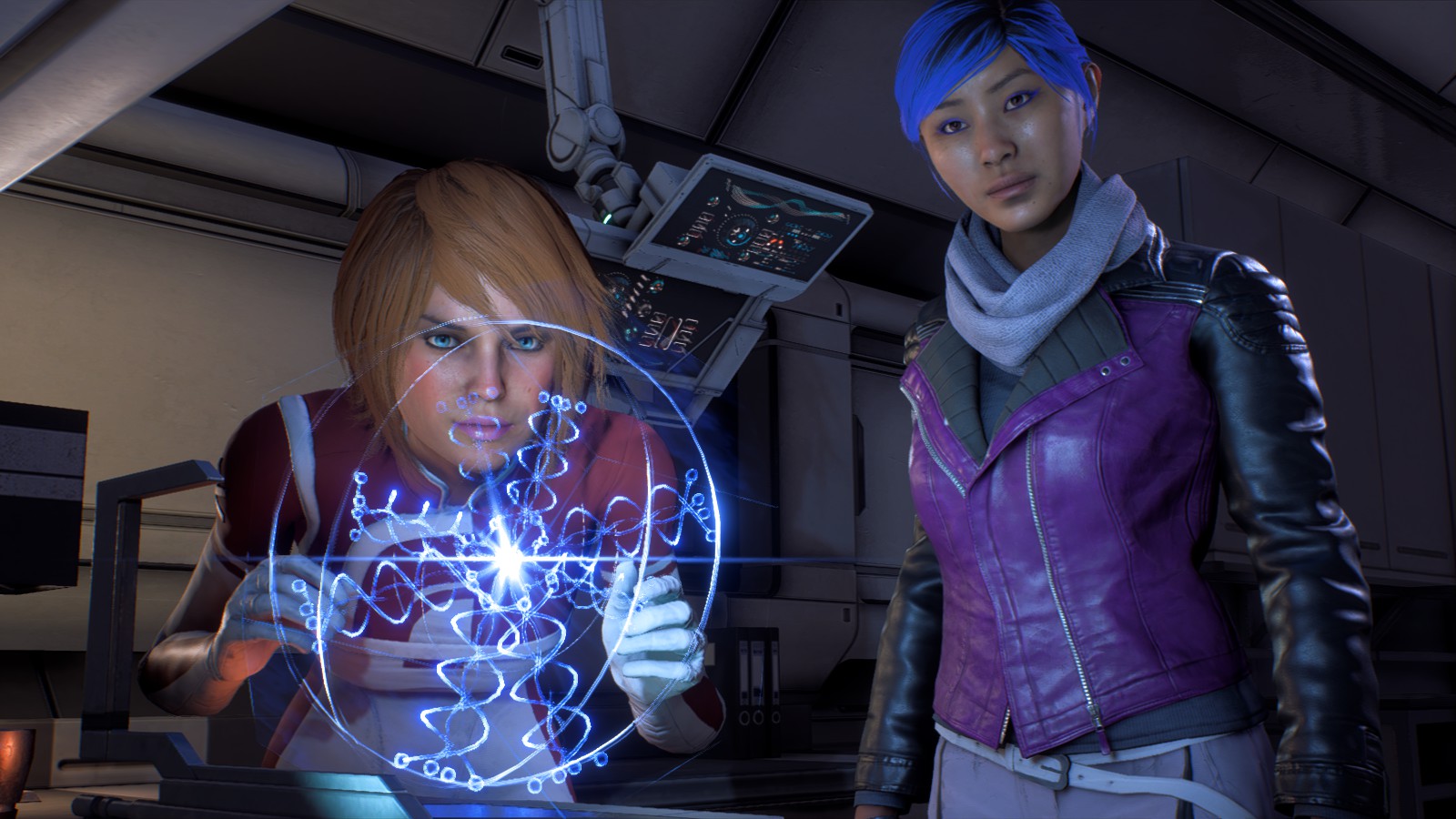
Anyone who complains about the facial animations in this game has never seen Suvi nerdgasm.

I also found Ryder, the main character, a little flat-feeling. This despite the fact I like Fryda Wolff a lot better than Jennifer Hale (sacrilege, I know). I think the dialogue changes might be to blame.

Dr. Suvi Anwar and Sara Ryder in Mass Effect: AndromedaI don’t mourn the rigidity of paragon/renegade, but the new tone options are so similar to each other it’s hard to define a specific personality for your Ryder.

There’s also a surprising dearth of “mean” options. It’s like instead of blurring the lines between paragon and renegade, they just made everyone paragon. This shouldn’t bother me since I was always pure paragon anyway, but somehow it does. Being the good guy doesn’t feel as meaningful if you don’t have the option to be the bad guy.

Still, there is enough character here to give the game real heart.

We made it:

I’ve been reviewing things on this blog and elsewhere for a long time, and I’m coming to the conclusion reviews can be surprisingly hard, because there’s a lot about how things fit together and how things feel in the moment that can’t be explained in rational terms. Andromeda is a good example. I can rattle off no end of things I didn’t like about it, but the end result is still a game I deeply and truly enjoyed. It’s somehow more than the sum of its parts.

Reading it back, this sounds like a fairly lukewarm review, but the fact is I loved Andromeda. Partly it’s that a lot of my favourite things about it are things I can’t talk about without spoilers, but partly there’s something special about this game that can’t be readily quantified.

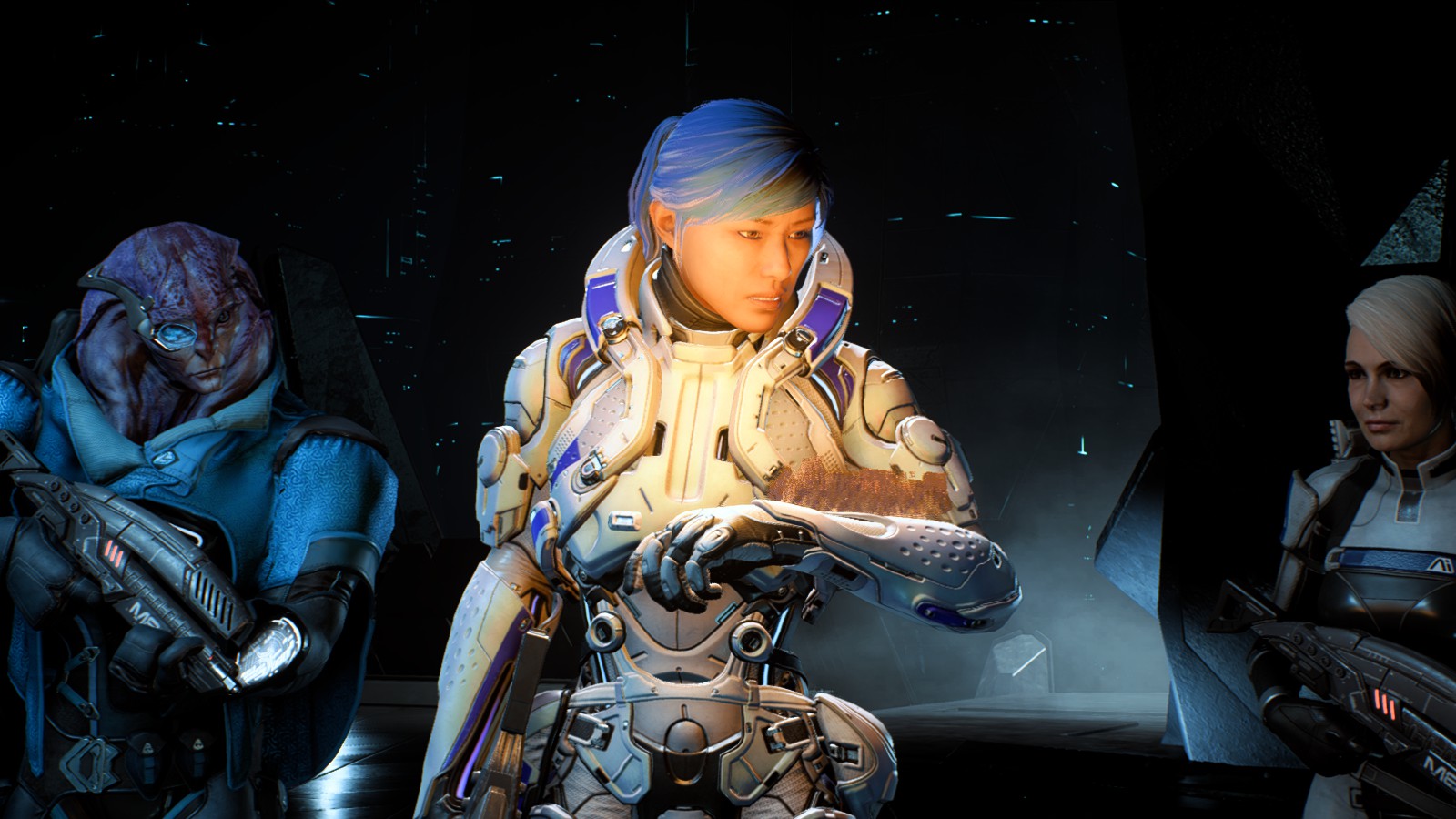
Sara Ryder, Jaal, and Cora Harper in Mass Effect: AndromedaI can’t wait for DLC. I’m most hoping for stories relating to the “benefactor” and Keelah Si’yah.

Overall rating: 8.7/10 Familiar enough to be nostalgic, but fresh enough to be exciting.

One another thing: I was surprised and delighted to discover the song that plays during Andromeda’s credits is by none other than Norwegian prodigy Aurora Aksnes. I’ve been a big fan of Aurora’s for a while now, and I can’t believe I didn’t know she was involved with the game.

I hope the extra exposure gets her more fans; she totally deserves it. If you’re looking for it, the credits song is called Under Stars, and while you’re at it, I recommend checking out her other stuff, too. Warrior, Winter Bird, and Runaway are my favourites.