
Defiance Season Premiere:
Suddenly they’ve decided to go full Battlestar Galactica dark. I normally try to keep spoilers to a minimum, but there will be some this time. It just can’t be avoided.
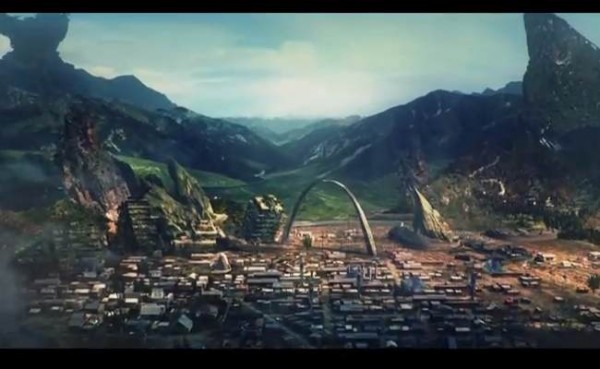
 The confusingly titled first episode of Defiance’s third season is billed as two episodes but is really just a single, two-hour episode. It takes place seven months after the destruction of the Kaziri and Defiance is once again a very changed place.
The gulanite mine has collapsed, crippling the town’s economy. As a result, the Earth Republic has abandoned the town, and Amanda is mayor once again.
This surprises me. After all the development given to the E-Rep and Pottinger, it’s a bit jarring to have them just gone. On the other hand, I never really liked Pottinger or his ilk. Would have been nice to see them violently ejected rather than just gone, though.
Things get going again with the arrival of the last two survivors of a heretofore unknown Votan race known as the Omec, a word is synonymous for “devil” in Casti. True to their nightmarish reputation, the Omec are a violent and predatory people who see other races as little more than food sources.
They’ve come for the gulanite, and their technology can get the mines running again, but Defiance’s Votan residents are incensed by this deal with the devil, and with good cause.
 I question the wisdom of adding yet another alien race to the mix, especially since most of the current races are still underdeveloped. Two seasons in, we still know next to nothing about the Sensoth, the Liberata, the Gulanee, or the Volge. The Volge, in particular, already fill the niche of evil conqueror race, and are one of Defiance’s bigger mysteries.
Along the way, the Omec survivors also free Nolan and Irisa from their stasis pod, and it soon becomes clear Irisa has greatly changed. Her killer instinct is gone, and she’s become downright pacisfistic. The world’s view of her has also changed greatly. To many, she’s a celebrity, a folk hero. Berlin, however, is less welcoming.
I am rather surprised Berlin stuck around when the E-Rep left. I suppose events at the end of last season must have dampened her patriotism, but she doesn’t have any particular ties to Defiance, either. If nothing else, I would have liked to have seen her disillusionment play out firsthand.
Meanwhile, the Tarrs and Rafe McCawley continue their pursuit of Pilar and the kids. Along the way, they encounter a band of Votanis Collective soldiers led by a Castithan general named Rahm Tak. Their goal is to destroy Defiance, and it’s here the episode gets really crazy Dark, as Tak is sufficiently ruthless and sadistic to make Datak and Stahma look positively saintly by comparison.
Hell, I think even Nim Shondu would be like, “Whoa, slow your roll, dude.”
Putting the Votanis Collective in the spotlight is something I’ve wanted for ages, but I was hoping for insights into Votan culture and intricate politics. A band of sadistic war criminals isn’t as interesting. Perhaps the insights will come later.
 I’m also not sure why they’re after Defiance. With the mine collapsed, the Kaziri gone, and the E-Rep departed, the town has no strategic value that I’m aware of.
But the most memorable part of the episode — and that’s not a compliment — is undoubtedly the near total extinction of the McCawley clan.
Quentin and Christie are no great loss, but it’s hard to imagine the show will ever be the same without Rafe.
Rafe was always one of the highlights of the series, but perhaps the greatest loss is his relationships with other characters, especially Datak. The rivalry and then grudging friendship between those two was one of the great joys of Defiance. You just can’t have Datak without Rafe. It’s like the Road Runner without the Coyote, Homer without Marge, Starbuxk without Apollo.
The show is less without Rafe, and worst of all, his death doesn’t serve any purpose that wasn’t already accomplished by the deaths of his children.
Later story developments may redeem this episode, but right now, this is an uninspiring start to the season.
Overall rating: 6.8/10
Dark Matter, episode two:
 My experience has been that the second episode of a series is almost always a bit weak, and this is no exception.
Mostly this episode deals with the crew’s attempts to defend the mining colony from corporate forces. Which isn’t bad; it’s just not especially memorable.
What made the first episode interesting was learning about the characters and the mystery of what happened to them. There’s not much of that this time. We get a little bit of the characters dealing with the revelation of their true identities — or the continued lack of an identity in Five’s case — but it feels like an afterthought.
We do once again have hints that Five has some kind of psychic powers, but her revelation that the crew is dangerous is a bit redundant given what we already know.
There were also some fairly cliche bits. Obligatory antihero torture scene. Obligatory breathless girl begs dashing space hero to stay with her scene.
Again, not a bad episode. Just a forgettable one.
Overall rating: 6.9/10


 Superior Realities