Review: Shadows of the Apt: Heirs of the Blade (+New Writing)

Review: Heirs of the Blade

“Heirs of the Blade” is the seventh book in Adrian Tchaikovsky’s vast steampunk/fantasy series, “Shadows of the Apt.” For a quick rundown on what the series is about, please see my review of the last installment, “The Sea Watch.”

After the rather rambling detour of the last book, “Shadows of the Apt” gets its groove back in a big way with “Heirs of the Blade,” which I found an exciting emotional roller-coaster from beginning to end.

In contrast to the epic and varied (almost to the point of being scattered) plots of most of the previous books in the series, “Heirs of the Blade” focuses almost exclusively on just three women.

The first is Tynisa Maker, halfbreed child of the forbidden union of a Mantis-kinden man and a Spider-kinden woman. You’ll remember from my previous review that I find the Inapt races the most interesting part of this series, and the Mantids and Spiders the most interesting of the Inapt, so you can probably imagine how I feel about a girl who is half Spider and half Mantis.

Haunted by the ghosts of her past — both metaphorically and literally — Tynisa flees into the exotic lands of the Dragonfly-kinden Commonweal, seeking only death. In the finest tradition of her Mantis ancestors, she isn’t particular about whether she gives or receives it.

The second is Seda, teenage empress of the Wasp Empire. Now, I’ve said before that I find the Wasps very unremarkable as villains go, but Seda is single-handedly turning this perception around. Every scene with her is chilling, as we learn more and more about the depths of her cruelty and her need to dominate the world.

Seda is not just the glorified schoolyard bully most powerful Wasps are. Exposed to the dark power of an Inapt ritual, Seda’s Aptitude has vanished, leaving her in the dark and uncertain world of the Inapt. But rather than fear this change, she has embraced it, learning the blood magic of the Mosquito-kinden and using it to solidify her rule.

She now stands poised to unleash not only the vast Apt armies of the Empire upon her enemies, but also the dark and forgotten powers of the Days of Lore. And her magic grows stronger with every passing day.

The third woman upon whom “Heirs of Blade” revolves is the unfortunately named Cheerwell Maker (called “Che”), Tynisa’s Beetle foster sister. Che was once my least favourite of the major cast members, but she has finally started to carve a place for herself alongside such stellar characters as Seda and Tynisa.

Che was exposed to the same magic that changed Seda, and she now finds herself in the same position as the empress: her Aptitude lost, but a vast well of magical power put in its place. In “Heirs of the Blade,” Che begins to learn the full extent of her new powers, and the lengths Seda will go to to stop them reaching their full potential.

One final thing about Che’s plot that I greatly enjoy is her traveling companion, the rogue Wasp agent Thalric. Thalric is an incredible complex character, and I could write a whole blog just about him, but suffice it to say, the man is awesome.

Each of these three main plots is engaging and exciting individually, and together, they make for a thoroughly enjoyable book. But it is Tchaikovsky’s skill as a world-builder, always his greatest strength, that takes this book from “good” to “great.”

It’s not just the intricate culture of the Commonweal, or the gradual way the reader learns it’s not the fairytale land it’s cracked up to be. It’s the way every kinden is given such a distinct and recognizable personality, and the way those personalities inform every aspect of the novel.

The whole way through Tynisa’s plot, I kept thinking things like, “That’s such a Mantid thing to do” or “What a perfectly Mantis dilemma.” The fact that what constitutes a “Mantid” thing to do is something I readily recognize without needing to be constantly reminded is a testament to the skill with which Tchaikovsky develops the various kinden.
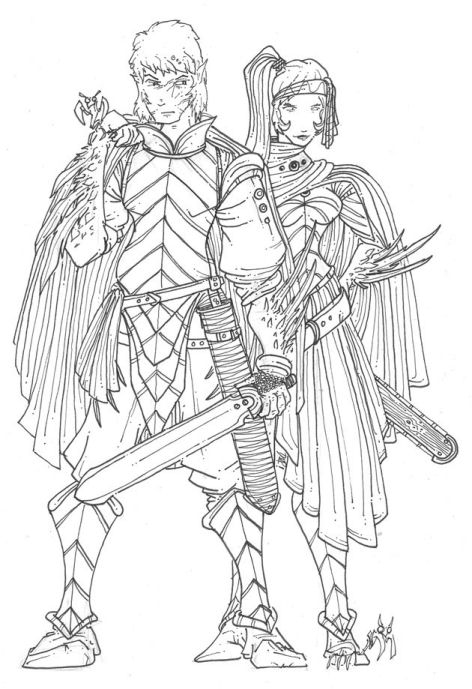
And it’s not limited to Tynisa, either. The way Che and Seda react to their newfound magic is perfectly archetypical of their kindens. Respectable Beetle girl that she is, Che is rather overwhelmed by it all, but being a Beetle, she just keeps stumbling along and somehow finds a way to adapt. Seda, in true Wasp-kinden fashion, sees her magic only as a potential weapon, a way to further her own power and that of the Empire.

If I have one complaint about this book, it’s that it lacks the feeling of epic struggle the earlier novels in the series had. The war with the Wasps has been on the back-burner for three whole books now, and while I somewhat understand why the author has chosen this route, I’m growing rather weary of the calm before the storm. Let’s get to the storm already, shall we?

Overall rating: 8.8/10 An above average installment in an above average series.

All installments of Shadows of the Apt are available on my Amazon Affiliate. I encourage you all to check it out.

New writing:

Weird Worm has posted another of my articles, “Three Weird Guys (Who Could Beat You to a Pulp).” If you ever wanted to watch a large angry man rip apart a door, this is the article for you!
Review: World of Warcraft: Cataclysm (+ New Writing)

Review: World of Warcraft: Cataclysm:

It may seem odd to review a game more than a year after its release, especially when I’ve been playing and blogging about that game all the while, but MMOs are never really finished upon release. Only now that the expansion’s final major patch has come and gone can we really take a step back and judge it as a whole. So now, as the expansion winds down, I bring you my thoughts on World of Warcraft: Cataclysm.

The world redesign:

The massive revamp of the old world is perhaps the biggest change brought by Cataclysm. People have very mixed feelings on this, and I myself am conflicted, but the fact is it had to be done. The old 1-60 zones were simply atrocious, especially when compared to higher level content.

Unfortunately, people are correct when they say this took a lot of development time away from the endgame, and the expansion did suffer as a result. While I think Blizzard was right to redesign the old world, I don’t want something to like this to be done again.

Gameplay – The good:

One of the chief things I liked about Cata is the way it improved the questing model. Some people found it too linear, but I found the more story-focused design extremely enjoyable. Gone were the days of wandering around a zone, doing disparate and dull quests with no connection to each other or the greater plot. Nearly every quest in Cataclysm was part of the zone’s unified plot, and often connected to the greater theme of the expansion as whole.

NPCs were also given more depth and character. Often, instead of every hub featuring a new set of no name NPCs, zones would have a standard cast of characters that would travel along with players. This allowed Blizzard to give them more interesting characterizations and for the player to form greater bonds with them. I still smile whenever I think of Gwen Armstead, or Erunak Stonespeaker, or Thisalee Crow.

The quests themselves were also better designed, with unique and fun mechanics. The Molten Front was the best example of this, with its mobs of various strengths, diverse quests, and the way its terrain also played a role in questing (something I pray we see more of).

The other major gameplay improvement brought by Cataclysm is the Raid Finder. As I’ve already stated in past posts, I think this is a revolutionary improvement and one of the best ideas Blizzard ever had. The endgame is no longer only for the select few.

Gameplay – The bad:

Cataclysm is likely going to be remembered mostly for its difficulty, which most agree was rather steep compared to Wrath of the Lich King’s. It didn’t bother me as much as it did some people, but it did make for a great deal of stress, especially in the early days.

What really bothered me about it was the effect it had on the community. There has always been conflict between casuals and the hardcore, but Cataclysm fanned the flames rather severely. The entire expansion seemed calculated to drive a wedge between the game’s fans, right down to the way only raiders could get access to tier shoulders and helms, giving an obvious visual cue to differentiate the “bads” from the “real” players.

I also found that I had very little to do at max level in this expansion. This slowly improved over time with the addition of more dungeons, the Molten Front, and finally the Raid Finder, but even so, I often found myself struggling to find reasons to log in. Heroics were really the only option I felt I had (especially before the Molten Front came along), and this felt particularly stifling considering that Cata launched with fewer dungeons than previous expansions.

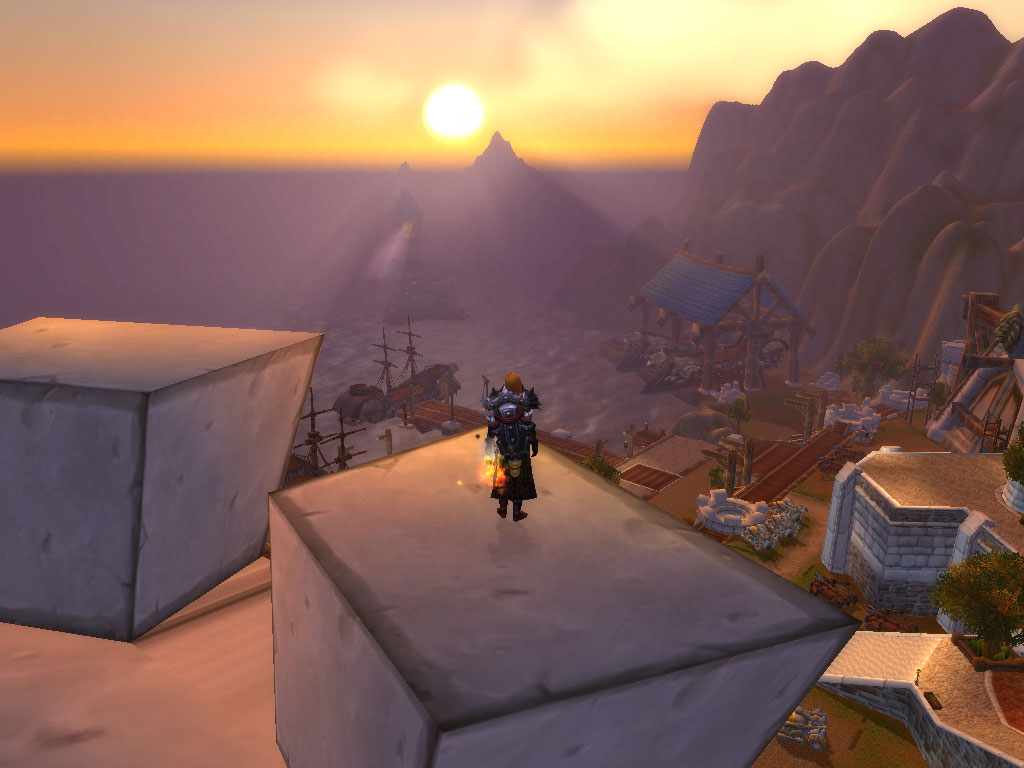
My paladin takes in the sunset in StormwindMaybe it wasn’t all Cataclysm’s fault. I reached level 80 very late in Wrath, and it took me a while to work through all the content. By comparison, I’ve been at 85 through most of Cataclysm, so the content’s had to tide me over for much longer. But I’ve also heard a lot of other people say that Cata left them with little to do, so there must be something to it.

The story:

I’d say Cataclysm’s story can best be described as inconsistent.

There are a lot of individually amazing zones in Cataclysm, and not just for high level characters: Vashj’ir, Hyjal, Southern Barrens, Gilneas, Silverpine Forest… As mentioned above, minor characters were fleshed out like never before, and there was plenty of emotion and drama to be had even without going into a dungeon or raid.

I enjoyed Thrall’s journey to becoming the World Shaman. I don’t at all understand these complaints about him being over-exposed. Aside from a few cameos, he only appears in one short and optional quest chain, one dungeon, and one raid. Yup, Thrall has certainly been rammed down our throats this expansion.

Certainly, it’s nice to have one of the greatest heroes in Warcraft lore actually doing something, instead of sitting in Orgrimmar picking his nose like he has for the last three games.

On a more nit-picky note, I did enjoy the way the Night Elves finally returned to their savage roots from Warcraft III. They’ve been pigeon-holed into tree-huggers for far too long.

On the other hand, the expansion’s story is extremely scattered. A lot of the zones, especially for high level characters, have little or no connection to each other in terms of story, and a lot of plot threads were left hanging, such as the Neptulon arc from Vashj’ir.

Deathwing was also very underwhelming as a villain. Aside from the final raid and one quest in the Twilight Highlands, he’s hardly present at all, and the player is given no real reason to hate him. His story is all telling and no showing.

After how memorable and in your face the Lich King was last expansion, this is a big letdown.

Cataclysm’s story has many, many amazing moments, but somehow, it does end up feeling like less than the sum of its parts. But at least it wasn’t the nightmarish, rambling lorestrocity that was Burning Crusade.

The verdict:

Cataclysm is a very inconsistent expansion in many ways, and it’s hard to judge it, but I think it did WoW more good than harm. 4.3 went a long way towards restoring my belief that Blizzard will always make things better in the long run.

Overall rating: 7.4/10 By comparison, Wrath probably would have been at least a nine, whereas classic and Burning Crusade would have earned sixes or lower.

New writing:

WhatMMO posted another of my articles: 6 Legendary MMORPG Bosses. What do you think of my picks? What are the most memorable bosses you’ve fought?