Book Reviews: Night Vale, It Devours and Black Company, Port of Shadows

I’ve got a pair of book reviews for you today. First up…

Welcome to Night Vale: It Devours

Cover art for the Welcome to Night Vale novel It Devours!I won’t lie: As much as I love Night Vale, I found this book pretty disappointing.

It Devours follows one of Carlos’ scientists, Nilanjana Sikdar, as she investigates strange occurrences that may be connected to the Joyous Congregation of the Smiling God. This investigation is complicated by a budding attraction between Nilanjana and Darryl Ramirez, one of of the Congregation’s most devout members.

Seems like it could be an interesting story, but… well, it really isn’t. The writers are clearly trying to make a point about the dangers of blind faith, which is admirable, but it’s extremely ham-fisted and unsubtle. It’s not so much a story with a message as it is a message with a story half-heartedly built around it.

It doesn’t help that the main characters are fairly weak. I don’t find Nilanjana or Darryl to be especially likable or interesting characters individually, and worse still their budding romance feels completely forced. The two characters have nothing in common and no chemistry whatsoever, and I was never really clear on why they even liked each other.

The book isn’t a complete waste. It is written with that trademark Night Vale wit and charm, and many of the background characters are memorable. I particularly enjoyed Nilanjana’s coworker who devoted her entire career to disapproving of potatoes.

Carlos also gets a fairly meaty supporting role, and we learn a lot about what makes him tick. I read in the YouTube comments recently there’s a section of the fanbase that has the head canon Carlos is on the autism spectrum, and having read It Devours, I can definitely see why.

Still, despite highlights like that, this is a book I’d have trouble recommending, even to serious fans of the podcast.

Overall rating: 5.9/10

The Black Company, Port of Shadows:

Cover art for The Black Company, book 1.5: Port of Shadows by Glen Cook.Man, who the hell expected a new Black Company book after all this time?

What makes it even weirder is that this isn’t a continuation of the story. It’s an interquel, dubbed “book 1.5”.

That kind of has “unnecessary money grab” written all over it, so I didn’t exactly expect much from Port of Shadows. But it ended up impressing me as much as It Devours disappointed.

Following the battle at Charm, the Black Company has been given a cushy garrison assignment at the city of Aloe. An investigation into a young woman with a mysterious connection to the Lady threatens to disrupt their peace, and the arrival of a new Taken throws Croaker’s life into disarray.

Of course, it is a bit of an awkward fit into existing continuity, though attempts are made to explain the inconsistency. It’s not perfect, but at the end of the day I believe continuity should serve the story rather than the other way around, so I can let it slide.

Reading this, I reflected on how strange it is that I enjoy the Black Company books as much as I do. In theory they’re everything I profess to hate in the fantasy genre. They’re ugly, bleak, cynical books in a low magic setting with no heroes worth rooting for.

I can only say what I’ve always said: I love the way they’re written. The prose is steeped in dry wit and gallows humour, and it makes what would otherwise be an appallingly unpleasant story into a delightful page-turner.

Though I must admit I do worry what it says about me that I just used the word “delightful” to describe a book that features the phrase “consensual necrophilia” as a major plot point.

Anyway, as with the series as a whole, I struggle to explain precisely what it is I enjoyed so much about Port of Shadows, beyond the clever prose. I suppose there is a good mystery here; wanting to uncover what’s really happening is definitely part of what makes it such a page-turner.

I’ll also say that it feels a bit like the later Black Company books in that it presents a softer side of the Company (I use the term loosely) and shows them as being… well, if not the good guys, then at least the lesser of two evils relative to the forces they’re opposing. It does make the whole thing a bit more palatable compared to those times when the Company is just the bad guys.

Going in, I was afraid Port of Shadows was an unnecessary addition to a completed series, and arguably it is, but I wound up enjoying it thoroughly despite that.

Overall rating: 8.5/10
Star Trek: Picard’s First Season Is a Rough but Worthwhile Journey

I’ve had very mixed feelings on Star Trek: Picard’s first season, which wrapped up last night (spoilers ahead).

The official logo for Star Trek: Picard.Certainly, there’s a lot to like about it. Aesthetically, it’s masterful. The special effects, cinematography, art design, and soundtrack are second to none. The acting is also excellent throughout, and most of the characters are excellent.

Patrick Stewart’s Picard is of course flawless as ever. That goes without saying. I also deeply enjoyed the guest appearances by Jeri Ryan as Seven of Nine. Jeri Ryan is a great actress, but Voyager’s writers never did her justice. Seven mostly just felt like a cheap Data knock-off with added fan service in the form of a ridiculous skin-tight catsuit.

Picard finally gives Seven of Nine the development she deserves (and reasonable clothes). She’s probably more fleshed out in a few episodes of this show than she was in all of Voyager, and it’s just a delight. I’m quite happy with the not-so-subtle implication that she will be promoted to main cast next season.

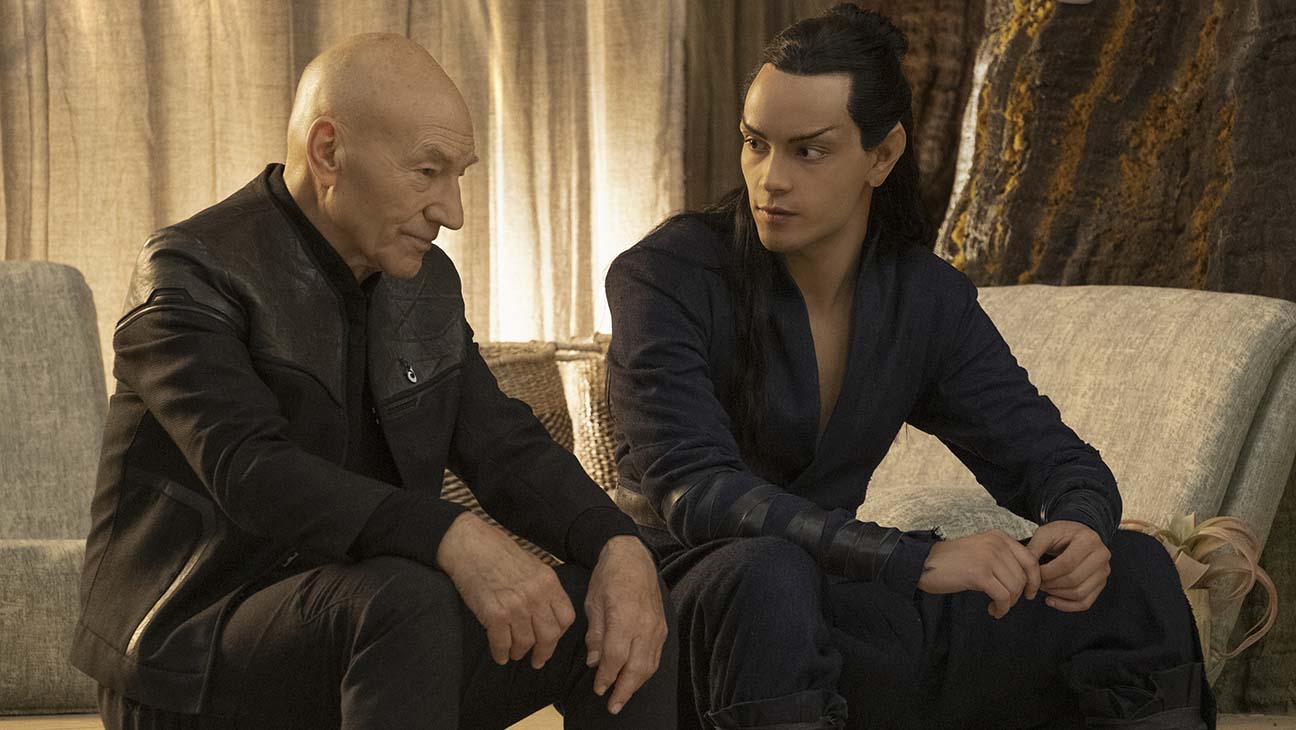
Many of the new characters impress, as well. My favourite by the end of the season was probably Romulan warrior-monk Elnor, who is as sensitive as he is deadly.

Can I just say how utterly I love the Qowat Milat? In my head canon, they are the “true” Romulans. I think their philosophy is the original Romulan culture that existed from the Time of the Awakening, when they were Vulcans marching Under the Raptor’s Wings. The Qowat Milat’s philosophy is the exact counterpoint to Surak’s teachings. Instead of repressing their emotions, they express them all, without reservation or hesitation. Instead of cold pragmatism, they live to fight for only the most hopeless of causes.

I love this because it makes the Romulans so much more than just the evil cousins of Vulcans. Clearly their culture was corrupted somewhere along the line, but the Qowat Milat shows it was built on something beautiful and unique.

Evan Evagora as Elnor on Star TreK: PicardAs a long-time Romulan fan, I’ve wanted to see them get this kind of development forever, and even if nothing else about Picard had been good, the whole thing may have been worth it just for this.

However, for all the positives this show has, I spent most of the season feeling more dissatisfied than anything. There’s much good, but also a lot of flaws.

I did say that a lot of the new cast is good, but not all of them. For me the biggest weak link was Raffi. She’s just a shambling mound of manufactured drama without any sincerity or believability.

What makes matters worse is she’s in the same show as Rios, who is basically the exact same character except better. They’re both Starfleet officers who had personal breakdowns following painful events.

But Rios suffered genuine, horrific trauma, and even after that he maintains obvious competence and nobility of spirit. Meanwhile Raffi abandoned her family, gave up on life, and became a junkie simply because she got fired. That might work as a story in a contemporary setting, but with the boundless opportunities and flawless social safety net of the Federation, it just doesn’t work.

That’s the trouble with writing in a utopian setting. You can’t just forget it’s a utopia when it becomes convenient to the plot.

I was also disappointed with the handling of Soji’s storyline. It pains me to say that because she’s a character with enormous potential. A representative of a new race of artificial life, the living legacy of Data himself. That’s a wonderful character concept.

Isa Briones as Soji Asha on Star Trek: PicardUnfortunately they never really use her for anything. She is, when you get down to it, the archetypical damsel in distress. She’s just there to be acted on by others and, ultimately, to be a goal for Picard to chase.

I hope this changes in future seasons, because honestly I love the actress and the character, and she deserves better.

But by far my biggest issue with season one of Picard was how bleak and grim it felt. In a world where cynicism rules the day and our media seems to be in a race to the bottom to see who can provide the most shocks and wallow most deeply in the worst aspects of humanity, a series about Jean-Luc Picard felt like the perfect opportunity to bring back the hope and inspiration that Star Trek has so long stood for. Discovery certainly hasn’t delivered on that front.

But for much of the series it seemed determined to continue wallowing in all that is awful. We saw a broken Picard and a broken Federation, and through it all there seemed little cause for anything resembling hope.

The series hit its nadir about halfway through the season with the episode “Stardust City Rag.” Despite a stellar performance from Jeri Ryan, this episode was so off-putting I almost gave up on Picard then and there.

Icheb’s brutal death was too much — it was just torture porn, pure and simple. I’m not opposed to Star Trek going to dark places — I think any effective drama should be prepared to do so — but there’s a difference between depicting bad things and sadistically reveling in the most gruesome, horrific events imaginable. Forget Star Trek; this scene wasn’t appropriate for any media save a slasher film.

Agnes in Star Trek: Picard.But what bothered me even more was the reveal that Dr. Jurati — up to that point the most lovable member of the cast — was a murderous traitor. With her innocent manner and boundless curiosity, Jurati had struck me as Picard’s representative of Star Trek’s spirit of optimism and exploration. Her turning out to be a villain felt like the writers communicating that Star Trek’s hopefulness was well and truly dead.

My interest in the series almost didn’t recover from that, but I clung on, with the slightest ghost of hope remaining. Picard is perhaps the most serialized TV series I’ve ever seen. It’s all one continuous story, making it almost impossible to judge each episode as an individual unit. Because of that, I held out hope that my faith would eventually be rewarded.

Against all odds, it was.

At the last moment — almost but not quite too late — Picard turns around and finally embraces the inspirational nature of what Star Trek should be at its best. The image of Jean-Luc Picard making a suicide run against hundreds of Romulan warbirds in a tiny passenger ship just to save a bunch of people who want to destroy him and everything he holds dear because he believes they are still worth saving is just about the most “Star Trek” thing ever, and it deserves to be remembered as one of the iconic moments of the entire long franchise.

Virtually everything about the season finale is damn near perfect. It doesn’t entirely erase all of my complaints, but it does counterbalance them enough to make the whole rough journey feel worth it.

I also have to say as much as I love a good cliff-hanger, I appreciate the courage of ending the season with a largely happy conclusion, with no new crisis to confront. It’s a daring choice in a world where the media is an arms race of ever bigger shocks and ever more endless drama.

Soji, Rios, and Picard on the bridge of La Sirena in Star Trek: PicardIn fact, the finale was so good it makes me wonder if we really need a second season. This is such a satisfying ending it could just as easily work as the conclusion to the series. Of course, presumably the Reapers are still out there (because Star Trek turned into Mass Effect somewhere along the line), so the potential for more is there, but I’m not sure the need is there.

All in all, it was a very imperfect season, but it does eventually pay off.