In the past, I’ve talked about the inspirations behind the more tangible aspects of the World Spectrum series. Today, I’d like to discuss what inspired the broader aspects of the books, the overall feel of the world and the stories.
 Battlestar Galactica:
These days, my feelings toward Ron Moore’s Battlestar Galactica reboot are decidedly mixed. My view is that it was three seasons of pure brilliance… and then the fourth season.
But when I started on the World Spectrum books, I was deep in the throws of BSG fandom, and I think it shows in my writing. Apocalyptic danger, killer robots, the fate of humanity on the line, a reckless female protagonist.
Now which am I describing there? BSG, or the World Spectrum?
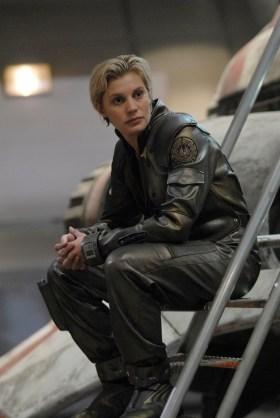
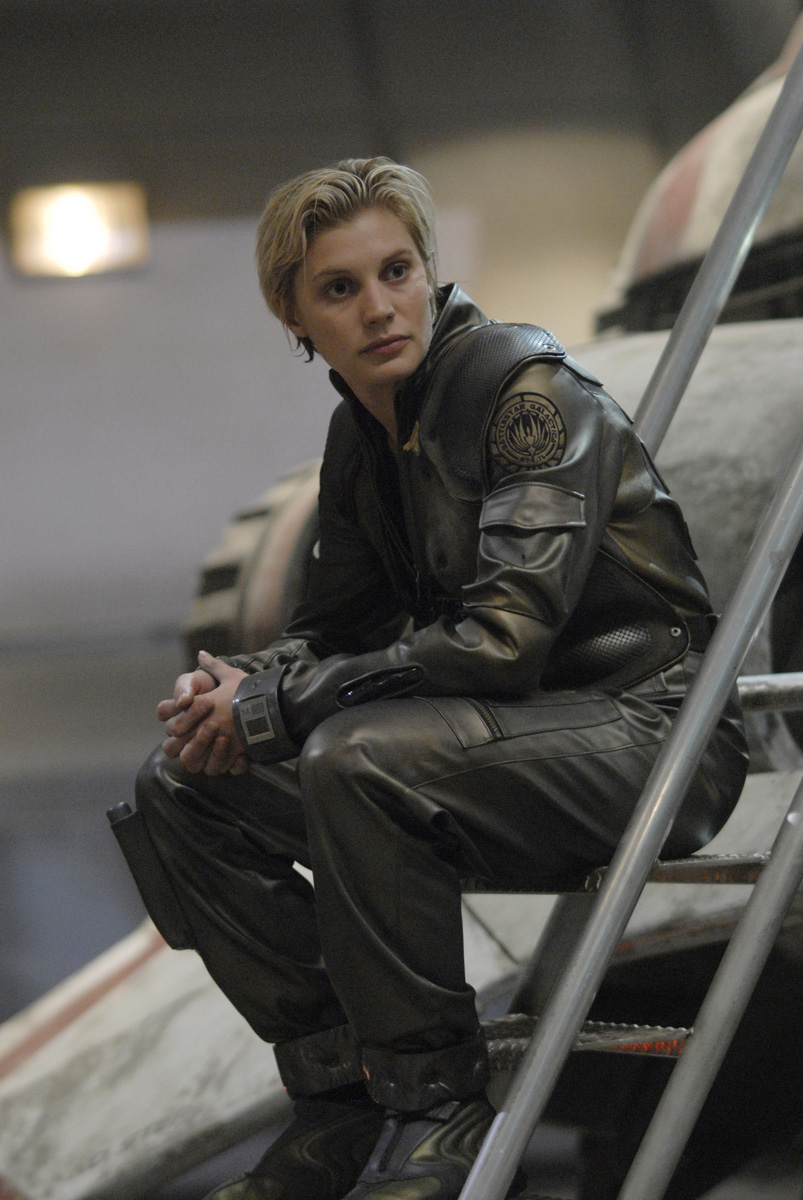
By the way, in the unlikely event these books ever get turned into movies, Katee Sackhoff is probably my first choice to play Leha.
I really loved the apocalyptic feeling of BSG. The idea that humanity is teetering on the brink, and every single life is precious. It allows you to ratchet up the tension so much more than you could in a story where worlds and nations are still thriving.
 But I think what I admired even more about BSG was the message that survival alone isn’t enough. One needs to be worthy of survival.
So that became one of the main dramatic questions of the World Spectrum series. Not just will humanity be saved, but is it worth saving? Can we create a world where we live in peace, or are we doomed to forever be our own worst enemies? This theme runs throughout the entire series, and if I’ve done my job right, there isn’t a clear answer. This is something I want readers to decide for themselves.
I’m not the biggest fan of clear moral messages in fiction. It has its purpose, but I think it’s more valuable to raise questions and leave it the consumer to decide what to make of them. It’s easy to agree with an inspiring message without really thinking about it — I believe this is why there are so many bigoted Star Trek fans despite its message of tolerance. I think, at least in theory, you can achieve more by making someone reexamine their beliefs than by simply telling them what to think.
The Three Worlds:
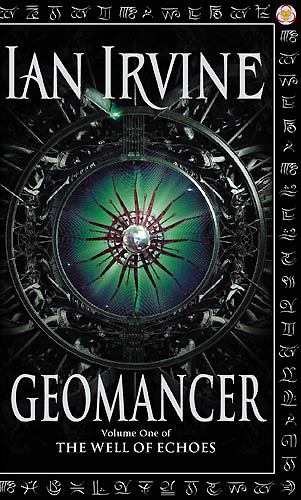
I’ve talked before about my great admiration for Ian Irvine’s Three Worlds Cycle. They’re an absolute masterpiece of epic fantasy.
I’ve already mentioned how the spectrum of worlds draws a lot of inspiration from the three worlds of Irvine’s work, but his books had other influences on my writing. In particular, the overall look and feel of the World Spectrum universe, as well as the way magic is treated, are very much inspired by the Three Worlds books.
 You see, before he was a professional writer, Ian Irvine was a scientist — a biologist, to be specific, though he also studied geology a fair bit — and this shows in his writing. He has what I can only describe as a scientific approach to fantasy. Instead of just falling into the “because magic” trap, he’s thought in great detail about the biology, technology, and culture of his worlds, and it makes his works feel so much more real than other fantasy books.
Magic, in particular, is treated more as a science than an art in the Three Worlds novels, often being assisted or facilitated through complex apparatuses.
His books aren’t exactly steampunk, but they do feature a lot of spectacular mystical technologies. In particular, I recall the multi-legged war machines called clankers, which served as inspiration for the Quadramatons and Sextamatons of the World Spectrum.
I’ve tried to replicate this feel of science fantasy in my books. Truth be told, I’ve always tended to think of fantasy worlds from the perspective of real world scientific logic. I was a bit of a science geek growing up, and I can remember pondering things like why Elves evolved pointed ears even at an early age.
Ian Irvine showed me how awesome scientific fantasy could truly be and inspired me to run with the idea.

 …When asked what your favourite book is, you list off the complete works of at least three different authors.
 …Money is a mythic creature you hope one day to discover.
 Superior Realities