
It’s been many long years of waiting, but I’ve finally gotten my hands on the fourth and final book of James Maxey’s wildly original Dragon Apocalypse series, Cinder.
 This is a series with a strange history. The first book, Greatshadow, is easily one of the best novels I’ve ever read, but while the following volumes still had many strengths, the truth is it’s pretty much been downhill from there. That sounds harsher than I mean it to, but the fact remains that while I’ve enjoyed each book, I’ve enjoyed each one less than the previous.
Part of this is due to the strange structure of the series. Halfway through, the Dragon Apocalypse changed its main character and its entire writing style. It was a jarring transition I still haven’t fully adjusted to.
It also seems there has been some real world turbulence for the series. I’m not clear on what exactly the story is, but Cinder seemed to take an awfully long time to make it to market, and it’s now under a different publisher than the previous books.
The change in publishers definitely wasn’t an upgrade, either, as the quality of the product has taken a hit. I have never seen a professional novel with anywhere near this many typos.
But whatever the journey, Cinder is finally here now.
It is a book of inconsistent quality. Once again, there’s been a shake-up of perspective. Now the novel’s perspective shifts regularly between the series’ large cast of characters, and while many of these characters are familiar, a lot of attention is spent on a new character, the book’s namesake, Cinder.
Cinder is the daughter of Stagger and Infidel. Conceived in the spirit realm, she has skin as black as midnight and the ability to shift between the physical and abstract realms at will.
Cinder is one of my main problems with the book, because I find her fairly dull in comparison to most of the other characters. This is the same problem I had with Sorrow in the last book, though ironically by now Sorrow has grown on me and I would have liked to have seen her get more attention this time.
It should also be noted that the long gap between Cinder and the previous book left my memory of the series to date rather atrophied, and that also probably hindered my enjoyment of the story. In retrospect I should have reread the rest of the series first, but my impatience got the better of me, and I spent the first few chapters mostly trying to remember who everyone was and what was going on.
However, my biggest problem with Cinder is that it feels very, very rushed. In this fourth and final installment, the Dragon Apocalypse has come at last, the primal dragons of ice and storm uniting to destroy the world of humanity and plunge the world into an eternal blizzard.
Cinder deals with spectacular, earth-shattering events. It has a massive cast of characters whose stories need closure. And it tries to deal with all this in less than 300 pages. There’s just not enough time to give everyone and everything its due.
If ever there was a series that should have been spread out to ten or so books, this was it. The Dragon Apocalypse boasts one of the most brilliantly colourful and wildly inventive settings in all of fantasy, with no shortage of bizarre and awe-inspiring places, creatures, characters, and concepts. Four short books simply isn’t enough to do justice to the world or its story.
Still, I don’t like dumping on this book so much. Partly this is because I have spent some time speaking with James Maxey in the past (briefly, several years ago, over email), and I found him to be very humble and gracious and an all around good guy.
And partly there is still a fair bit to appreciate in Cinder. As mentioned above, the setting of the Dragon Apocalypse still offers no shortage of wonders. I love the concept of the primal dragons, immortal beings whose souls have fused with the fundamental aspects of the natural world, and Cinder more so than any of its predecessors shows off the terrible grandeur of the primal dragons.
There are also still many great characters in the story, even if Cinder herself didn’t blow me away. It was great to see Infidel back in action, even if her role was relatively small, and I’d happily read an entire series devoted to the adventures of the Romer clan. Seriously, Gale is awesome; can we get a book that’s all about her?
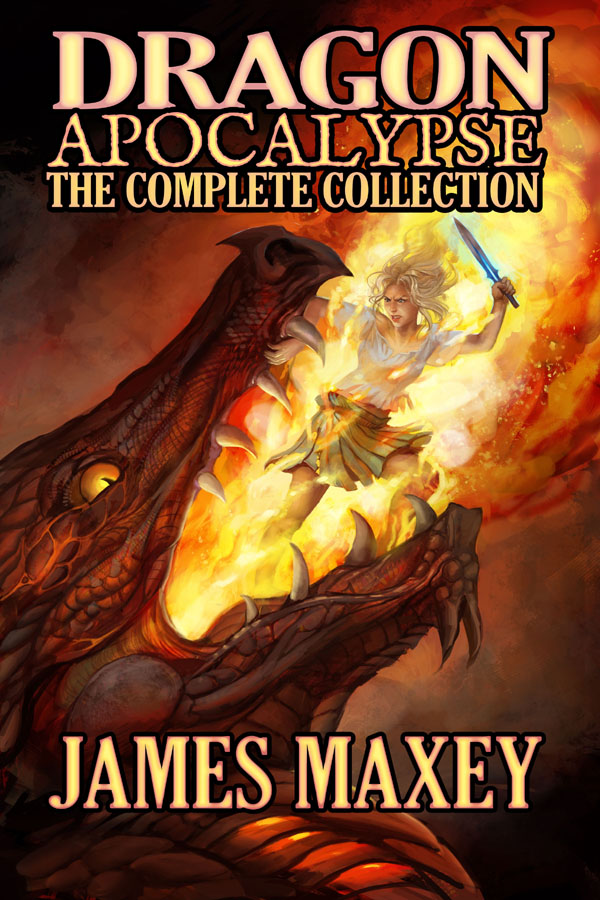 And I have to say that I did really like how it ended. Without spoiling anything, I think there’s a beautiful poetry to the final conclusion of Stagger and Infidel’s long, bizarre story.
In the end, it does remain true that every Dragon Apocalypse book is less enjoyable than the previous, but it started from such lofty heights that even after four books, the end result is not bad.
Overall rating: 7/10
I do want to say again that despite whatever flaws the series might have developed after, Greatshadow is one of the best books I’ve ever read and something that is absolutely worth your time. It’s a hilarious, heartfelt, and brilliantly strange story that I can guarantee is not like anything you’ve read before.


 Superior Realities