TSW’s Second Anniversary + Review: The Chaoswar Saga: A Crown Imperiled

As of today, The Secret World is two years old. Of course, that’s a great accomplishment for the game, but more importantly, it’s time for us all to drown in a sea of free loot.

Players defend Harbaburesti during the Guardians of Gaia event in The Secret WorldThe Guardians of Gaia event is back, bringing with it buffs to double or at least greatly increase the acquisition of ability points, black bullion, AEGIS XP, and… pretty much everything else in the game, really. There’s also an all new world boss in Tokyo, with new loot and new lore.

Also, there will not be a golem in Fusang Projects this year. That sound you hear is everyone in the Secret World breathing a sigh of relief.

I don’t really see anything topping last year’s Joelzilla Incident, but I fully expect awesome times ahead. TSW puts on fantastic world events, but none have quite topped Guardians of Gaia, in my view.

Today also marks the release of the first additional mission pack added to Tokyo (much sooner than I expected): Sidestories: Love and Loathing, which features five new missions from the various Tokyo NPCs. More Daimon Kiyota can only be a good thing.

Review: A Crown Imperiled

If you follow this blog regularly, you may have heard me say in the past that mediocrity is very hard to review. Without any brilliant moments to praise, or any monumental blunders to rant over, there isn’t much to say.

You may also remember my review of the first book of Raymond E. Feist’s Chaoswar Saga — itself a continuation of the enormous Riftwar Cycle, which tells the story of the embattled world of Midkemia — about two years ago.

I finally got around to reading the second book of this trilogy, A Crown Imperiled, and it is a very hard book to review.

It’s doubly hard because Feist’s writing has become so consistent and predictable that I feel anything I could say would just be repeating what I’ve already said many times before, even if I’ve technically only reviewed one of his other books on this blog.
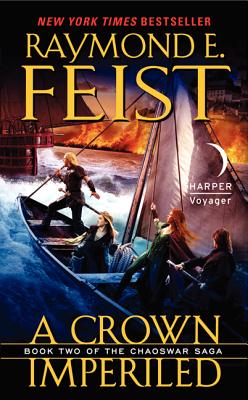
Cover art for "The Chaoswar Saga: A Crown Imperiled" by Raymond E. FeistIn short, A Crown Imperiled is a classic example of the rut that the Midkemian novels have fallen into. Feist has created a world full of rich and memorable characters, terrifying threats, and fantastical wonders.

And he all but ignores them in favour of the mundane, the generic, and the predictable.

Every new Midkemia series splits its attention between the longstanding characters who have carried this series from the start — like the godlike magician Pug and the Dragon Lord Tomas — and new characters introduced for that series.

Two things invariably hold true: The new characters are nowhere near as interesting as the old ones, but they get the lion’s share of the attention.

The majority of characters in the Midkemia books are the very definition of forgettable. As in I had literally forgotten everything about most of them right down to their very existence in the time between reading this book and the last one. The only reason I remembered Ty Hawkins was that he has the same nickname as me.

So that’s a major knock against this book out of the gate, and the plot suffers from similar issues. There are some very interesting things going on, but they are not the focus of the story. The side-dishes have crowded out the entrèe.

Martin and Brendan — whom I could not tell you anything about — are digging in to halt the Keshian invasion, a war that the book makes abundantly clear is just a distraction for some other nefarious plot. I swear half the scenes with these characters were just them discussing the logistics of preparing for a siege. Or that’s how it felt.

Meanwhile, their equally nondescript brother Hal ends up running through the wilderness with the fugitive princess of Roldem, which ultimately accomplishes nothing other than providing an excuse for a very generic romance arc.

A map of Midkemia's Triagia continent, setting of the Riftwar novelsThe most interesting part of this book involves the return from the dead (sort of) of Miranda and Nakor. I was never the biggest fan of Miranda, but Nakor is awesome enough to make all the other tedium of these books worthwhile, and the fact they’ve returned, and the method of their return, raises some intriguing questions.

There’s also a potentially interesting plot involving a Dark Elf chieftain, but it’s largely abandoned after a few chapters because reasons.

Unfortunately, the mind-blowing twist at the end of the last book is largely ignored.

In case it wasn’t clear by now, I wasn’t very impressed by A Crown Imperiled.

It may be that I am being harsher than the book deserves. Certainly, it’s still a well-written book in the technical sense, and it’s not without its thrills. But it’s hard to ignore how much potential is being completely wasted.

At least Nakor is back. That almost makes all the other stumbles worthwhile. That guy is amazing.

Overall rating: 6.5/10 While the last few books felt above average for the flagging Riftwar series, A Crown Imperiled is a return to form, and not at all in a good way.

Thoughts on Bioshock: Infinite

One of my purchases on this year’s Steam sale was Bioshock: Infinite, and as of yesterday, I’ve reached the utterly bizarre ending.

The flying city of Columbia in Bioshock: InfiniteI thought of doing a proper review, but it didn’t seem necessary. Pretty much everyone already has an opinion on this game, and most things I could say are just repetitions of what other reviewers have said. Suffice it to say that I would put Infinite in the same category as Mass Effect, Dragon Age, and Remember Me — a great experience, but not a particularly compelling game. If I’d done a review, I’d probably have given it a seven or an eight out of ten.

However, there are a few aspects of the game that have stuck with me and left me feeling very confused and conflicted, so I thought I would share my thoughts on them. I’m not sure if anyone else will find them particularly interesting, but thinking out loud might grant me some clarity, if nothing else.

There will be many a spoiler.

The American nightmare:

I feel as though I wasn’t really in the target audience for Bioshock: Infinite because I’m not American.

Columbia as a setting is very obviously targeted at an American audience, with the intention of making them uncomfortable. I’m somewhat surprised Infinite isn’t a more controversial title — or maybe the controversy is there and I just didn’t notice — because it is a ruthless evisceration of the American cultural legacy.

Colored and Irish washrooms in Bioshock: InfiniteColumbia is essentially a distillation of all the darkest aspects of American history and culture. It pulls no punches in displaying the utter brutality of slavery, racism, and unfettered capitalism.

And perhaps the most disturbing thing about Columbia is not its cruelty, but the way it has deified its cruelty. It has built a religion around hate and selfishness. This is a society where they raffle off the privilege of throwing the first pitch at a lynching.

Of course, I’m Canadian, so I have the privilege of viewing this all from a safe distance, comfortable in the blanket of smug superiority that we Canadians are so good at not showing.

But for an American, I imagine this could be a pretty hard game to stomach.

Dat ending:

So… the ending.

That was weird wild stuff.

I’m really not sure what I thought of the ending. I guess I liked it? Maybe? A little? Or not?

Dafuq did I just play?I don’t know.

The thing is I never liked unhappy endings. I’ve often been criticized for this, but I tend to think a story has failed if it doesn’t offer at least some positivity at its conclusion. I’m not a fan of fatalism.

Bioshock: Infinite’s ending is pretty fatalistic. I never developed any fondness for Booker, and obviously his alternate incarnation as Comstock was just a horrible psycho, so I do not mourn them, but Elizabeth deserved a happy ending. Having every version of herself commit suicide by transdimensional patricide is kind of a bitter pill to swallow.

On the other hand, she prevented Columbia and all of its associated horrors from ever being created, so at least she died for something. We could count that as a win.

I guess.

On the plus side, it managed to be an incredibly complicated and arcane alternate universes/timelines story that actually made sense and wrapped up all its loose ends. That’s no mean feat.

And if nothing else it deserves major points for being different, and for being able to affect me so strongly.

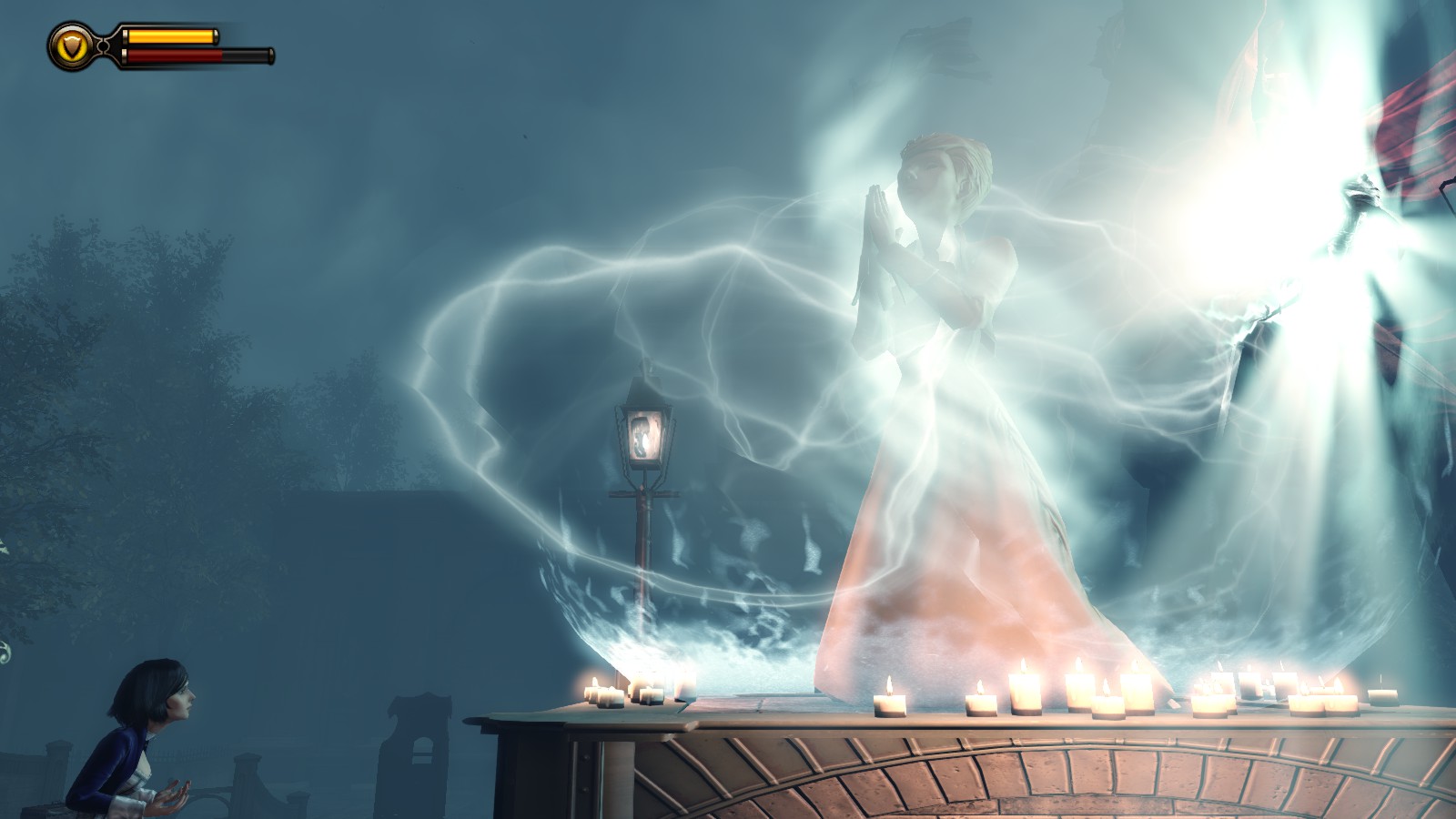
Elizabeth confronts the spectre of her "mother" in Bioshock: InfiniteThis is going down as one of the greatest video game mindfracks I’ve ever experienced, beaten only by the Red Sargassum Dream and perhaps Walk Into Empty in The Secret World.

Things like this make me so happy for the growth of video games as an artistic medium. That things like this are even technically possible now is amazing.

The Elizabethan Era:

And that brings me to the final aspect of Infinite that lingers in my mind after its conclusion: Elizabeth.

I think it’s safe to say that anyone who’s played this game would agree that Elizabeth is by the far most memorable part of the game. She essentially is Infinite, the heart and soul of the story.

From a purely technical perspective, Elizabeth is a triumph. She is likely the greatest AI companion in video game history, with all apologies to Alyx Vance. She is never a burden or a hassle, and she fits into the gameplay seamlessly. You only notice her when she’s helping. She makes you wonder why every other game has gotten escort quests so wrong.

But what is perhaps even more impressive is how human she seems. She is perhaps the very first video game character I’ve ever seen who actually has real, believable facial expressions, without falling into some “animated corpse” uncanny valley.

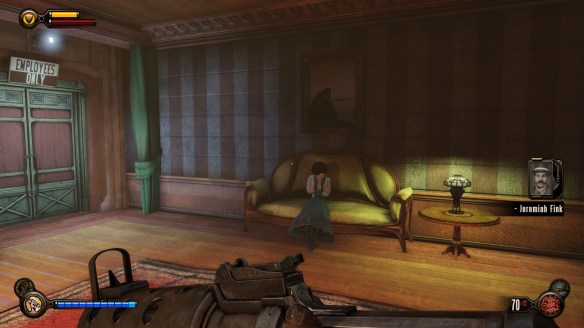
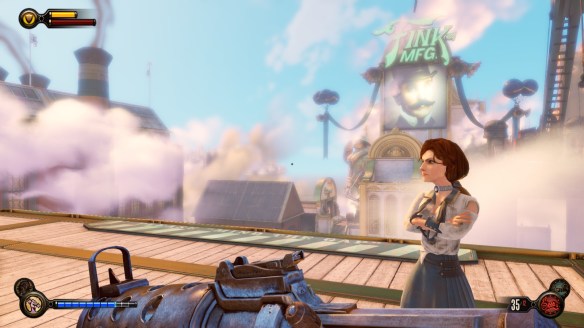
Elizabeth resting on a couch in Bioshock: InfiniteAs an aside, I’m surprised I haven’t seen more “Elizabeth is not impressed” memes.
Then there are so many little touches that make her seem real, like the way she will have a seat on any available chairs if the player stops moving for any length of time. She is a fantastic example of showing and not telling, as her actions and animations display so much of her personality. Her childlike curiosity about every little thing is on full display as she constantly leans over tables to read the notes on them or inspects everyday objects. The game never has to directly highlight this part of her; it’s just always there.

Very well done.

But then we come to Elizabeth as a character, and that’s something that I’m a bit more torn on.

The problem is that Elizabeth is as stereotypical an example of the portrayal of women in video games as could possibly exist. She is a damsel in distress, through and through. She’s completely helpless on her own, and is totally reliant on the player’s direction and support.

In her case, it doesn’t even make logical sense for her to be so helpless. She has godlike powers — all of time and space is quite literally at her fingertips. Admittedly, her powers are slightly unreliable, but even so, it strains credibility to the breaking point that she couldn’t have escaped Columbia years ago. She certainly shouldn’t be as reliant on Booker’s help as she is.

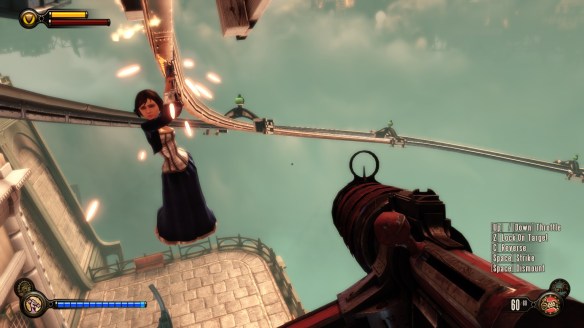
Riding the skylines with Elizabeth in Bioshock: InfiniteSo here we have a woman who possesses unimaginable power, but is completely unable to accomplish anything or act on her own initiative unless her daddy is there to hold her hand.
Sheesh.

Again, why isn’t this a more controversial title? Or is there actually a lot of criticism and I just don’t know about it because I haven’t paid much attention to Bioshock prior to now?

Here’s where I start to feel conflicted, because despite the fact that Elizabeth couldn’t possibly be a more sexist stereotype, I really like her.

I mean, she was designed to be likable. Absolutely every aspect of her, from her over-sized blue eyes to the way she provides you with unlimited health and ammo in combat, was designed to endear the player to her.

But damn it, it works. I wasn’t terribly enamored with Infinite’s gameplay, but I was always eager to keep playing, keep pressing forward, just so I could ensure Elizabeth would achieve her dreams of life in Paris. And I’m quite saddened that she never will.

Elizabeth giving Booker the cold shoulder in Bioshock: InfiniteEven putting aside cheap tricks like her big eyes, Elizabeth is just an utterly likable person. She’s kind, gentle, and full of love for even the simplest aspects of life.

Come to think of it, she rather reminds me of the Reborn. Readers of my World Spectrum novels will know what I’m talking about.

Is it wrong of me to like Elizabeth so much even as she embodies all the negative ways women are stereotyped in video games? Am I betraying my own beliefs? Does this make me a hypocrite?

I’m so conflicted.

* * *

If nothing else, Bioshock: Infinite is a game I won’t soon forget, and I now feel much more motivated to get the original Bioshock to work on my computer.