
If you’re a fan of the story in Warcraft — or any franchise, really — you no doubt have some conspiracy theories surrounding past events or future plot twists. Of course, I’m no exception.
Just for fun, I thought I’d post some of my more tinfoil-laden theories about WoW’s story. These range from vaguely plausible to fairly ridiculous.
Mogu = proto-Orcs:
 This has been in my mind since the first piece of Mogu concept art I saw. It shows a large, mean, green fellow with tusks.
Sound familiar?
Even considering most of them aren’t green — and that Orcs were not originally green — the physical resemblance between Orcs and Mogu is fairly eerie.
But Mogu and Orcs are from different worlds. How could they be related? I think the answer is they’re not… not exactly.
We know the Mogu were originally Titan creations. They fought the Old Gods and helped to shape the world. They became corrupted after being afflicted by the Curse of Flesh. This is a very similar story to how the Dwarves, the Gnomes, the Tol’vir, and the Vrykul came to be.
It’s never been explicitly stated that the Titans visited Draenor, but it seems likely. I’m of the impression any world that is not nightmarish chaos has been ordered by the Titans. We do know that there were Old Gods on Draenor, and where there are Old Gods, there’s usually Titan involvement.
My theory is that the Mogu, or something very much like them, existed on ancient Draenor independent of the Azerothian Mogu. They were afflicted by the Curse of Flesh more severely than on Azeroth and eventually evolved (devolved?) into Orcs, similar to how the Curse caused humanity to evolve from the Vrykul.
Deathwing’s fall was according to plan:
 I think we can all agree that the end of Cataclysm felt a little too neat and easy. But I think this was entirely deliberate on Blizzard’s part. I think the events of Cataclysm, including Deathwing’s defeat, were all part of a larger plan by the Old Gods that has yet to reach fruition.
Think about what Deathwing’s goal was. He sought to destroy the Dragon Aspects, including himself, so that the Old Gods could reclaim Azeroth without the opposition of the Titans’ greatest remaining servants.
And that’s exactly what Deathwing achieved. The Aspects spent their power to destroy him, and Azeroth’s defense now falls to mortals — mortals who are so very easy to corrupt.
The Old Gods lost one of their more powerful tools, but they defeated their greatest enemies in the process, and Deathwing was always unreliable as a pawn. He was so mad that he had turned against his masters in the past.
All in all, the events of Cataclysm seem to have played out pretty well for the Old Gods. The Aspects are gone, us mortals have been lulled into a false sense of security by our seeming victory, and the Old Gods are free to plot their next move. They have no problem playing the long game.
Old Gods are madness elementals:
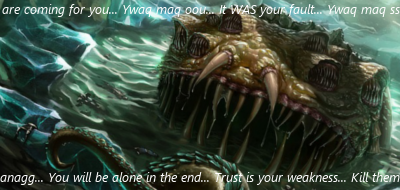 A lot of tinfoil hat theories involve the Old Gods. They lend themselves well to it, since we still know so little about them.
This one relates to their true nature, and it’s inspired by their connection to the elementals. The elementals are some of the original servants of the Old Gods, and this led me to believe that the Old Gods are themselves elementals of a sort: madness elementals.
Now, “madness elementals” is a pretty dumb term, but it’s the best phrase I can come up with to describe what I mean.
Think of it this way. Ragnaros is the sentient incarnation of fire. He is a fully self aware being. He has thoughts, plans, strategies, and something approaching a personality. But at a fundamental level, he’s still fire. His main desire in life is to consume fuel and burn brighter.
In the same way, I view the Old Gods as sentient incarnations of insanity. They’re self aware, they think, they strategize. But at their core, they’re really just insanity made manifest. Nothing about them makes sense, and that’s how they like it.
 This is why the Old Gods’ minions constantly fight each other. This is why their plans often blow up in their faces, why their servants are so unreliable, and why they’re generally so chaotic as to make the Burning Legion seem sane and calm by comparison.
And this is why, despite all that, the Old Gods are still making progress in reclaiming their world. It doesn’t matter that all their plans spiral into chaotic clusterfracks. Chaos, irrationality, and madness all feed the Old Gods, even if it seems to set them back in the short term. The Old Gods are insanity incarnate, and the less the world makes sense, the more powerful they are.
Sylvanas mind-controlled Thrall:
This one is the most far-fetched, but I’ll include it anyway.
Basically, this theory was my way of explaining how out of character Thrall was through much of WoW’s lifespan. If Sylvanas was mind-controlling him, it explains why he would let the Forsaken into the Horde, why he wouldn’t kick them out even after they went rogue at Angrathar, and why he tolerated rogue elements within the Horde like the Defilers and the Warsong Clan.
We know that Sylvanas has incredible powers of mind control, though it’s been largely forgotten in recent times. This was a large part of how she established the Forsaken empire — by dominating the local humans, Gnolls, Trolls, Ogres, and Murlocs.
 To be clear, I don’t think Thrall was ever her puppet. His mind is too strong for that. I think she just manipulated him subtly. I think she nudged him where she wanted him to go, tipping the scales when he was making difficult decisions.
Her reasons for making him bring the Forsaken into the Horde should be obvious, but why the other stuff?
Because the Forsaken need war. The whole reason the Horde tolerates them is because the Forsaken provide a crucial foothold in the Eastern Kingdoms. If things cooled down between the Horde and the Alliance, the Forsaken would no longer be needed.
So she made Thrall betray his desire for peace. She made him send outriders into Warsong Gulch. She made him tolerate the atrocities committed by her people in the Eastern Kingdoms.
Or so my theory went. Sylvanas’s issues with Garrosh largely disprove it. If she had that much power, she’d either have manipulated Garrosh the same way or prevented Thrall from picking Garrosh in the first place.
 New article:
My latest list at WhatMMO is 6 Most Iconic MMO Characters. Just remember that, in the final hour, all must serve the one true king…



 Superior Realities