Review: SC2: Heart of the Swarm: Multiplayer

In part two of my review of Starcraft II: Heart of the Swarm, I’ll be covering the changes to multiplayer.

Oracles in the new Heart of the Swarm expansion for Starcraft 2I should preface this all by saying that I am very bad at Starcraft II multiplayer, so I’m not going to be commenting on the state of balance or anything like that. This is just my opinions on what’s fun as a player and a spectator.

New multiplayer units:

Obviously, the most interesting change to multiplayer is the new units added to all races.

Initially, I was rather critical of the new units, but I feel a bit better about them now. I still think the tempest is pretty boring, though I will admit it has its uses, and I do agree that Terrans kind of got the short end of the stick. Widow mines are cool, but hellbats are just a really weird and confusing firebat rehash.

I still think the new Zerg units are cool, though — vipers are absolutely hilarious to watch in action. And I am grateful that they didn’t end up scrapping units from any race.

As a Protoss player, that race is always what I most care about, and I’m mostly happy with what we got — tempest aside.

The new mothership core unit in Starcraft 2: Heart of the SwarmProbably the most interesting addition is the mothership core. It’s made of tissue paper, so you have to be careful with how you use it, but its mass recall ability opens up a lot of possibilities for early aggression, and it’s helpful for base defense, as well.

A slight downside is that the mothership core is actually a lot better than a full mothership, meaning the upgrade is only going to be useful for identifying noobs or trolling your opponents.

Oracles are also quite a welcome addition. After countless revisions, they ended up being a very scary harassment unit capable of annihilating entire mineral lines in moments. Protoss have never really had any good options for harassment before now, so this is a big deal.

Unfortunately, I’ve learned I’m very, very bad at harassment. This bothers me because it’s a strategy I really enjoy, but it seems to lose me the game every time.

At least I can enjoy it as a spectator.

Taking the sting out of failure:

The new oracles and tempests in Starcraft 2: Heart of the SwarmThe other major changes to multiplayer seem designed to take some of intimidation factor out of competitive play. I’ve already covered the new training tools, but that was just the beginning.

The multiplayer rewards in Wings of Liberties basically only came one way: win ladder matches. Hundreds upon hundreds of ladder matches.

HotS changes this by introducing an RPG-style leveling system. Things like spending resources and killing enemy units awards you experience for your current race, and the higher level you are, the more decals, portraits, and unit skins you unlock.

The interesting thing is that you still earn XP even if you lose your match — though you obviously get more from winning. This seems like a pointless palliative at first, but it really does make defeat feel a bit less painful and make the ups and downs of competitive play easier to bear.

You can also get experience from more than laddering. Unranked play and even matches against the AI still earn XP, so players of all stripes can get their sexy new unit skins.
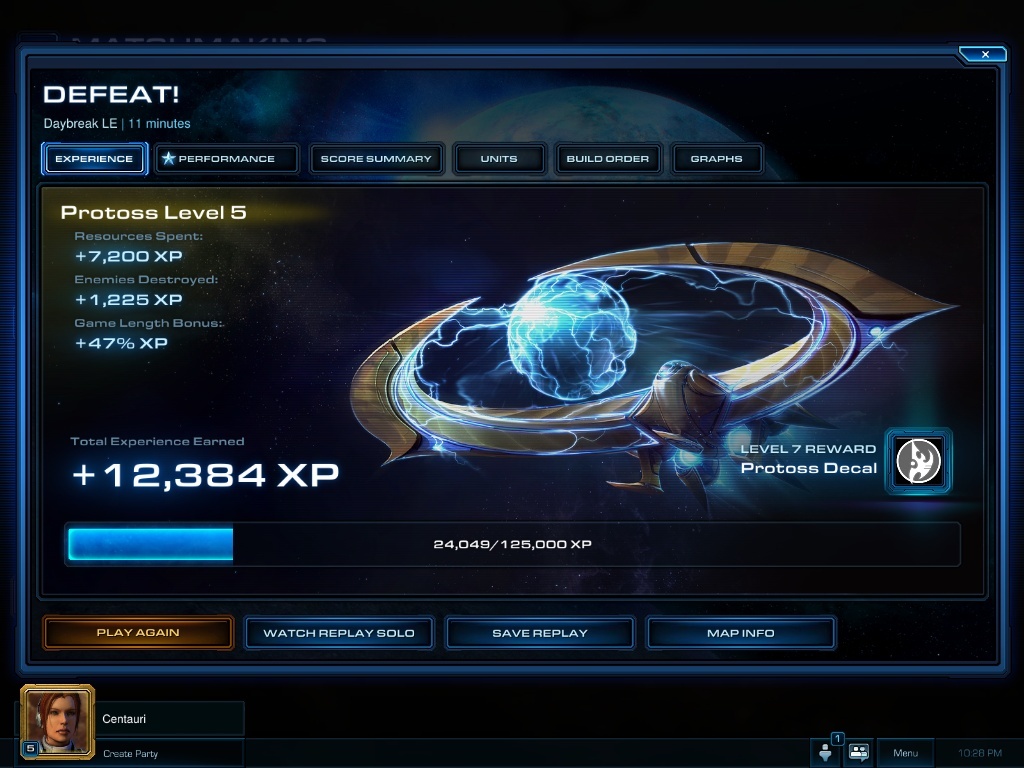
The new leveling system in Starcraft 2: Heart of the SwarmSpeaking of unranked play, it’s probably my favourite new multiplayer feature. There’s nothing Blizzard can do to eliminate ladder anxiety entirely, but unranked play helps a lot. It allows players to get all the benefits of ladder — like MMR-based matchmaking — without the risk of losing your ladder standing.

My ladder rank may be nothing impressive, but I’d still rather not sink any lower. Gold league I can live with. It’s refreshing to not have to worry about suffering the indignity of a demotion to silver after a losing streak.

Still not perfect:

With all that being said, HotS does nothing to address many of my long-standing complaints about competitive play in Starcraft II.

My biggest complaint is that the game is so utterly skewed towards economy as the most important factor that, for most players, you can pretty much ignore combat entirely if your macro is good enough. You can just a-move your units into the enemy base and go back to macroing.

I don’t think that’s a good design for a game that’s supposed to be about epic, fast-paced combat.

The beginning of a Starcraft 2 ladder matchIt’s also a fact that nothing at all happens during the first three or four minutes of the vast majority of games. If something does happen, it’s usually someone doing an all-in cheese strategy, and nobody wants to see that.

One of the reasons I like to watch replays from Husky is that you need a complete goofball like him to make the opening minutes bearable.

I don’t see how this could be changed without completely redesigning Starcraft II. All I can say is I miss hero harassment and creeping from Warcraft III.

I would love a mode that lets players begin with pre-established bases, but again, it’s too big a change to ever become the norm at this point.

* * *

Overall rating: 7.5/10 An evolutionary improvement, not a revolutionary improvement.

Review: Starcraft II: Heart of the Swarm Campaign

This being a Blizzard game, I have a lot to say about Heart of the Swarm. To prevent killing my readers with a massive wall of text, I’m splitting my review over two posts. Today, we cover the campaign. Spoilers will be marked, so you can skip them if you haven’t finished the game yet.

Best. Level design. Ever:

Raptor strain zerglings in Starcraft II: Heart of the SwarmThe great strength of Wings of Liberty was its inventive level design. Previous strategy games were primarily an endless spree of “destroy the enemy’s base” missions, but WoL provided some kind of unique mechanic or complication for nearly every mission.

Heart of the Swam has taken this same idea and enhanced it even further. It would not be an exaggeration to say that HotS has the best and most original level design of any RTS game in history.

It should be noted that Zerg is by far my least favourite race to play in Starcraft II, but even so, I found nearly every mission in HotS to be stupidly, ridiculously fun.

What was most clever about the missions was the way they very much hammered home the feeling of the Zerg. The idea of feeding on your enemies to grow, evolve, and overwhelm more enemies is very present in most missions.

A particular standout that will no doubt be cited in many reviews is a mission designed to emulate the movie Alien. You start out with but a single Zerg larva aboard an enemy ship, and you must crawl through air ducts and shadows to consume lifeforms, gain biomass, and eventually spawn more Zerg.

The Zerg Swarm in Starcraft II: Heart of the SwarmIt illustrates the deadly ingenuity of the Zerg as a species: it only takes a single larva to fully corrupt and consume an entire ship full of enemies.

I think the most interesting missions, though, were the ones where the player controls only a single hero unit — usually Kerrigan.

RTS games have had the “hero and a small group of units in a dungeon” missions forever, but HotS has taken the concept to a whole other level. Aside from still using RTS controls, these missions are indistinguishable from a high quality action RPG, with boss fights to rival the greatest World of Warcraft raid encounters.

My personal favourite was the mission where you command the Hyperion. I would gladly pay for an entire game where you play as the Hyperion. I didn’t stop smiling once during that whole mission.

This brings me to my next point:

Kerrigan is my hero — literally:

Selecting Kerrigan's abilities in Starcraft II: Heart of the SwarmAs someone who loved Warcraft III and its hero units, seeing them disappear in Wings of Liberty was a bit disappointing. But HotS is the true successor to Warcraft III in the unique genre of role-playing strategy game.

HotS is the perfect hybrid of RTS and RPG. It has all the best aspects of both genres and few, if any, of their weaknesses. The heroic power and personal progression of an RPG meld perfectly with the epic scale and deep gameplay of an RTS.

The really great thing about the power of Kerrigan as a hero unit is the way it feeds back on the level design. It allows HotS to throw challenges at the player that would otherwise be utterly insurmountable, but because Kerrigan is so powerful, the impossible becomes possible, and it feels great to be able to pull off such feats.

I’m sure it will likely be a futile hope, but I would be overjoyed if the hero mechanic continued into Legacy of the Void.

All that being said, the campaign did still have flaws.

Slow down!

The Zerg infest a planet in Starcraft II: Heart of the SwarmThe downside to the inventive level design of WoL and HotS is that they both featured too many missions with a time limit of some sort. At first, this is a refreshing idea that makes the game feel much more intense.

But both games have relied too heavily on it. When nearly every mission is a panicked rush to the finish, it ceases to be exciting, and you lose the chance to stop and appreciate the subtleties of the game.

It gets particularly bad when several of these missions come in rapid succession, as the constant stress of trying to beat the clock builds up after a while. It becomes more an endurance test than an enjoyable gaming experience.

On the plus side, the final mission was an old school, hour-long war of attrition, and I’m very grateful for that.

The rushed pace of the missions ties into my other main complaint with the campaign, and that is that it’s very short. Technically, it has nearly the same number of missions as WoL, but many of those are evolution missions — mini-scenarios where you choose to evolve a unit one of two ways.

The Primal Zerg Dehaka in Starcraft II: Heart of the SwarmEvolution missions are a really neat idea, and I enjoyed them a lot, but they should not have been used as a substitute for real missions.

It took me about two weeks to finish WoL, but I finished HotS in less than a week, and that’s while playing at an unusually slow pace. Considering how long we had to wait for this game, that’s just not acceptable, in my eyes.

The story:

WARNING: Here be spoilers. If you wish to avoid them, skip ahead to the next part of the review.

The story in HotS is told better than WoL’s was, but overall, I think WoL had a better story to tell.

The story arcs in HotS are now unified so you can’t bounce between them schizophrenically. This is a massive improvement and makes the story feel much more focused and coherent.

Sarah Kerrigan and James Raynor in Starcraft II: Heart of the SwarmUnfortunately, the story itself was a bit disappointing.

Whereas WoL’s plot started dull but quickly grew to excellence, HotS starts off well but then loses its way.

The early missions are nothing short of brilliant, containing some of the most emotional and gripping moments in any Blizzard game to date.

But they started to lose me when Kerrigan re-infested herself. Considering we spent a whole game trying to make her human again, I did not enjoy seeing her throw that all away almost overnight.

Yes, we did free her from the evil of the Queen of Blades and the corruption of Amon, so it wasn’t really a waste that we de-Zerged her, but on a very visceral level, it feels unsatisfying to see all the work to bring her and Raynor together again come to naught.

I know most people want Starcraft games to be nothing but gloom and death, but after all they’ve been through, I just want to see Sarah and Jim ride off into the sunset together.

Sarah Kerrigan and the Primal Zerg Zurvan in Starcraft II: Heart of the SwarmI also felt Mengsk’s death was entirely too clean and simple. There needed to be some sort of twist or something. Perhaps the “ha ha, joke’s on you; Amon’s already returned” would have worked better coming from Mengsk than Narud.

This would also cover another complaint, and that is that the Amon and Mengsk plots felt too separate from one another. Bouncing between them felt a little odd.

On the plus side, I really loved how they fleshed out the history and identity of the Zerg. There were a lot of ways they could have screwed this up, but they hit a nice balance between showing how Amon had corrupted them without making them out to be kind, cuddly killer space bugs.

The original Zerg weren’t universe-consuming hellbeasts, but they weren’t particularly nice, either. They were Darwinism incarnate — apex predators with no code beyond survival of the fittest.

That’s pretty cool, if you ask me.

On the whole, the story is good from a “big picture” standpoint, but very weak on character and emotion. This is especially disconcerting because the first few missions lead one to believe this will be a very emotional and character-driven game.

A Zerg army in the Starcraft II: Heart of the Swarm campaignFinal thoughts:

Heart of the Swarm deserves serious praise for accomplishing something I didn’t think was possible: it made me enjoy playing Zerg.

From a strict gameplay perspective, HotS clearly draws on everything Blizzard has learned from their long history of producing the best strategy games around, and the result is an exceptionally fun game.

Unfortunately, the problems with the story make the game feel a little soulless, and it’s over so quickly that part of me wonders if it was really worth the wait, despite how much I enjoyed it.

Overall rating: 7.9/10 A mostly excellent game slightly marred by an inconsistent story and very rushed pacing.