
As someone with a craving for quality high fantasy television, I’ve long had an interest in Once Upon a Time, but for one reason or another, I didn’t find the time to give it a shot when it premiered. I did see a few episodes here or there in my final months in Toronto, but they were all out of order.
 What I saw left with me with some mixed feelings. At times, the show seemed very clever and offered a great portrayal of old school fantasy, but at other times it was so smarmy it made me want to puke. I didn’t much care for Emma, the main character, but I loved many of the peripheral characters.
Overall, the good seemed to outweigh the bad, and now that I’ve finally signed up for Netflix, I’m going to start watching the series properly and in order.
As with previous binge watches, my individual episode reviews may be a bit more truncated and spoilery than usual.
Pilot episode:
Once Upon a Time wastes very little in establishing the format and overall arc of the series. Like the other episodes I’ve seen, the pilot jumps between scenes in our world and flashbacks to a fantasy kingdom to tell a cohesive story.
Our hero is Emma Swan, a bail “bondsperson” who is contacted out of the blue by the son she gave up for adoption, Henry. She is forced to take him back home to a small town called Storybrook, and along the way, he regales her with outlandish stories about how Emma and everyone in Storybrook are actually exiles from a fairytale land, and how it’s Emma’s destiny to save them all.
 Except they’re not just stories.
As this is happening, the pilot also illustrates the final days of the fantasy kingdom as an evil queen unleashes a terrible curse to end all happy endings. The imprisoned black magician Rumpelstiltskin* foresees the only hope will come from the daughter of Snow White and Prince Charming , and they call upon their allies to save the newborn Emma at all costs.
*(Played by Robert Carlyle, who is awesome.)
The rest of the episode deals with Emma attempting to wash her hands of Henry, and largely failing. As this happens, the seeds of a rivalry between her and Regina, Storybrook’s mayor and the evil queen in truth, are sewn.
The pacing is good, and there’s an emotional punch without it being too overwrought. A lot of the actors already seem very comfortable in their roles, and the characterizations come through strongly — though it probably helps that I already have some familiarity with the characters.
Something I really enjoy about Once Upon a Time is all the clever little ways events and characters in our world mirror the fantasy world, and that’s already on full display. Regina offering Emma some apple cider, for instance.
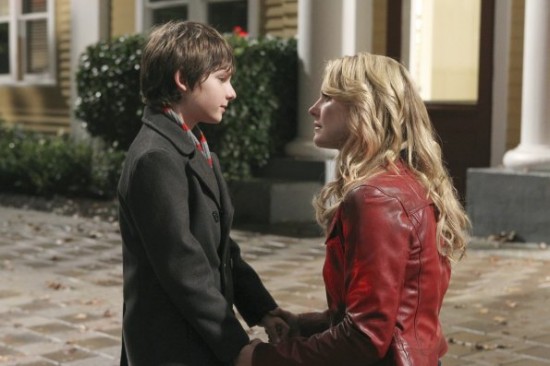 If I have a complaint, it’s the pilot ended too soon and left me wanting more… but that’s not really a complaint.
Overall rating: 8/10 A strong start.
“The Thing You Love Most”:
As with most shows, the second episode of Once Upon a Time is a little on the slow side.
In Storybrook, Regina does everything in her power to drive Emma away. If I was coming in fresh, I’d find this all very unreasonable and a bit strange, but based on later episodes I’m seen, I’m of the impression Regina still knows who she is and thus likely knows what Emma represents.
On the fantasy end of things, we learn the backstory of Regina’s use of the curse, and the terrible cost she had to pay for it.
I don’t really have any major complaints about this episode. It’s just not terribly memorable. Also, again, I don’t much care for Emma. The actress just doesn’t feel authentic. She’s trying too hard to seem tough.
 The one interesting thing to come out of this — that was news to me — is that Regina’s father’s name was Henry. Hmm…
Overall rating: 6.9/10
“Snow Falling”:
As the name might imply, this episode focuses heavily on Snow White. Specifically, the start of her relationship with Prince Charming — which turns out to be a mocking nickname she gave him.
On the fantasy side of things, Snow is a brigand living in the woods for fear of being caught by the evil queen. She robs Charming as he passes by, and he hunts her down and blackmails her into helping him retrieve what she stole.
It starts out as one of those “trying so hard not to be cliche it feels terribly cliche” things, but the plot evolves well, and it has a lot of action and excitement. It’s perhaps a bit hokey, but hokey in a way that’s more endearing than irritating — which based on my experience to date is probably an apt description of Once Upon a Time as a whole.
Meanwhile, in Storybrook, a field trip to the hospital leads to Henry learning that Prince Charming is in that reality a comatose John Doe. He gets it in his head that if Mary Margaret — Snow White in truth — were to read their story to him, he might wake up, and an in an attempt to not hurt Henry’s feelings, she and Emma choose to indulge him.
 But as is often the case, Henry’s ideas aren’t so crazy after all.
The most interesting thing about the Storybrook side of “Snow Falling” is once again all the subtle ways it mirrors the events of the fantasy world, like David/Charming being drawn to the toll bridge and Mary Margaret waking him with mouth-to-mouth resuscitation.
Also, the normal world versions of the Seven Dwarfs really crack me up.
On the whole, I do find Snow White a much more compelling protagonist than Emma. She’s got the perfect balance of spunk, toughness, and humanity, along with a healthy dose of charisma, and the actress seems to be having almost too much fun with the role.
Overall rating: 7.6/10 Less Emma makes for a better episode.
“The Price of Gold”:
We continue to run down the list of classic fairytales. Today, Cinderella’s up to bat.
But there’s a twist. In this version of things, Cinderella won her grand life not through the blessing of a faerie godmother, but through a deal with Rumpelstiltskin, and as he is so fond of reminding people, all magic has a price. In this case, the price is a child.
Events in the real and fantasy worlds mirror each other as Rumpelstiltskin/Mr. Gold attempts to claim ownership of Cinderella/Ashley’s soon to be born child. In the real world, Emma travels across town to try to save Ashley and the child as the circumstances shine an uncomfortable light on Emma’s own past.
This was one of those times where Once Upon a Time just felt a little too smarmy for my taste. They tried so hard to make Cinderella sympathetic that it felt cloying, and the episode just hammered home the whole redemption/anyone can change angle a little too heavily.
 Also, it was a very Emma-heavy episode, and I think my feelings on her are clear at this point.
On the plus side, the nod to the darker side of fairytales and the terrible price of magic was quite cool, and there was a lot of Robert Carlyle in this episode, and that’s always a good thing.
Overall rating: 6.8/10
“That Still Small Voice”:
And now it’s Jiminy Cricket’s turn.
In Storybrook, he’s Henry psychologist, Dr. Hopper — I see what you did there, Once Upon a Time.
When a sudden earthquake exposes an old mining tunnel, Henry becomes convinced Regina is keeping a secret there key to uncovering Storybrook’s true nature. He’s determined to explore the mine despite the dangers, so Regina coerces Dr. Hopper into denouncing Henry’s “fantasies.”
Naturally, Henry doesn’t take this well, and he runs off to explore the mine on his own, becoming trapped. The race is then on for Emma, Regina, and Dr. Hopper to save him.
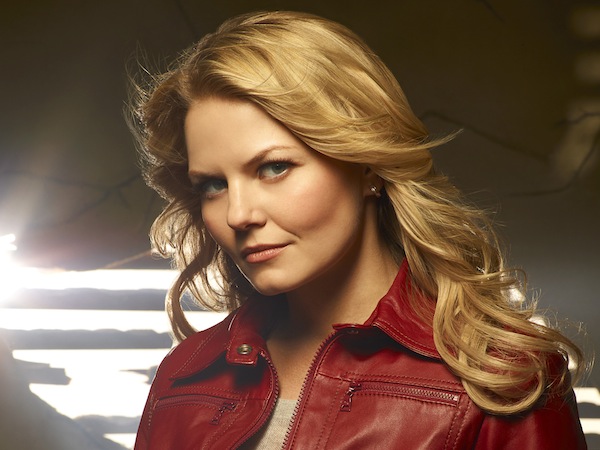 On the fantasy side of things, we learn how Jimmy became a cricket in the first place. Perhaps not surprisingly, it involves Rumpelstiltskin. And it gets surprisingly dark.
I really do hope that some definitive proof of Storybrook’s true nature is uncovered soon, because the inevitable “you’re crazy, Henry” speech is getting very tiresome. It’s good the show acknowledges how preposterous the whole situation is, and it makes sense for Emma to be skeptical, but it’s the same scene every episode, and we as viewers know Henry’s right, so it feels quite redundant.
Otherwise, I felt this was a solid episode. One thing that was particularly interesting was seeing some nuance added to Regina’s character. This is the first time it’s been clear that she really does care about Henry, and seeing her put aside her loathing for Emma for his sake was a powerful moment.
I may not be a particular fan of Emma, but her interactions with Regina can sometimes be quite interesting. They’re so at odds, but they’re united in wanting to protect Henry.
…I can only imagine the slash fics that must exist involving those two.
Overall rating: 7.5/10
“The Sheperd”:
This is one of those times when I have very mixed feelings on Once Upon a Time. There’s much I like about this episode, and much I don’t.
 This time, the focus is on Prince Charming… who turns out to not be such a prince after all. He just plays one in real life. On the Storybrook side of things, he’s torn between his feelings for Mary Margaret, and his loyalty to his wife, who is notable for not being Snow White in any reality.
Snow White and Prince Charming are one of the highlights of the show. They’re very likable characters, and the actors who play them have a lot of charisma. It’s very hard not to like them. So any episode that focuses on them earns some points.
And the fight with the dragon was quite cool, if a bit brief for my taste.
But this another case of laying the emotion on a bit thick, and having David/Charming go back to his wife is disappointing, and not for the reasons the show intended. I don’t need to have seen later episodes to know he’ll end up with Mary/Snow; why waste our time pretending that’s in doubt?
It also doesn’t make a lot of sense for Charming to have been able to pull off all his feats of martial prowess if he was really just a shepherd. The overall impression is it was a very short amount of time between his being ushered off the farm and meeting Snow. How’d he become an expert archer and swordsman in that time?
Overall rating: 7/10





 Superior Realities