
I think we all went a bit crazy during quarantine. Me, I developed a crippling addiction to co-operative card games.
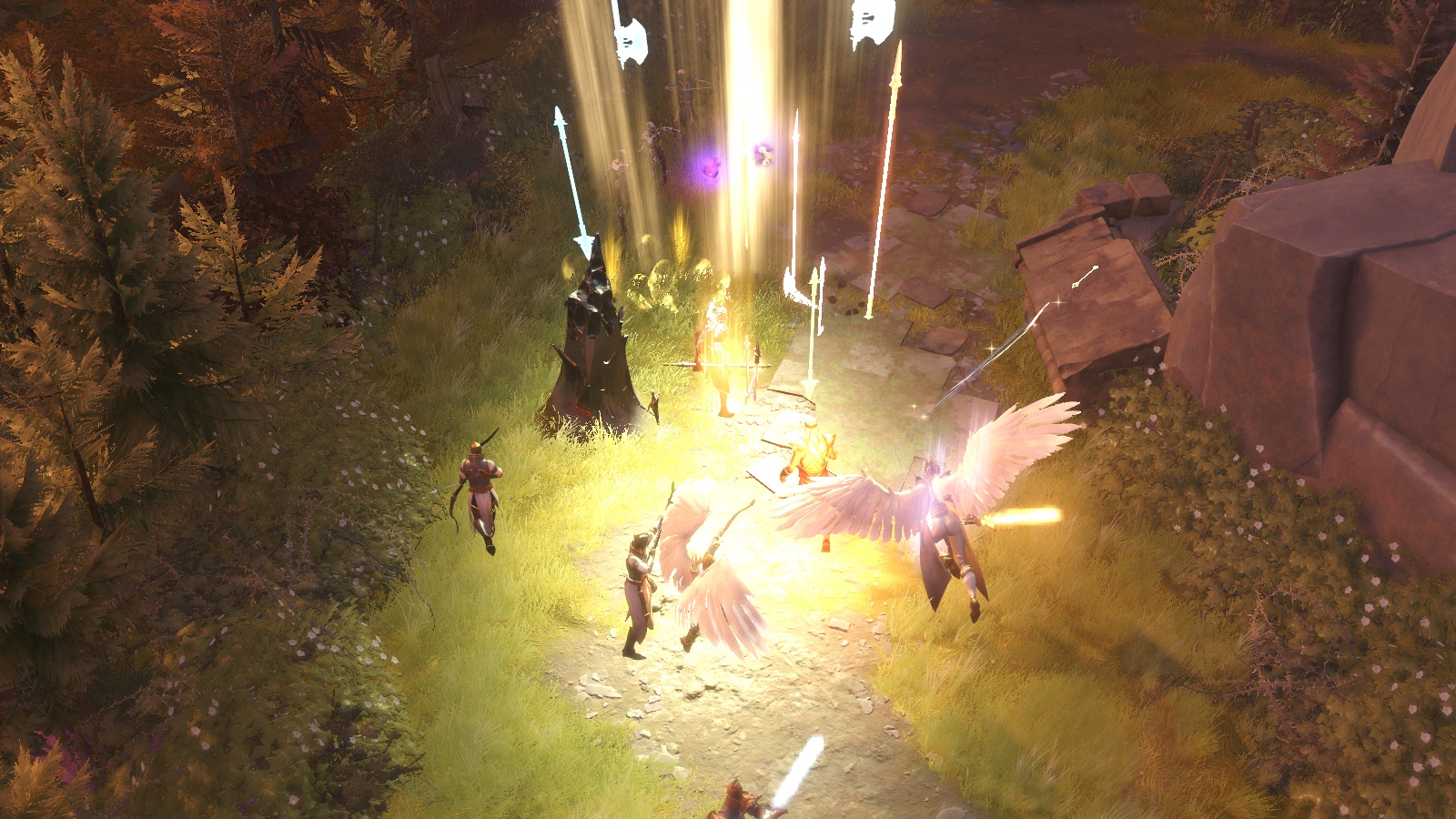 It started with playing Magic: Legends. For all its flaws, I adored the build system in that game, and it made me realize just how much pleasure I get from deck construction, keyword synergy, combos, and other hallmarks of card games like Magic: The Gathering. It goes a long way to explaining my love for the ability wheel of The Secret World, itself inspired by collectible card games.
Magic is the poster-child for these kind of games, and I dabbled with its digital version, Arena, but I’ve never much enjoyed competitive play. I went so far as to buy a small collection of cheap used Magic cards and homebrew some rules for solo play, and it worked better than you might expect, but it didn’t have a lot of replay value. There’s only so much you can do to fit a square peg into a round hole.
No, I had to find some games that were built for PvE play from the ground up, and while there aren’t that many co-operative card games of this nature, I did find a few.
A few months ago I was singing the praises of Arkham Horror: The Card Game over at Massively Overpowered. Since then, however, I’ve found myself starting to fall out of love with the game.
It’s strange, and I don’t entirely understand why my feelings have changed so much. I think a lot of it boils down to the fact that the game’s story-driven nature leaves it somewhat lacking in replay value.
 There are other quirks on the game that have begun wearing on me, too. It requires a huge amount of table space (difficult in my tiny apartment), and the set-up time for some scenarios can be downright brutal. You need to clear a good chunk of an afternoon to play this game.
Also, while in theory the deck-building options are vast, in practice they can be quite restrictive. Resource costs, XP costs, class limitations, limited hand slots, limited ally slots, limited arcane slots… Customizing my deck is one of my favourite parts of these games, but Arkham Horror sucks a lot of the fun out of that.
It’s also possible I just picked a bad campaign to start with. My first (and so far only) full cycle was the Innsmouth Conspiracy, and it turned to be a bit of a disappointment. I was expecting a cloak and dagger tale full of intrigue and mystery, but in practice it’s more like a Michael Bay movie. Very much not the tone I expected from this setting.
I have considered trying another cycle before giving up on the game. It’s possible Innsmouth was simply a dud.
Either way, I do have other options for my card game fix.
Around the time I started with Arkham Horror, I also tried Lord of the Rings: The Card Game, which is made by the same company. In contrast to Arkham Horror, it was harder to get into initially, but I’ve since fallen in love with it.
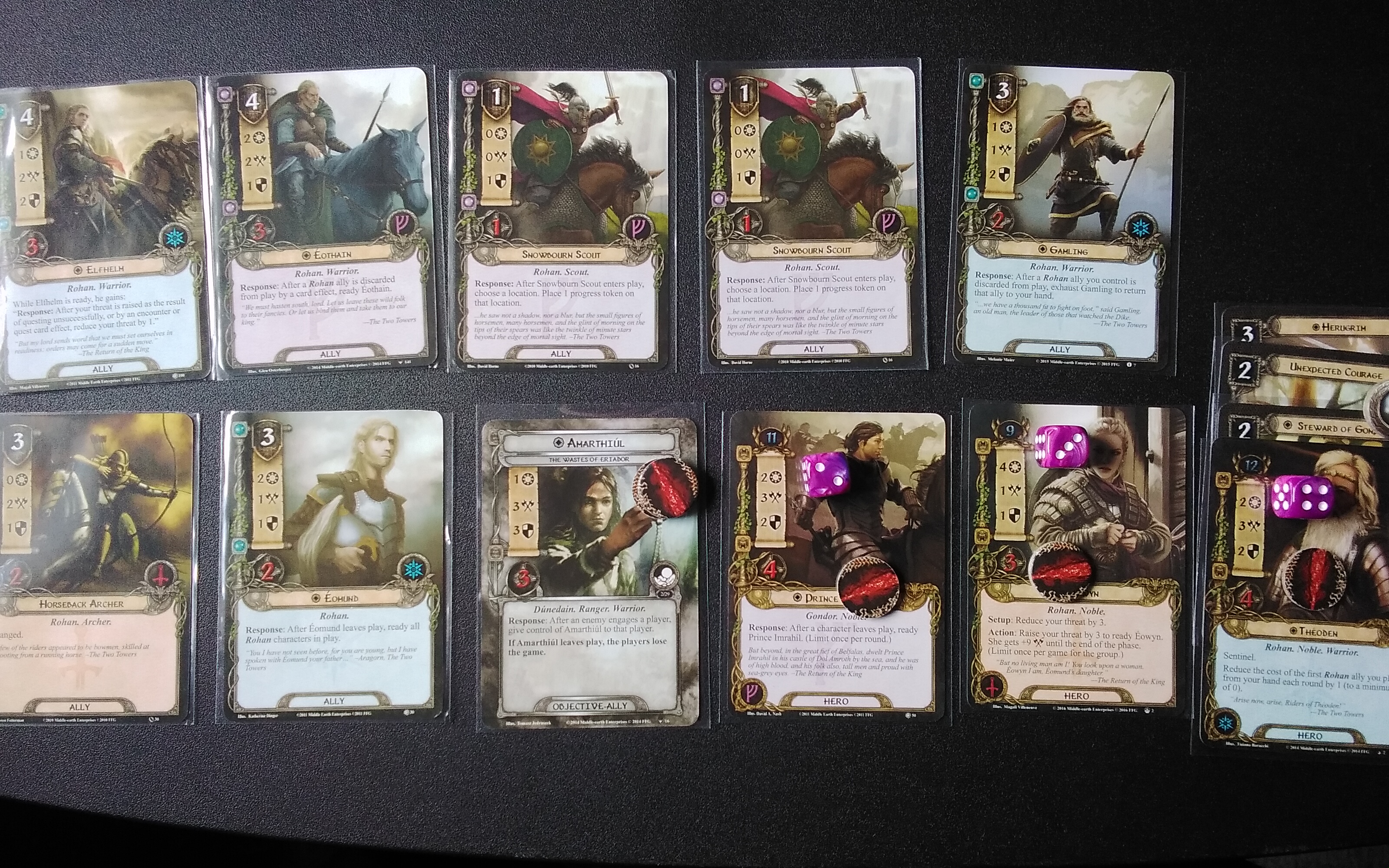 LotR was the first co-op card game made by Fantasy Flight Games, and it has a certain degree of jank as a result. The earlier scenarios are kind of a mess, and it’s brutally difficult across the board. I ended up coming up with some house rules to make the game a little less punishing, as the difficulty doesn’t scale well for solo play (which has thus far been my focus).
That said, despite its rough edges, there is a lot of genuine brilliance in this game. Unlike Arkham Horror, there are almost no restrictions on how you can build your deck, and the options for fun builds are nearly limitless.
FFG has a remarkable talent for translating theme into game mechanics, and this is most true in LotR. I am eternally impressed by how different the playstyle of each archetype is, and how well it fits the lore.
For example, Ents enter play exhausted (basically they have summoning sickness from MtG). You know, because they don’t like to be too hasty. But once they’re finally roused, they’re among the strongest allies in the game.
Meanwhile, Silvan Elves feature various powers that trigger when they enter play. To get the best use out of them, you need to find ways to continually move them into and out of play, emulating the hit and run guerilla tactics you’d expect of forest-dwelling Elves.
 That the designers of this game had a true knowledge of and love for Tolkien’s work shines through every aspect of this game. I keep coming back to one card in particular that showcases this brilliantly: Tale of Tinúviel.
I just love that this card exists. It’s a relatively deep cut of Tolkien lore, and the mechanics of it capture the theme so elegantly. It may not be the strongest combo in the mechanical sense, but the Tolkien nerd in me just squeals with delight every time I play Tale to have Arwen buff Aragorn.
.I’m also impressed by their ability to turn even single lines from the books into fascinating, thematic cards, as seen in Distant Stars or The Long Defeat.
The appreciation for Middle-Earth can also be seen in the game’s story-telling. Initially weak in the early cycles, later cycles feature almost as much story text as Arkham Horror, and while the quality of the writing may not be super strong in the technical sense, it does do an admirable job of telling new tales in Middle-Earth in a way that feels faithful and respectful to the source material.
The more I play this game, the more I appreciate it, and I believe it will continue to be the focus of my card-game obsession moving forward.
 I was even inspired to check out the digital adaptation, “Lord of the Rings: The Adventure Card Game.” As of this writing I’ve only just started on it, but I’m not nearly as impressed with this rendition of the game. It’s more “loosely inspired” by the physical card game than a direct adaptation, and while it plays well enough, it doesn’t have the same cleverness or thematic strength as its forebear.
FFG does have one more co-op card game that I haven’t played yet, Marvel Champions. I’ve ignored it so far it due to my general disinterest in super heroes, but the two main exceptions to my super-heroic ambivalence are Spider-Man and especially the X-Men… and it just so happens that Marvel Champions’ latest expansion is Spider-Verse focused, and the next begins a major X-Men wave.
That was enough to convince me to buy the core set as an early birthday present to myself, although I haven’t actually picked it up from the store yet. I’ll give the core set a whirl and see if it’s worth investing further.
I’m just not sure it does anything that my current collection of games doesn’t. By all reports Champions shares a lot of DNA with the LotR card game (but with weaker deck-construction options), and I do already have a super-hero game.
Yes, my newfound obsession has led me to one more title, Sentinels of the Multiverse: Definitive Edition.
I played an earlier version of the game at a board game meet-up many years ago and enjoyed it. The thought of buying my own copy of the game was always in the back of my mind, but I didn’t really look into it until I started developing this greater interest in card games. By the time that happened, the Definitive Edition was on the cusp of launching its Kickstarter, so I got in on the ground floor.
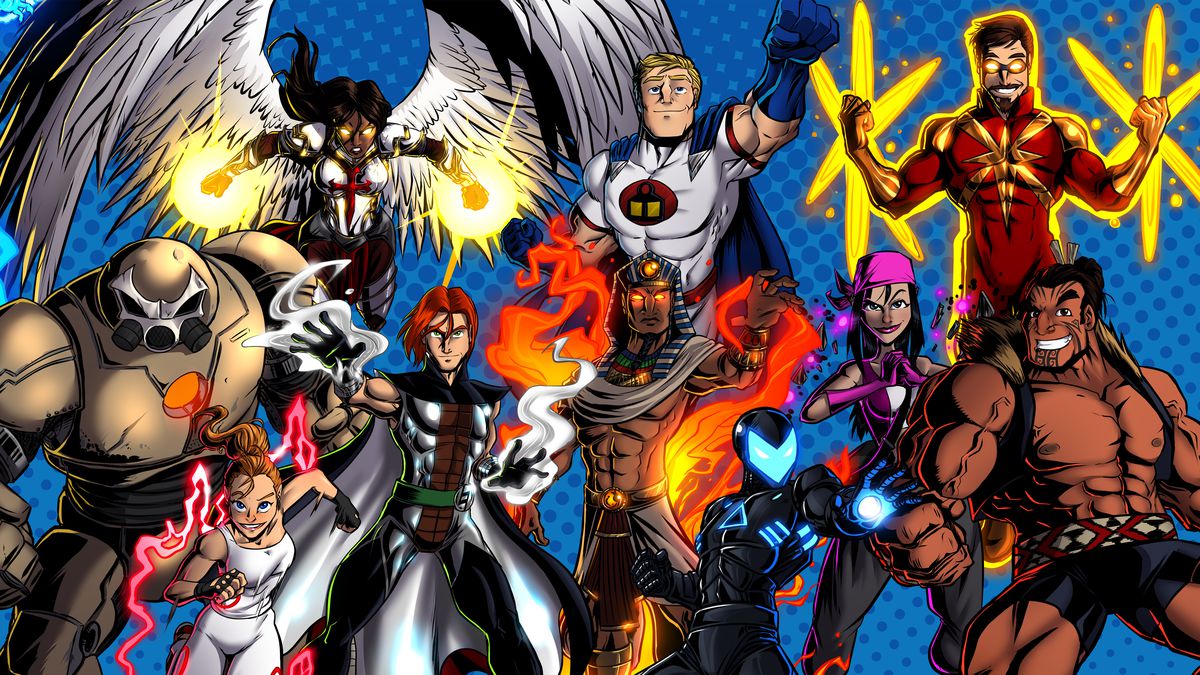 Sentinels is very different from FFG’s card games in many ways. For one, it has no element of deck construction at all. Each hero has a pre-built deck that can’t be altered. Despite that major deficiency, though, I’ve still gotten quite a bit of fun out of it.
Sentinels’ strength lies in its relative simplicity. There’s an elegance to its rules that is quite admirable, and it’s a good casual game to play with other people. It can be a welcome break from the complexity and punishing difficulty of LotR and Arkham Horror.
To give you an idea of how big the complexity gap is, most people recommend playing LotR and Arkham Horror “two-handed” (controlling two decks as if you were two players), but I’ve never been able to do this. I find it too mentally taxing.
However, Sentinels requires a minimum of three heroes, so if I want to play it solo, I need to play three-handed… and I still find that less overwhelming than playing LotR or Arkham Horror two-handed.
I don’t think Sentinels will be the sort of game where I feel the need to own everything, but I have already pre-ordered the Definitive Edition’s first expansion, Rook City Renegades. I wanted more variety than the core set offers, and with its focus on darker themes and magical heroes, RCR feels like the perfect expansion for me.
I’ve long been concerned this interest in card games was a passing fancy that I would later regret, but after about a year of this, I’m beginning to think this is a more long-term addition to my list of interests. I can see myself losing interest in specific games (as I said above, Arkham Horror is on the bubble), but I think I’m likely to stick with the hobby as a whole. At the very least, I don’t see myself getting bored with LotR any time soon.


 Superior Realities