
Although I will be discussing lore in this post, I also have some important points to make about the mechanics of the game, and particularly the role of factions, so no need to flee in terror if you’re not so big a lore geek as me.
The Army of the Light:
You can be forgiven if you’ve never heard of the Army of the Light. Even for Warcraft lore nuts like me, it’s a very obscure concept. To the best of my knowledge, it has only been mentioned twice in the entirety of Warcraft history.
The concept was first introduced in the novel “Rise of the Horde” by Christie Golden. It was part of the Draenei origin story, and provided an obvious counterpoint to the dark path taken by their Eredar cousins under Archimonde and Kil’jaeden.
Sargeras promised that the Eredar would be the generals of his Burning Legion if they pledged themselves to his evil crusade. Similarly, the Naaru accepted the Draenei into service and promised that they would one day lead an army of many races that would cast down the Legion once and for all.
So essentially, the Army of the Light is the anti-Burning Legion: a force of pure righteousness that will sweep across the universe, bringing order and justice to all.
Many have hypothesized that the Horde and the Alliance may be precursors to the Army of the Light. This would explain the Draenei’s continued presence on Azeroth, and the Naaru’s interest in us puny mortals.
But the concept seemed to be largely abandoned after that. Personally, I thought Blizzard had decided to drop that plot thread or even just forgotten about it.
But then came Velen’s entry into the “Leaders of Azeroth” story series: “Prophet’s Lesson.” In this story, Velen has a vision of the Army of the Light confronting a nameless, shapeless darkness.
And lo and behold, the Army of the Light is exactly what many fans theorized it could be: a force formed from both the Horde and the Alliance, including humans, Tauren, Goblins, Elves, and even Undead and Dragons.
What’s even more interesting, though, is who is implied to be leading the Army: Anduin Wrynn, the young prince of Stormwind.
This is probably the biggest revelation: not that the Army may yet come to pass, but that it may do so within a mortal lifetime. In other words, this could happen in a future game — it’s not something thousands of years away that Blizzard could chose to never deal with.
Where lore and gameplay collide:
And this is where we abandon lofty theories on lore and begin to deal with the fundamental mechanics of the game. If the Army of the Light is ever to be realized in World of Warcraft’s lifetime, that means there would need to be peace between the Alliance and the Horde.
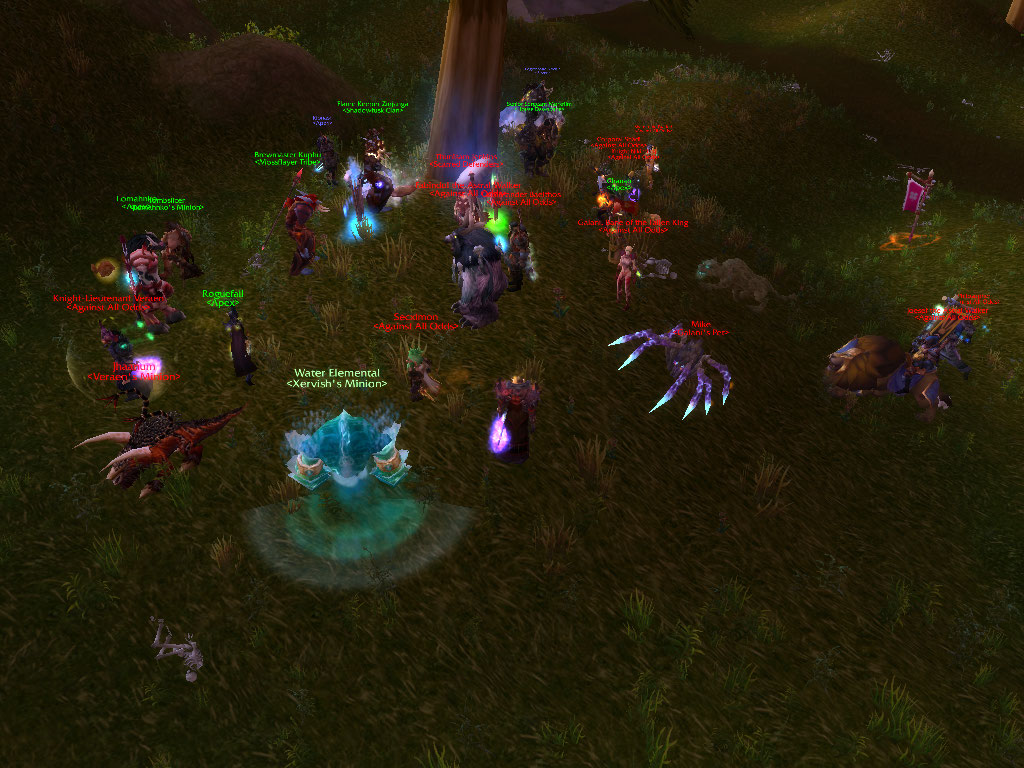 This is somewhat far-fetched from a lore perspective, but it’s even more improbable from a gameplay perspective. Blizzard has built WoW from the ground up with the polarization of factions in mind. There are language barriers, grouping barriers, and player versus player — not to mention the psychological rivalry Blizzard has instilled in many players.
Now, I make no secret of the fact I strongly dislike the faction system. I think it goes against the very concept of an MMO. Why should my aesthetic choice of a race and faction impact who I can interact with? I never wanted my paladin to be human, but she needed to be if I was to able to play with my friends on the Alliance side.
Aside from that, I feel the artificial rivalry between factions just leads to a lot of immaturity and general douchebaggery. I shouldn’t be afraid to bring up the fact that I play both factions, but I am, because it usually leads to me receiving all kinds of verbal abuse.
It’s also worth noting that avoiding factions seems to be growing more common in MMOs. Guild Wars eschews factions altogether, allowing all players to interact freely, and the factions of The Secret World are only segregated in PvP content.
 But while I’d love to see the day when my Blood Elf warlock is grouped with my buddy the human death knight, I recognize it’s not likely. Many people are attached to the faction system, and they would resent joining forces with their rivals.
Add to that the need to maintain a pretense for PvP and the fact that Metzen’s been implying the war between the Horde and the Alliance will never end, and it seems like peace is something we’ll never see.
But yet, the Army of the Light still taunts us. Blizzard’s storytelling can be fairly scattered, but I’m pretty sure they didn’t dig up this ridiculously obscure idea for nothing. Blizzard keeps hinting they have some grand plan for the future of the WoW universe, and it seems likely the Army of the Light could play into that plan.
And then there’s Mists of Pandaria, an entire expansion devoted to decrying the evils of petty war. I’ve heard rumors that even Wrathion is trying to get the two factions to reign in their aggression.
Finally, there’s Anduin Wrynn. As Terenas reminded us, no king rules forever, and when Varian is gone, his son will lead the Alliance. Anduin is a holy man. He believes in understanding and tolerance. He doesn’t cling to violence and hate like his father, and he would seek peace wherever possible.
So lore seems to point us in one direction, but gameplay another. Can these two things be reconciled? Will Blizzard one day revamp one of the fundamental aspects of their game, or is the Army of the Light just a carrot to be dangled in front of lore fans?
Perhaps an even better question is, “Would uniting the factions be a good idea?” I personally am wholeheartedly in favour of it, but others might not agree.
What do you say? Is peace possible? Should it be? Would you be willing to put aside your negative feelings towards the other faction and join them in the final war against the darkness?
 The countless trilogies, quartets, and duologies of “The Riftwar Cycle” tell the tale of the godlike magician, Pug, and his secretive Conclave of Shadows as they struggle to protect the world of Midkemia from… well, you name it.
 Superior Realities