
Along with movies and smiling, TV is one of those things that I’ve been having trouble finding time for lately. As a result, I was only vaguely aware of the existence of Orphan Black, and I knew barely anything about its premise. Sci-fi show, something something clones.
 However, I was on Space’s website looking for an update on the second season of Defiance (still a few weeks off), and I noticed they had the full first season of Orphan Black, so I decided to give it a shot.
Since I’m binge-watching this show, my reviews may have to be a little truncated for brevity’s sake. I will also be relatively loose with spoilers.
“Natural Selection” (pilot episode):
Our story begins with Sarah Manning, a con artist and general screw-up of the highest order. While waiting for a train, she notices a distraught woman lingering near the tracks. Moments before the woman commits suicide by jumping in front of a train, Sarah notices something startling: the woman looks exactly like her.
Being who she is, Sarah’s first instinct is to steal the woman’s purse and flee the scene. Sarah comes to learn the woman’s name was Beth Childs, and she was living a fairly comfortable life.
Sarah decides to take advantage of the situation by convincing society that Beth was in fact her, effectively faking her own death, and by briefly taking over Beth’s life long enough to steal all her money and ride into the sunset.
 Sarah also displays a startling lack of curiosity about the fact that Beth was apparently her long-lost twin.
As you might expect, this scheme proves far, far more complicated than Sarah hoped. Pretty much everything imaginable goes wrong with this scheme right out of the gate — Beth was married, and a police officer, for starters. And just to make life more interesting, Sarah encounters another of her dopplegangers, who is promptly murdered before her eyes.
I was not impressed by Orphan Black out of the gate. My main early concern is that this will be one of those stories that just strings people along, providing lots of mystery but few answers. I’m all for mystery, but a good mystery will provide a steady stream of answers and new information while constantly opening new questions. A bad one will just keep piling on the questions.
Despite an almost absurd number of complications being thrown Sarah’s way in the first episode, essentially nothing happened. We learned nothing of value beyond the fact that there are a lot of people who look like Sarah. It just leaves you thinking, “Huh?”
I’m not a big fan of Sarah as a character, either. I’ve kind of got a chip on my shoulder regarding mothers who abandon their children, but even without that little blotch on her character, she’s just not a likable person. She’s a walking train wreck: selfish, erratic, and irresponsible.
 Her writing is pretty inconsistent, too. She often comes across as a complete moron (You really thought you could just bluff your way through the life of someone you never met? Really?) but in times of great duress, she suddenly morphs into a criminal mastermind who can think her way out of anything.
With that being said, the premise of the show has a lot of potential, and this would hardly be the first show I’ve seen that got off to a rocky start only to improve later, so I decided to keep going.
It was also interesting to discover Orphan Black is filmed in Toronto. Some scenes took place within walking distance of where I used to live.
Overall rating: 5.9/10
“Instinct”:
The second episode picks up immediately after the pilot’s conclusion, with Sarah fleeing the unseen killer who sniped her German doppleganger (as opposed to her Canadian doppleganger). She receives a phone call from a mysterious woman who (believing her to be Beth) is desperate for some information the German was supposedly in possession of.
However, this is once again complicated by Sarah’s ongoing efforts to continue posing as Beth, which once again dovetail into every kind of bad you can possibly think of, and her family issues, as she struggles to keep her “death” a secret from her daughter while her distraught boyfriend makes life miserable for her foster-brother.
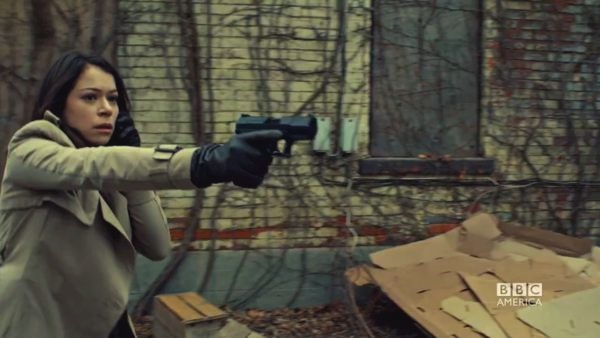 Like the pilot, “Instinct” manages the impressive feat of being incredibly eventful and almost absurdly complex while still advancing the plot in almost no meaningful way. At this point, Orphan Black seems to be the epitome of going nowhere fast.
Sarah also continues to show a bizarre disinterest in the fact that she has stumbled into a deadly web of intrigue involving a large of number of women who all share her face. If it were me, I’d be freaking the Hell out.
This episode is mainly noteworthy for introducing two more of Sarah’s duplicates: a prickly soccer mom named Allison, and a geeky eccentric named Cosima.
Overall rating: 4.9/10 I finished watching this episode only a few hours before writing this post, and I’ve already forgotten most of it.
“Variation Under Nature”:
At last, in the third episode of Orphan Black, things start moving forward. Sarah meets with Allison and Cosima, who reveal they are all clones — though how they know this is unclear — and that someone has been killing them off one at a time.
 It’s around this time that I came to another conclusion about Orphan Black: All the clones seem to be nuts. Sarah is, as noted previously, the poster child for screw-ups everywhere. Allison appears to be irritability incarnate. Beth was a mentally unstable junkie.
Only Cosima seems at all sane or likable. Unfortunately, she seems to be the clone getting the least amount of attention right now.
In general, Orphan Black has a real problem where all of the characters seem unhinged or just generally unlikable. At this point, the only character I have any real fondness for is Felix, Sarah’s brother, and even there, my feelings toward him are lukewarm at best. He’s an incredibly one-dimensional and borderline offensive stereotype.
Still, his baby-sitting gig has to have been the best moment of the series to date. “Look, Mom, we’re cross-dressers!”
Brilliant.
“Variation Under Nature” also features the already strained plausibility of the series taking a nose-dive. I’m used to TV cops behaving not at all like real cops, but then you’ve also got the fact that Sarah is still somehow managing to pass herself off as someone she knows essentially nothing about, and really crazy stuff like a woman just getting up and walking away after being impaled.
 Oddly, the thing that bothers me the most might be the fact that Cosima is the only clone who wears glasses, even though they’re all genetically identical. How’s that work?
On the plus side, I’m growing increasingly impressed by Tatiana Maslany, who plays the clones. I may not be particularly fond of the characters she plays, but she does portrays them all convincingly, and does an excellent job of distinguishing them. Her speech patterns and mannerisms change radically from one clone to another, and they all feel very much like separate individuals.
I particularly like subtle details like how she occasional lets subtle elements of Sarah’s British accent slip through when Sarah is pretending to be Beth.
Ai, so many clones.
I’m also enjoying the Torontonianism of it all, which was on full display in this episode. Driving down the Gardiner, visiting the suburbs of Scarborough, chasing a suspect through Parkdale.
Mmm, nostalgia.
Overall rating: 6.1/10 Feels like the series is only now getting started. If they’d cut out the filler and condensed the first three episodes into the pilot, I’d have enjoyed it a lot.
* * *
 I want to like Orphan Black. I really do. I’m starved for some decent sci-fi, and it seems to have a lot of potential. The main plot about the clones is quite interesting, the lead actress seems very talented (and, to be honest, is also quite easy on the eyes), the production values are high, and it feels good to support a Canadian production.
But as it stands now, I’m just not enjoying it that much. The plot rambles, seemingly doing everything in its power to avoid advancing its most crucial points. The characters are uniformly unlikable. There is much that strains credibility or just flat-out doesn’t make sense.
As it stands now, I’m on the fence about whether to continue watching. I want to give it a fair shake, but after three episodes, it still seems a long way from finding its footing. If no more reviews appear on this blog, you’ll know why.



 Superior Realities