
From the time I first began learning about the Mass Effect franchise, I’ve seen a strange degree of overlap between it and another beloved sci-fi gaming franchise, StarCraft. At times I’ve dismissed it as the result of an over-active imagination, but they just keep borrowing from each other.
 I thought it’d be interesting to look at the bizarre relationship of these two franchises that increasingly seem to have been separated at birth.
This post will contain spoilers for Mass Effect: Andromeda up to and including the mission Journey to Meridian.
Your StarCraft in my Mass Effect:
It began with my reading a plot synopsis for Mass Effect 1. I couldn’t help but notice that it sounded eerily like the cancelled StarCraft: Ghost game, which was also a third person shooter.
An elite human operative goes on an intergalactic journey to track down and stop a renegade Spectre.
Which game did I just describe?
Of course, once you get into Mass Effect, the two games divulge quite a bit, but by then the connection between StarCraft and Mass Effect had wormed its way into my thoughts, and I kept seeing small similarities here and there.
 The Protheans and the Reapers both bear some vague resemblance to the Xel’naga in their role in the story. Turians look like Protoss with hydralisk mouths. Alliance military uniforms look a fair bit like Dominion naval uniforms. Biotics are not unlike the telekinetics wielded by some of the more powerful ghosts.
Your Mass Effect in my StarCraft:
And it’s not a one-way street. StarCraft II clearly took a lot of inspiration from the Mass Effect franchise.
The basic structures of the games are largely the same. Go to the bridge, pick a location via the galaxy map, play a mission, and come back to your ship to chat with the NPCs before embarking once again.
Wings of Liberty even tried to copy a little bit of Mass Effect’s famous choices by giving the player great control over what order to do missions in, and even some choices on how to direct the story.
This was somewhat of a failed experiment, as Blizzard just isn’t that good at non-linearity. Later games abandoned most (though not all) player choice regarding the story and what order to tackle things in, but the general Mass Effecty structure of missions and conversations remained.
 And StarCraft was definitely the richer for it. Every entry in the StarCraft II trilogy has featured some great core characters, and in both SC2 and Mass Effect, the conversations between you and your crew are highlights, whether you’re talking spirituality with Thane or being simultaneously fascinated and chilled by Abathur’s utter inhumanity.
Then there’s the Covert Ops DLC to consider. To match Nova’s high-tech feel, the traditionally guitar-heavy soundtrack given to Terrans was shifted more towards synth sounds, and the end result is very reminiscent of a lot of Mass Effect’s music. One song in particular that plays in the main menus sometimes sounds almost exactly like the main theme from the earlier ME games.
Plus, if you squint, the Griffin has a pretty similar silhouette to the Normandy.
A new phase:
And then came Andromeda, and things just got weirder.
I kind of blinked when I saw Andromeda was going to prominently feature a ship called the Hyperion. But that’s small fries.
You can also see a bit of the Zerg in the Kett. Their modus operandi is pretty similar. Go around assimilating other species and stealing their best genes. Abathur and the Archon would have a grand old time talking shop, I’m sure.

This is concept art for a Remnant Vault in Mass Effect: Andromeda.
There’s still a lot of difference, though. The Kett are still humanoids who rely on technology, and they don’t appear to have any hive mind.
But then there’s the Remnant.
Holy hell.
The Protheans and the Reapers each occasionally reminded me of the Xel’naga in some vague ways, but the Remnant — or, more accurately, their creators — are the Xel’naga. Literally, unequivocally, the Xel’naga.
I remember the first gameplay video of Andromeda I saw. It featured a Remnant ruin, and I was like, “Hey, look, it’s a Xel’naga temple.” Finally playing Andromeda only confirmed the uncanny resemblance between the architecture of the Remnant and the Wanderers from Afar.
Still, that’s just visuals.
But then we learned the Remnant’s creators, the Jaardan, were grand intergalactic biologists who seeded life throughout the cosmos for unknown purposes. Then we learned their civilization was centered around a lost artificial world in deep space. Then we learned they were in the business of creating whole sentient races.
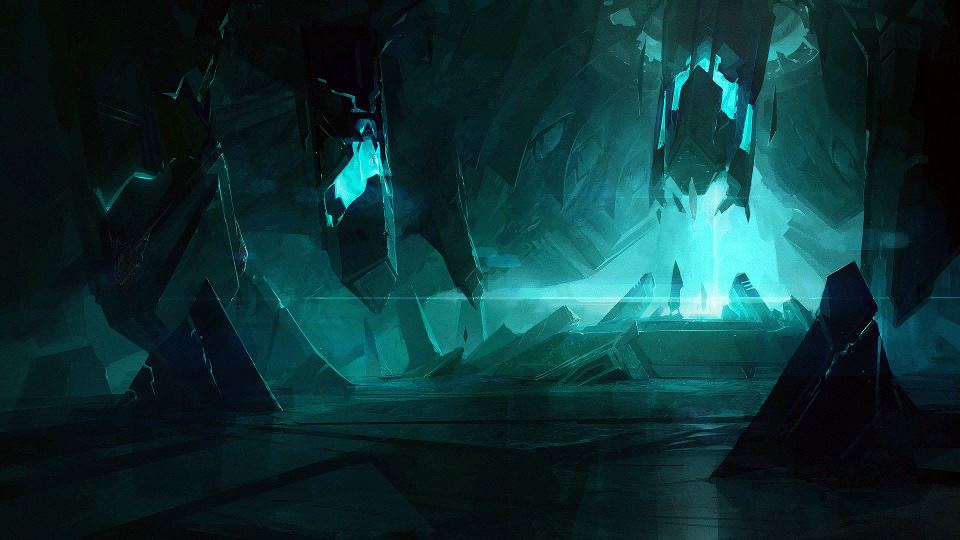
This is concept art for a Xel’naga temple in StarCraft II.
In other words, they are the Xel’naga.
And now it’s just too weird. An entire core section of the StarCraft universe has basically been transplanted wholesale into Mass Effect. At this point I wouldn’t be at all surprised if we found out the Kett were created by some renegade Jaardan. Hell, I wouldn’t be surprised if Artanis popped up on the Tempest vidcon.
Not complaining. In a way it’s kind of cool. Damn strange, though. I don’t think I’ve ever seen any work of fiction copy another in such an uncanny way. I like to joke that the Krogan are basically Klingons, but there’s vastly more difference between Krogan and Klingons than there is between the Jaardan and the Xel’naga.
Tinfoil abounds:
I don’t really know what all this means. I freely grant that at least a good chunk of this is my seeing patterns where there are none. Lots of these similarities can easily be dismissed as random happenstance.
And certainly there are plenty of differences between the franchises, too. Mass Effect tends to present a relatively optimistic vision of humanity’s future, whereas StarCraft embraces a more dystopic view.
But some stuff, especially around the Remnant/Jaardan/Xel’naga, is harder to dismiss. I mean, I don’t imagine Bioware is sitting around consciously stealing ideas from StarCraft, but the fact remains that if they were they could hardly do a better job.
 I know there has been at least a little cross-pollination between the two development teams. Brian Kindregan has written for both StarCraft and Mass Effect. But beyond that I don’t really know what’s going on here.
I just know it’s weird, and fascinating.

 Superior Realities