Retro Review: Age of Empires III

In retrospect, I can’t believe it took me this long to play Age of Empires III.

A battle in the Rockies in Age of Empires IIIEven if MMORPGs have become my focus these days, I grew up loving the real time strategy genre, and it still feels the most like home to me. When I think of the games that defined my childhood, nearly all of them are RTS games: names like StarCraft, WarCraft, and Age of Empires.

I can’t even begin to count the number of hours I lost to the Age of Empires series. I remember playing the original Age of Empires with my best friend online — my very first online gaming experience. I remember pitting my Mongol horse archer armies against the AI in a rough estimate of eleventy bajillion skirmishes in AoE 2.

The Age of Empires series sparked my interest in history. I spent many hours researching ancient cultures, particularly the Mongol hordes, because I wanted to learn more about the civilizations I’d been playing as.

I also loved the Age of Mythology spin-offs, and they helped to kick-start my lifelong love of ancient mythology.

But Age of Empires III was another game that came out during that period where Real Life prevented me from gaming. Even when I did return to the realm of pixelated slaughter, it sort of got put on the backburner of my mind.
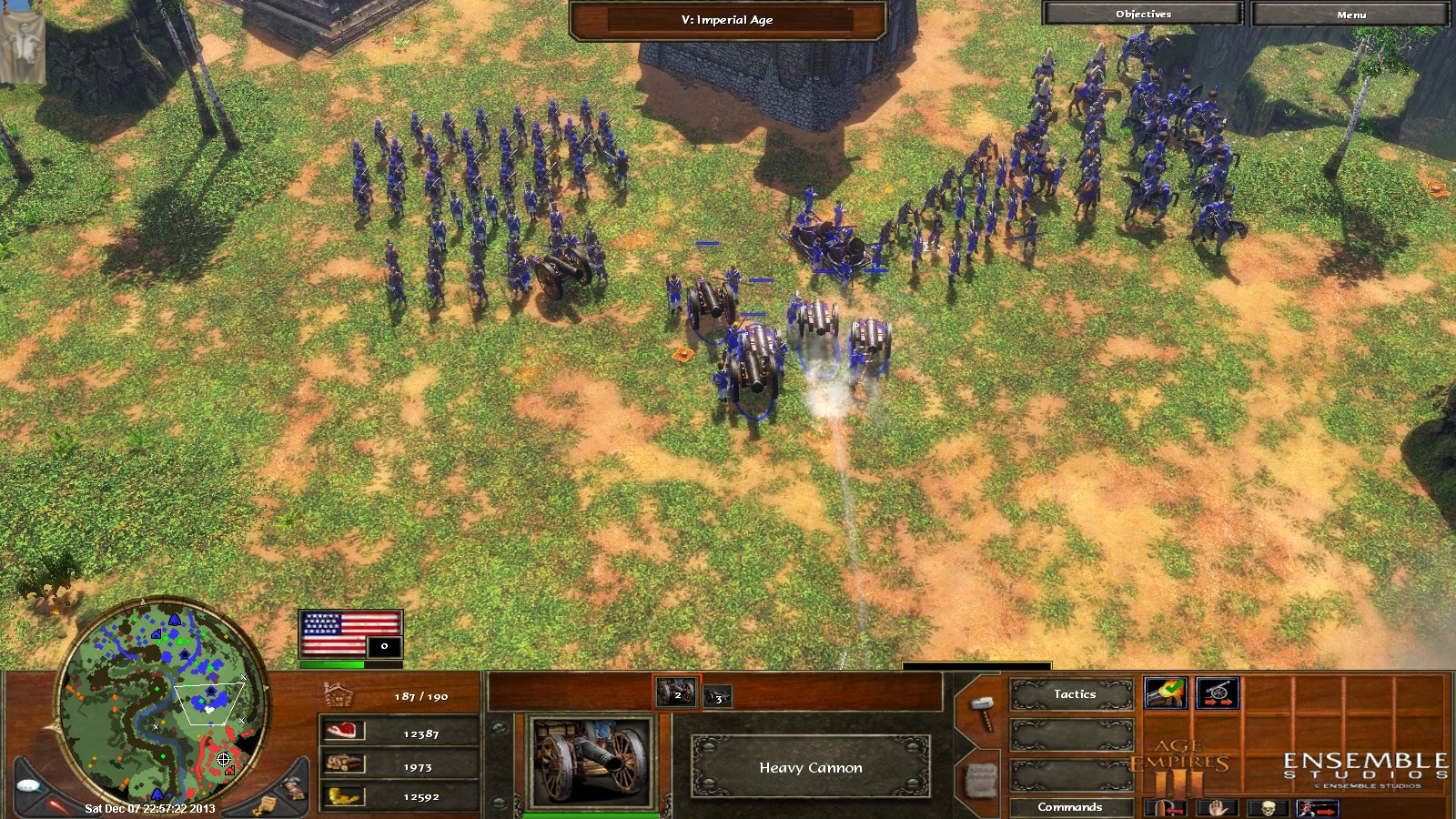
A battle in Age of Empires IIII suppose it’s down to the fact that, for whatever reason, I never had much interest in history after the Middle Ages but before World War 2 — the period AoE 3 focuses on.

Still, it seems silly that it took me this long to play it.

Comfortably familiar:

Mechanically, AoE 3 changes little from the previous games in the series. The basic formula remains unchanged from the original: Begin with a town center and some villagers, gather resources, advance through the ages, and eventually build yourself into a mighty military power and crush your enemies.

Stone has been removed as a resource, and there’s now one more age, but those are about the only major changes to economics, at least for the vanilla civilizations. The native and Asian civilizations added in its expansions have some unique economic mechanics, such as the native fire pit, which provides powerful buffs when villagers are assigned to dance at it, and the Asian civilizations’ export resource, which can be used to recruit European support.

Similarly, the military mechanics are a familiar rock/paper/scissors set-up, only slightly altered by the more advanced technologies of the setting. Basically, infantry have guns instead of swords now, but they still counter cavalry.
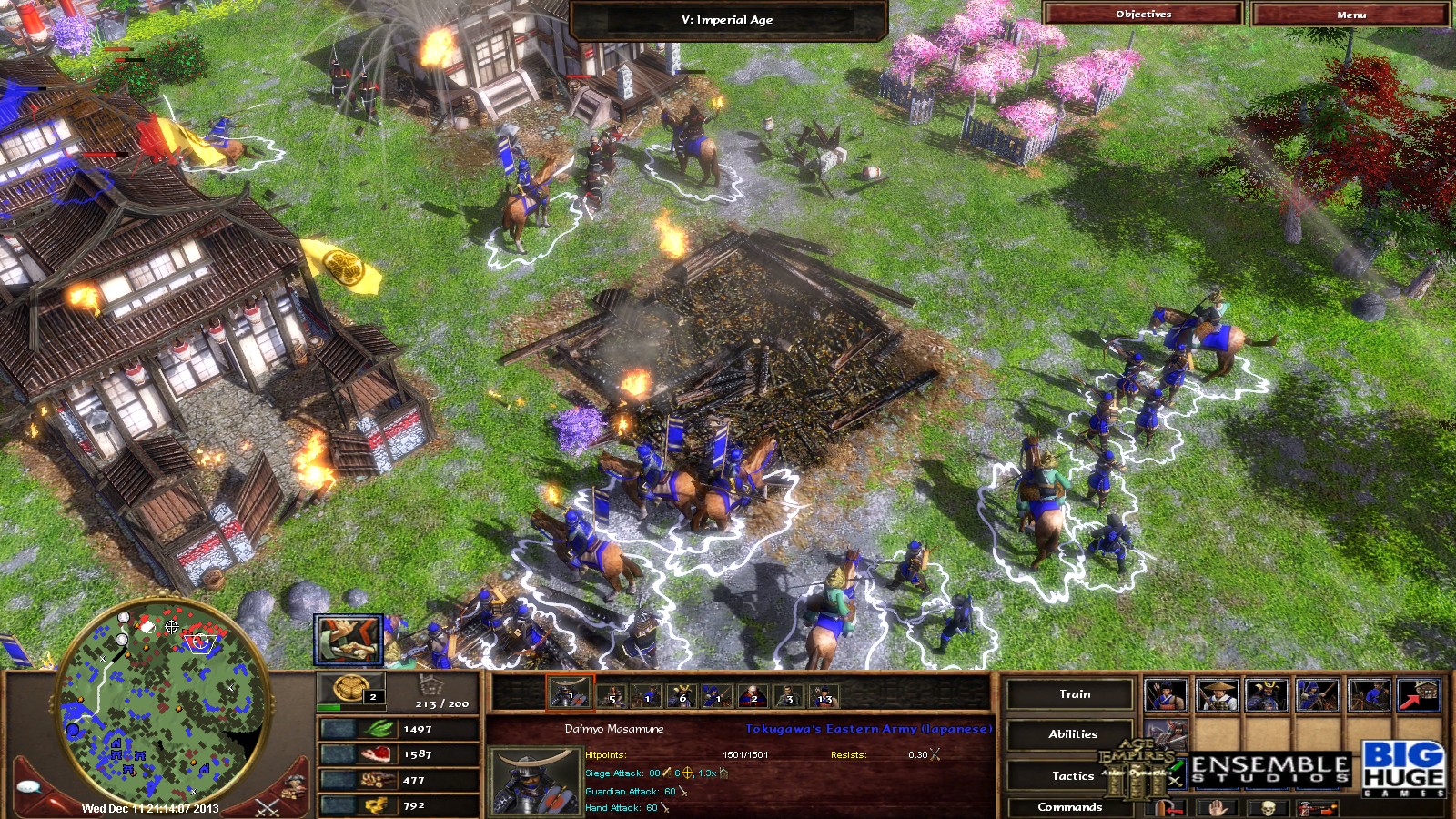
A battle during the Japanese campaign of Age of Empires IIIAoE 3 definitely lacks innovation, but I’m inclined to file that under, “Not fixing what wasn’t broken.” They had a winning formula with the previous games, and I don’t see why they should’ve changed it. I found a pleasant sense of nostalgia to going through the old base-building

And there are a few significant updates.

One is that players now begin each game with an explorer unit. These are similar to the heroes from Age of Mythology: They’re more powerful than standard units, have special abilities, and can be revived if killed. They can also collect treasures hidden around the map, ranging from small boosts of resources to units that will join your army.

Explorers are hardly game-changers, but searching for treasures does help make the early game a bit more interesting.

The other main addition is the home city system. Each civilization has a home city that can be leveled up like an RPG hero as you play the game. As your city levels, it gains access to more and more powerful shipments, which are boosts that can be called upon during a game. Shipments can be anything from extra resources, to more units, to powerful upgrades for your forces.

I’m not sure how I feel about home cities. There’s certainly nothing bad about them, but aside from speeding up and streamlining the game slightly with shipments, they don’t really add much. Your customization options are never great enough that it starts to feel like it’s “your city,” and shipments, while plenty useful, are never game-changing enough to feel all that exciting.

The home city screen in Age of Empires IIII suppose there’s something to be said for the persistent progression between battles, but I feel that home cities are somewhat a case of wasted potential.

The one other change is that the single player campaigns are now fictional stories rather than being based on actual events — barring the Asian campaigns, which are more historically based.

I’m not happy with this change. I preferred the historical epics of the original games — they were a very rare case where a video game actually did make learning fun. The new stories don’t have the same historical weight to them.

As for the stories themselves, they’d best be described as “adequate.” They’re not bad, but they’re not especially memorable — with the possible exception of the Sioux campaign, which I greatly enjoyed.

Old school rules:

The thing I most enjoyed about AoE 3 was its old school RTS feel, particularly its slower pace.

When I think about my fondest RTS memories from my youth, I think of epic, brutal scenarios played out over days. The sort of games where nearly every resource is mined out, where bases change hands multiple times, where countless digital soldiers have lost their lives in back and forth battles.
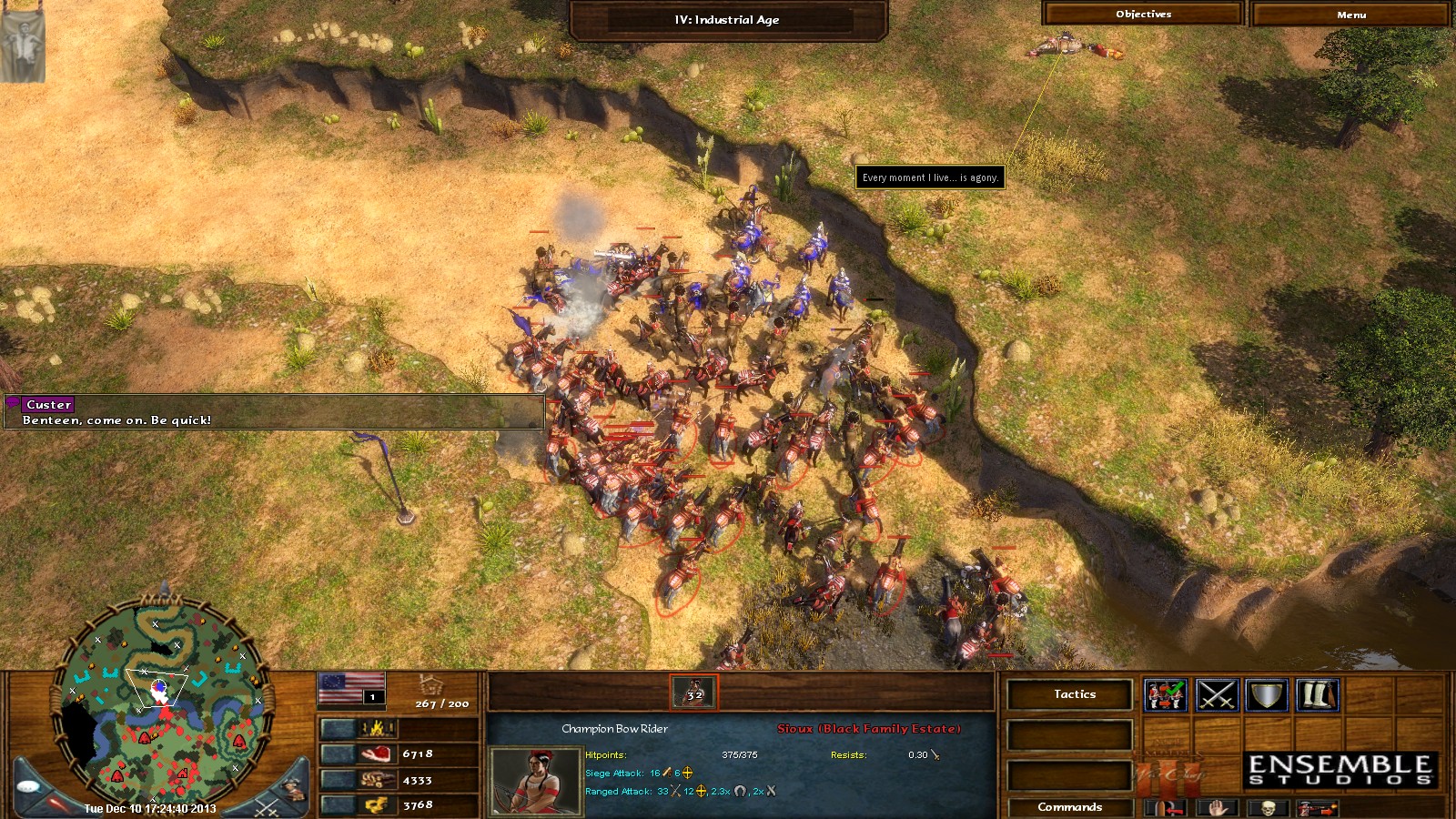
The Battle of the Little Big Horn in Age of Empires IIIAs much as I love the innovations of games like StarCraft II and Warcraft III, they don’t quite bring that same feeling of epic war that RTS games can capture so well.

AoE 3 has that in spades. While some missions are hurried, plenty more are lengthy brawls of the like to bring glee to any RTS fan’s heart.

Even in the shorter missions, I often found myself delaying my own victory just so I could spend more time exploring, upgrading, and building my civilization. After the over-caffeinated intensity of StarCraft II, the more relaxed pace is incredibly refreshing.

I also quite enjoyed the skirmish versus AI mode. Much as I think Blizzard is the master of the RTS genre, they’ve never managed to get their versus AI matches to a decent place. The AI is always incredibly predictable, one-dimensional, and just plain wonky in its strategies.

The AI in AoE 3 is much more balanced. There are a variety of difficulty settings providing appropriate experiences for all skill levels, and the AI is capable of executing relatively complex strategies effectively.

An interesting twist this time around is that each civilization has a unique AI personality based on a corresponding historical figure. These personalities all have distinctive playstyles, usually relating to their civilization’s strengths, and that adds a fair degree of variety to the versus AI matches. A battle against Henry the Navigator plays out very differently from one against Ivan the Terrible, even with all other factors being equal.

An army of Indian units in Age of Empires IIIIt’s also amusing that the personalities are fully voiced, and will sometimes taunt you or otherwise communicate, and just like their strategies, their styles of communicating vary wildly from one to another. Napoleon is a condescending prick, whereas Hiawatha is a noble, poetic soul.

Aesthetics:

The graphics of AoE 3 have held up surprisingly well, considering it’s getting pretty old in video game terms. The land units don’t look the best up close, but the environments are still very pleasing to the eye, and the ships are spectacular.

There are also some very impressive combat physics. Ships and buildings will not only catch fire when attacked, but they can have large pieces blown clean off. I’ve rarely seen the like even in much more recent games. Large-scale naval battles are particularly spectacular as masts topple, the air fills with cannon smoke, and shards of wood and broken beams splash into the surrounding waters with every brutal impact.

The music is pleasant enough, if not particularly memorable. The sound effects are good, especially the cannons, which provide satisfyingly visceral booms with every shot.

What I really enjoyed about the sound design was the continuing tradition of units speaking in their civilizations’ native tongues. Its fascinating to hear all these exotic languages from around the world. I particularly enjoyed the musical words of the Indian units.A naval battle in Age of Empires IIIVerdict:

If there is anything to complain about in Age of Empires III, it would perhaps be a lack of ambition. There are some underdeveloped features, and there aren’t a lot of mind-blowingly awesome moments to be had.

But honestly, I’m reaching. There might be areas where it could have been better, but I can think of nothing about AoE 3 that’s actually bad. Games really don’t get more solid or polished than this. This is pretty much a flawless mechanical execution of a real time strategy game.

8.5/10 In the ludicrously unlikely event that you’re a strategy fan who hasn’t picked up AoE 3 yet, do so right the Hell now.

Reminder: World Spectrum holiday sale

In case you missed it, I’m holding a sale on my World Spectrum novels from now until January 1. You can pick up the entire series for under $5, and they’re free of DRM, so they also make a great gift option.

The Great Horde Bias Rant

Prepare yourselves: It’s epic nerd rant time, and what I’m about to say will be very controversial in some circles.

Art of the Horde warring with the AllianceFor a long time now, there’s been a recurring complaint among the Warcraft fanbase – or part of it, anyway. “Horde bias!” they cry, talking about how Blizzard is in love with the Horde and secretly conspiring to make life miserable for the Alliance.

I’m tired of it. If you look at the facts, there’s little or no evidence that Blizzard has shown any special favouritism to the Horde. All these complaints of Horde bias serve no purpose but to make Alliance fans look bad, and they show a deep and fundamental misunderstanding of the art of storytelling.

The Alliance’s strong foundation:

Here’s something a lot of people ignore when talking about Horde favouritism: The few times where there has actually been a measurable imbalance in the gameplay, it’s almost always favoured the Alliance.

In the early days of World of Warcraft, it was simply better to be Alliance. They had far more content, and arguably far better content. No one in their right mind would ever claim it was more fun to level through the Barrens than through Duskwood.

“Guys, anyone know where Mankrik’s wife is?”

Or you could look up the attunement chain for Onyxia’s Lair. The Alliance’s version was vastly superior in both story and gameplay to the hideous grind the Horde got stuck with.

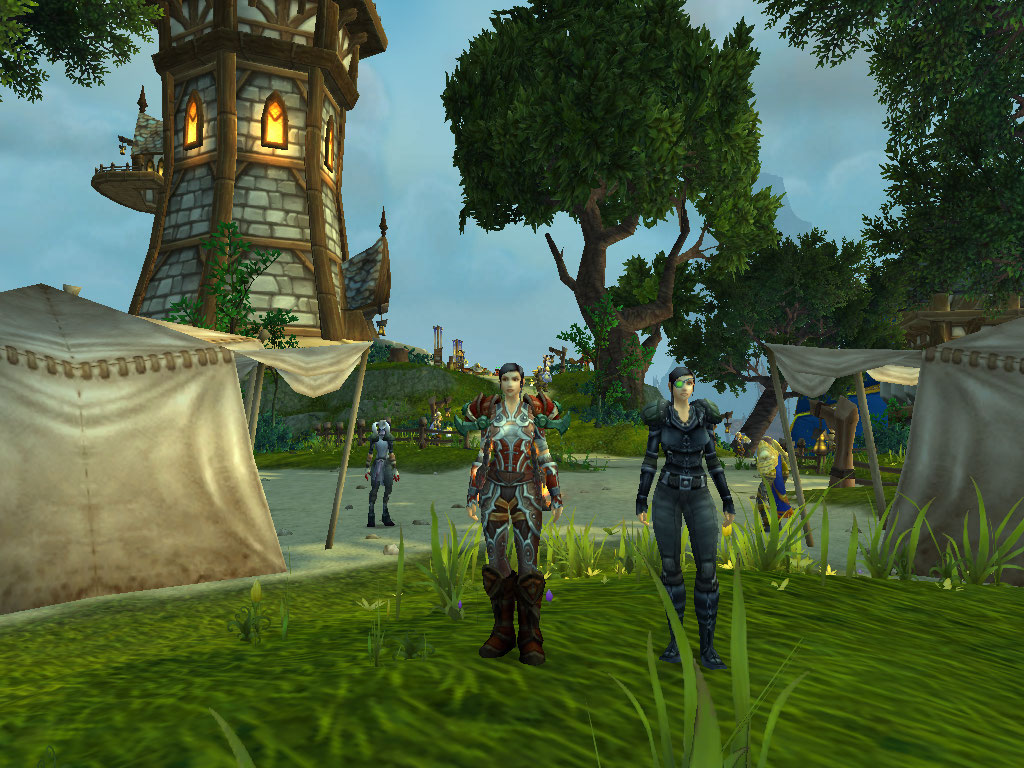
My rogue and her long lost twin, Amber KearnenA lot of people also argue that the Alliance’s base in Alterac Valley was – and still is – much easier to defend than its Horde equivalent.

Then there’s the fact that the majority of tie-in media for Warcraft has centered on the Alliance. Books tend to have a lot more depth than the in-game story, so that’s a big mark in the Alliance’s favour.

The upcoming Warcraft movie’s original script was also stated to be heavily focused on the Alliance. It was Duncan Jones that convinced Blizzard to give the Horde a bigger role.

The expansions:

I’ll freely grant that many of the expansions to WoW have favoured one faction over another, but it’s not as one-sided as some like to claim.

Burning Crusade was definitely a Horde expansion. Outland is the home of the Orcs and the Promised Land of the Blood Elves, so it only makes sense that it would focus on the Horde.

Wrath of the Lich King, on the other hand, was the Alliance’s story through and through. Every major story arc in that expansion put the Alliance front and center.

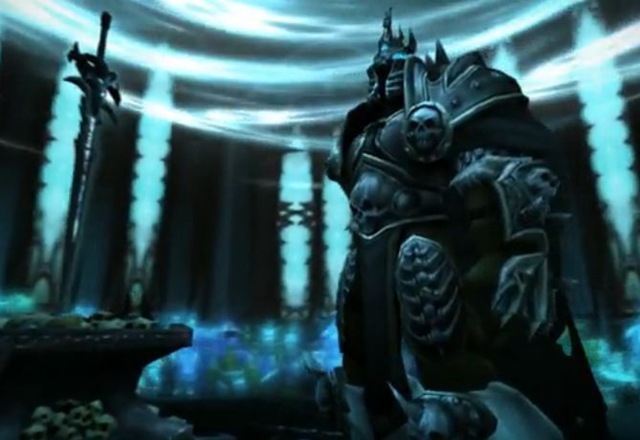
A screenshot from the Fall of the Lich King trailerThe war against the Lich King was led by Tirion Fordring and Darion Mograine, both former knights of Lordaeron. I’ve heard it argued that since they were neutral, they no longer count as Alliance, but they were certainly far closer to the Alliance than they ever were to the Horde. They fought to avenge Lordaeron, and in the case of the Argent Crusade, they were essentially a continuation of the Knights of the Silver Hand – an Alliance military organization that had fought the Horde in the past.

There’s also the fact that the Lich King’s Horde connections were completely ignored. I’m hard-pressed to remember any mention that the original Lich King was an Orc. Everything was about Arthas, even though he formed only fifty percent of the Lich King.

Then there was the storyline around Ulduar. The main character of this arc was Brann Bronzebeard, an Alliance hero. We got major insights into the origins of the Dwarves and the Gnomes, while learning nothing about the history of any Horde races despite there being plenty of opportunity to do so.

The Vrykul also provided insight into the backstory of humanity in the Warcraft universe, so that’s again an Alliance-centric story.

Finally, there’s the Nexus War storyline, which focused on Dalaran – an Alliance city. Yes, they may have chosen to accept the Horde’s assistance in battling a greater threat, but they’re still an Alliance city. All of the NPCs belong to Alliance’s races, its leaders are Alliance war heroes, the Horde’s representation is confined to one small corner of the city, and recent events clearly illustrate where Dalaran’s loyalties lie when forced to pick a side.

My rogue assists Jaina Proudmoore in purging Dalaran of the SunreaversIt is true that there were some good Horde storylines in Wrath: The Forsaken’s perfection of the New Plague and subsequent civil war, the introduction of the Taunka, Garrosh’s rise.

But it’s also true that all these storylines were essentially over by the time the player hit level 74, while the Alliance’s storylines continued through to the end.

My point here is not that Blizzard really favours the Alliance, but that they’ve been given their fair shake.

That brings us to Cataclysm, universally hailed as the epitome of Horde bias.

Yes, Thrall was the main character, but he’d left the Horde at the time. I’d be willing to accept that he still counted as a Horde character, but if you wish to put forward that argument, you can’t deny that Dalaran, Tirion, et al. were Alliance. There’s also the bizarre and utterly baseless belief that Thrall was rammed down our throats much more than any character had been in the past, but that’s a rant for another time.

The other complaints about Cataclysm are that the Alliance was always losing, and the Horde was always winning.

Neither is true.

Art of King Varian WrynnThe Alliance defeated the Horde numerous times throughout Cataclysm. They won in Ashenvale, and the only reason the Horde wasn’t driven from the forest completely was because they made a pact with a Demon. The Night Elves curbstomped the Trolls in Darkshore. Stormwind conquered Stonard in the Swamp of Sorrows — the oldest surviving Orcish settlement on Azeroth.

The forces from Theramore succeeded in conquering a good chunk of the Southern Barrens and razing Camp Taurajo — a strike at the very heart of Horde territory. The only reason the Siege of Orgrimmar didn’t happen then and there is that the Cataclysm split the Barrens and cut off the Alliance’s line of advance.

The Alliance may not have won in Gilneas, but they didn’t exactly lose, either. Despite being initially outnumbered and outgunned, they forced the Forsaken into a costly and humiliating quagmire war that is still raging.

Yes, the Horde won a lot. Maybe more than the Alliance. But this wasn’t a lore decision. It was to correct the original imbalance that existed in leveling content. All the Horde’s gains did was bring them even with the Alliance.

Meanwhile, the Alliance was constantly being presented as noble heroes who could no wrong, while the Horde suddenly devolved into their pre-Warcraft III Saturday morning cartoon villain status. There’s a reason why I switched to focusing on the Alliance in Cataclysm.

Mists of Pandaria:

My warlock rides to war on Orgrimmar with Vol'jinNow we come to the present day, where Horde bias cries are as loud as ever. I’ll grant that the Alliance got the shaft in Battlefield: Barrens, but otherwise, this was a very well-balanced expansion for both factions. Neither was shown as being perfectly good or perfectly bad, and each side got some great story moments.

I could go through all the examples, but I think it’s more worth talking about Siege of Orgrimmar and how it sums up the absurdity of this whole debate. Because as soon as it was announced, people were complaining that SoO was the latest example of Horde favouritism.

Yes, the Alliance invading the Horde capitol, smashing its military, and killing its leader is yet another example that Blizzard hates the Alliance.

I just can’t take this “Horde bias” talk seriously when people make arguments like this. There are even now plenty of people complaining that the Alliance never got its promised “fist pump moment.”

What part of ransacking the enemy capitol doesn’t qualify as a “fist pump moment”?

Honestly, what more could Blizzard have possibly done? Destroyed Orgrimmar and left the Horde without its main hub city? Spend weeks redoing all the quests and game mechanics associated with it? Removed the Horde from Ashenvale or another leveling zone, once again ensuring the world favours the Alliance?

My rogue plants the banner of Theramore in OrgrimmarAll things like that would do is punish the players. And I don’t remember having a say in whether Garrosh would become warchief, so that’s nothing but petty.

I’m really starting to think that most of the people complaining about Horde bias would not be satisfied by anything short of the complete removal of the Horde from the game.

Not that there weren’t missed opportunities for Alliance story. I’m pissed we never got that “Trials of the High King” questline. It sounded awesome. But the same is true for the Horde. There was massive build-up of both Saurfang and Sylvanas’s enmity for Garrosh, but they were all but ignored in the final climax of the story. Garrosh murdered Baine’s father, but Baine never got to play a major role in the warchief’s downfall.

The same is true of the game’s past history. The Alliance has some very legitimate cause for complaint that some of its races and leaders have been ignored — Tyrande comes to mind — but so do the Horde. Hell, Gallywix is the only racial leader who isn’t actually in the game. Lor’themar was the poster child for ignored characters up until recently. It took until MoP for Blizzard to even figure out how many eyes he has and get him a voice actor that can pronounce “Quel’thalas” correctly.

Warlords of Draenor:

Of course, there is one more part to this story. For once, I am inclined to agree that the Alliance has a right to complain about being ignored when it comes to Warlords of Draenor. I really can’t see them getting a lot of interesting story out of WoD, and if they do, it’ll just be more Draenei stuff.

Concept art of Shadowmoon Valley for World of Warcraft: Warlords of DraenorBut then again, it’s not looking too good for the Horde, either. There seems little or no opportunity for development of any Horde races other than the Orcs, who have already had plenty of time in the sun. I’m a big fan of Orcs, and even I’m not thrilled with an entire expansion of the Orcy McOrc Show, with Special Guest Star Orcs.

There’s also the fact that all of the Horde’s iconic heroes are being brought back from the dead to be loot pinatas. It’s hard to imagine an outcome for WoD that doesn’t crap all over the Horde’s history and past heroes. And it’s yet another thing to add fuel to the arguments that Orcs really are evil after all, as all of the iconic chieftains are being presented as villains even without Demonic corruption.

It’s not so much that WoD is looking bad for Alliance lore as it is that WoD is looking bad for lore period.

And this brings me to my final point.

Stories aren’t fair:

There is no Horde story and Alliance story. There’s just the story. Sometimes, it will favour one faction. Sometimes, the other. Perfect balance will never be achieved, nor should it be.

Can you imagine how boring the lore would be if each faction experienced joy and suffering in exactly the same proportion? There’s nothing Blizzard could do that would suck the fun out of the story worse than that.

A first person view of tanking the Sha of Pride in World of WarcraftStories aren’t fair. Sometimes, your favourite characters have bad things happen to them. Sometimes, the characters you hate triumph. That’s the nature of story-telling. The essence of drama is conflict, and you can’t have conflict without a little injustice.

Everyone would enjoy themselves a lot more if they just stopped getting so invested in the fates of fictional factions. Stop counting up each victory and defeat, looking for any perceived slight to your chosen team. Just enjoy the story for what it is.