
Last night, I got an email from Daybreak Games about Landmark. With a sinking feeling in my stomach, I clicked and found my fears confirmed: Landmark will be shutting down next month.
 If I’m being honest, this isn’t hugely surprising. Landmark has struggled to find an audience since its inception, and while I didn’t expect the end to come quite this quickly, I thought there was a pretty good chance it wouldn’t survive the year.
But that doesn’t make the news any easier to hear. Landmark has never been a focus of my gaming time the way titles like World of Warcraft or The Secret World have been, but the 72 hours I’ve logged in it (according to Steam) is still more than you get out of most single-player games, and while my play has dropped off over the last few months, I’ve always enjoyed the time I’ve spent with it.
Landmark was a very bare-bones game, but the potential of what you could create was always exciting, the beautiful works of fellow players always inspiring. Gorgeous graphics, lovely music, a warm and welcoming community, and an endless stream of new sights to see made it a great game for relaxation.
I am reminded of some of the most impressive things I’ve seen. One person on my server bought up builds all along one coastline and built themselves an entire kingdom, with castles and towns and outposts. Another constructed a huge hollow tree with an incredibly beautiful and detailed home amongst the branches. I’ve seen screen-accurate replicas of the Enterprise and the Serenity, functioning Stargtes, and even a Tim Horton’s.
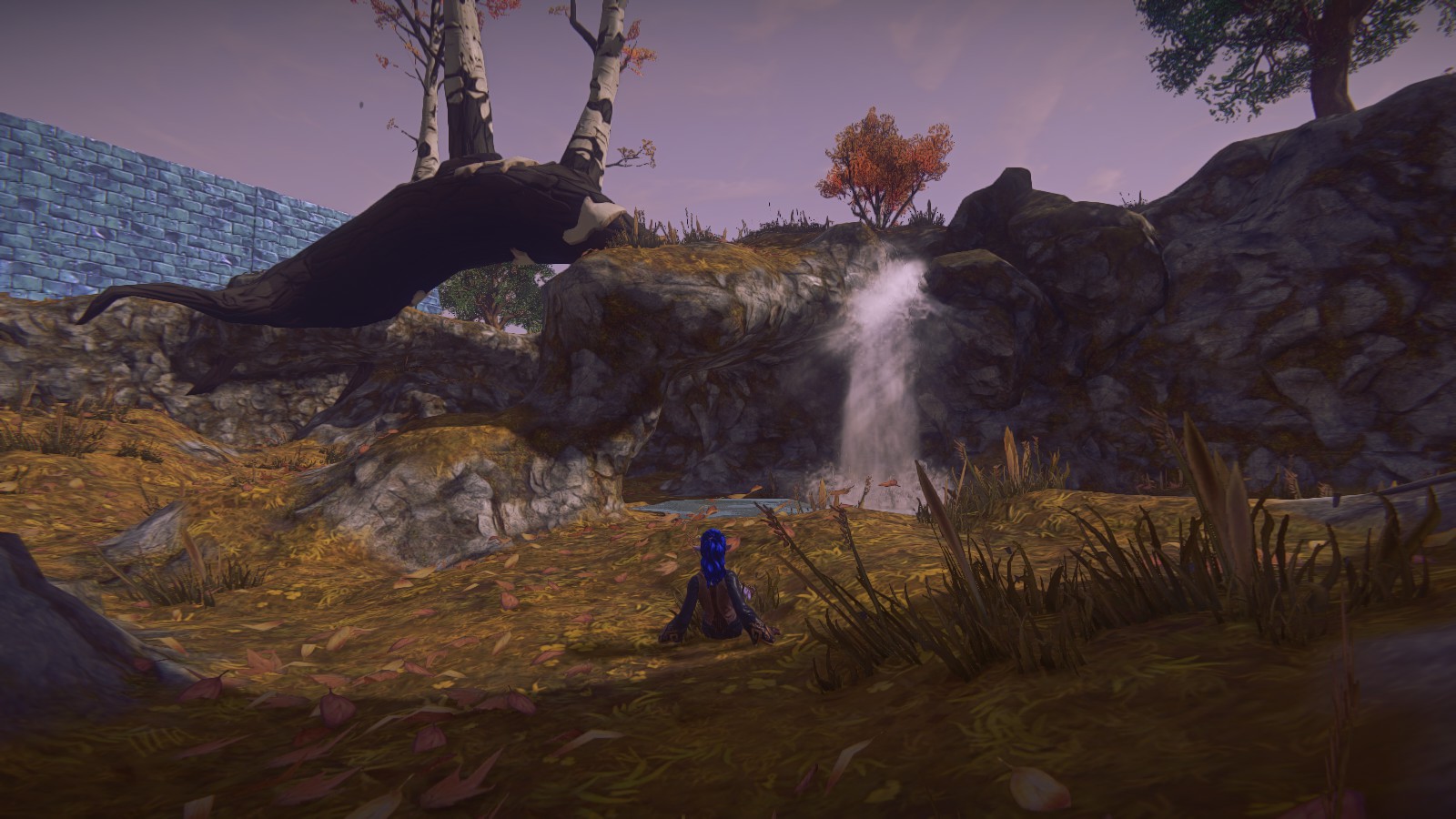
I think, also, of my own builds. I think of all the hours I spent perfecting my ambitious second build, and I can’t help but be frustrated that the Vale of Whispers’ life will be cut so short. I try to comfort myself with the knowledge of the players who’ve visited and enjoyed it.
 I think the first build is what I’ll miss the most, though. I built Maigraith’s Grove to be a serene place capturing all that I love about the fantasy genre, the natural world, and the interplay between the two. It was a wonderful place for relaxation, a literal happy place, and even as my time in Landmark dropped off, the mere knowledge of the Grove’s existence provided me a certain comfort. I may have grown up to be a city boy, but on some level the forest will always call to me, and my first build was a way to connect with that part of myself.
In a few weeks, they will be gone forever. I have taken many screenshots, and I may take more, but it will never be the same.
The journalist in me is watching my own reaction to the news with a kind of cold fascination. I’ve long lived with the knowledge that MMOs don’t last forever and that sooner or later I would become one of those people mourning a game lost, but this is the first time an MMO that I actually care about has shut down (it’s the third MMO I’ve played to sunset, but I had no real investment in or attachment to Dragon’s Prophet or Trinium Wars).
I am curious to see how I will cope with Landmark’s impending end. Will it motivate me to enjoy the game while I still can, or will the futility of it all drive me away?
My feelings can and likely will evolve over the coming weeks, but right now one emotion is drowning out all the others: Anger.
 To be blunt, I think the blame for Landmark’s end rests squarely on the shoulders of the MMO community.
When EverQuest Next was cancelled, the community turned on Daybreak, apparently not understanding that sometimes new concepts simply do not work. I, too, was disappointed by the cancellation of what looked to be a very promising game, but as someone who works in a creative field myself, I understood that it was simply a failed experiment. Unfortunate, but sometimes unavoidable.
The community, however, chose to demonize Daybreak as some sort of ogre. They took EverQuest Next’s cancellation personally. And a lot of that hate spilled over to Landmark, the proverbial lemonade made from EverQuest Next’s remnants.
People hated Landmark because it wasn’t Next. People hated Landmark just because it was made by Daybreak. People hated it because they had misinformed or unrealistic expectations of what it was supposed to be.
Landmark was never given a fair chance by the community. It was written off as a failure before it launched. It was lambasted with unfair and often misinformed reviews. It was attacked at every turn.
That’s not to say that all criticism of the game was unfair, or that it was by any stretch of the imagination a perfect game. It was grindier than it needed to be, its combat was weak, and it suffered from an unacceptable level of bugs and technical hiccups.
 And it is true that Daybreak has mismanaged it in some ways. It didn’t seem to get much in the way of marketing, for one thing. But far less deserving games have succeeded where Landmark failed. If Daybreak is the one that steered it into dangerous waters, the community is still the one that sunk it. Again, it was simply never given a fair shot.
I have long been a harsh critic of the state of the gaming community, and I’m sad to say that my cynicism has once again been proven right. We live a world where people cheer for games to fail, where the slightest misstep by developers is met by a level of bile that should be reserved for war criminals.
People are always wondering why MMO developers are so risk-adverse. Why they so rarely try new things, why they tend to be so cagey and uncommunicative. Look in the mirror, because that’s where you’ll find your answer.
I did have a nice if bittersweet time commiserating with the other Landmarkians last night. Lots of people visiting each other’s builds while they still can, lots of support. I got a nice compliment on my build from one person. They’re trying to find a way to keep the community together even after the game shuts down. I haven’t played the game enough to rightly count myself a member of the community, but I wish them well.


 Superior Realities