Review: Shadows of the Apt: The Air War + New Banner

Behold the shiny new banner for Superior Realities! Handcrafted by yours truly by the finest fan and concept art Google can provide. Bask in its bannery bannerness!

Review: The Air War:
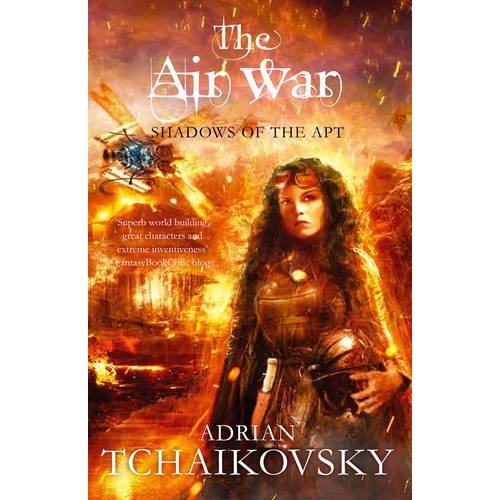
Cover art for "Shadows of the Apt, book eight: The Air War" by Adrian Tchaikovsky“The Air War” — a book that will in my mind always be called “The Wasp Empire Strikes Back” — is the eighth installment of “Shadows of the Apt,” the steampunk/fantasy epic by Adrian Tchaikovsky. For background on the series, see my reviews of the last two books.

In many ways, “The Air War” is exactly what I wanted. After three books of the calm before the storm, we’ve finally reached the storm. The Wasp Empire has recovered from its prior defeats. Empress Seda has consolidated her power, both political and magical, and now stands poised to unleash both the nightmarish magic of the Inapt and the industrial brutality of the Apt upon her foes.

And yet, I found “The Air War” just a bit underwhelming compared to how stellar the last book, “Heirs of the Blade,” was. I think there are two reasons for this.

The first is that Tchaikovsky has started to fall into the trap many authors of long stories do: the cast is simply getting too big. “Shadows of the Apt” was already an incredibly vast story with numerous major characters, each with their own arcs, but “The Air War” heaps even more new characters and subplots onto the proverbial plate.

The story is now so crowded that it’s becoming difficult to get invested in any particular character or plot, because the moment you do, you’re yanked to the other end of the world for another subplot, and it could be multiple chapters before you get back to the first character.

And despite the overcrowding, some characters are still managing to get neglected. After an entire book devoted to the adventures of Che Maker, it’s jarring that she is mentioned only once in all the six hundred pages of “The Air War.” And things just aren’t the same without Tynisa or Thalric.

To be fair, Tchaikovsky is still doing a better job of handling his characters than many other authors in similar situations. He has not yet reached the point Raymond Feist is at, where he’s just churning out an endless stream of generic and unimportant characters for no apparent reason. Even if I wish he’d focus on old characters instead of new ones, I must admit the new ones are pretty well-crafted.

The other issue is that it becomes clear very early on in the book that this is hour of the Wasp Empire’s ascendance, and that nothing is going to stop them. At the risk of giving too much away, “The Air War” is essentially just an endless litany of Wasp victories.

Keep calm and defend CollegiumOn the one hand, this does add a nice intimidation factor to the Wasps, which I feel they’ve generally lacked, but on the other hand, it gets repetitive.

I like books where the protagonists are frequently on the losing end of things. I’ve even written a few myself. But there needs to be some balance. The good guys need to win a few times, or at least come close, to throw their losses into even starker relief. There’s none of that here. I apologize for the gamer lingo, but this book consists almost entirely of the Wasps facerolling the rest of the world.

Still, “The Air War” has a lot going for it. It’s pretty much non-stop action from start to finish, and Tchaikovsky’s action sequences are not something anyone in their right mind is going to complain about.

There were also some characters that really stole the show.

The first, unsurprisingly, is Seda. She is well on her way to becoming one of my all-time favourite fantasy villains. Her depraved passions and utter ruthlessness are absolutely chilling, and the way we’ve seen her progress from someone utterly helpless to the most dangerous woman in the world is just masterful.

The second was surprising. Jodry Drillen, speaker for the Collegium Assembly, was never a character I took much note of. While not a bad man by any means, he was always portrayed as a politician to the core — a morbidly obese Beetle who loved power and its privileges. He never struck me as heroic, or even particularly likable.

But as the war wears on, a very interesting change comes over old Jodry. His veneer of political calm is slowly stripped away, and we’re left with our first real glimpse of the man beneath the calculated public image, and there’s more steel and more compassion there than one might have expected.

Also, while not a specific character per se, I quite enjoyed the portrayal of the citizens of the city-state of Myna. I don’t want to give too much away, but… let’s just say Mynans are badasses.

In the end, “The Air War” is a pretty solid book, but I’d hoped for more.

Overall rating: 7.4/10 Neither the best nor the worst installment of the series.

New articles:

What MMO has posted a couple more of my articles: Top 6 Hidden Talents of MMOs and 7 Habits of Highly Ineffective Players. Enjoy.

Original Fiction: The Ghosts of Contests Past

It’s been a long time since I posted any of my fiction. Writing is a personal business, and it’s always hard to share it with the world. But this is supposed to be a blog about my writing, and not just my freelancing, either.

Recently, I was looking through the old writing contests held by myself and a few other writers over at TrekUnited.com before the site essentially died. I found a lot of my stories there that I’d forgotten even existed, and I wanted to give them new life. Some of them might not be very good, but it was interesting to stretch myself as a writer, if nothing else.

Don’t worry; they’re not Star Trek stories. The contests just happened to take place on a Trek site.

Each contest would have a prompt — either a word, phrase, or a picture — and I’ve included the prompt for each story.

All stories are © Tyler F.M. Edwards.

Enjoy!

The Fall:

Prompt: “Crumble into chaos” plus the following picture:

A photo used as the prompt for my story, "The Fall"The distant screams faded away as he headed deeper into the park. It was quiet here, peaceful. Everything was neat and orderly, arranged into a harmonious union of nature and civilization. It was late autumn, and the bright flowers, emerald leaves, and lush grass of summer had faded, but they had only given way to a starker kind of beauty.

He headed down the white stone paths, admiring the gentle clatter of barren branches in the wind, the subtle play of mist along the ground, and and the refreshingly cold air. The day was overcast and grim, but still beautiful. He tried to savor it all without wasting too much time. There was little time left to waste.

He came to a steep stone bridge over a tranquil canal. He walked to its top and looked out. From here, he could see the order of the park spread out before him and gain an impression of the city beyond. And of the fires outside it. Out beyond the city, the bleak but pure gray clouds gave way to churning red-black skies.

He could hear the screaming again. The forces of chaos were closing in.

His gaze again swept the park, and a single tear rolled down his cheek. All this would soon pass away. All things must end, and soon, all things would. The fight was nearly over. The enemy had won.

But there was still one act of defiance left to him.

He looked down at the mirror surface of the canal. The bridge’s reflection seemed to link up to the actual structure, forming a perfect ring. It gave the place an uncanny quality–but there was more to that than an unusual reflection. This bridge was located at the exact center of the park — in fact, the very center of the city, the last bit of land unclaimed by chaos — and that gave it power. But even before that, it had been a place of significance, of wild energy never fully tamed. That was why the city had been built around it.

Once, his people had been great, and he had been among the greatest of them. He extended his hands, calling on the last vestiges of that power. A thin bubble formed between his palms, and images flickered within it. Some were images of nature: trees, grass, the sunrise, the flow of stars across the night sky. Others were of people: a laugh, a quite moment between two lovers, a child at play. It contained an echo of everything that had once been good in the world.

He separated his hands, and the bubble slowly drifted down until it disappeared into the water of the canal. The forces of chaos were about to destroy the last unclaimed holdout of order, but the future would hold more than the utter desolation they sought. One day, long in the future, the seed he had planted would sprout, and the world would begin anew. It would not be the same as it had once been, but it would be good in its own way.

The last of the city’s defenses had now failed. Flames licked the trees at the edge of the park. The sky churned maddeningly. The terrified screams of his people were giving way to the frenzied cries of a thousand thousand fallen souls, the darkest parts of history dredged up to bring about its end, the forces of chaos.

As the last bastion of order crumbled into chaos, he felt himself do the same. He at last gave way to grief within him, turning it into a searing rage. He tore the fires from his enemies’ control, swirling them into a vast whirlwind above his head. And then, as they closed in, he unleashed their own power against them, his furious howls mingling with the roar of the flame.

The Tale of the Sentient Solstice:

Prompt: “Sentient solstice.”

Come close, my boy, and I will tell you the tale of the Sentient Solstice.

Those in the cities will tell you it’s a myth, an old superstition. But it’s all too real, my boy.

In everything, there dwells a soul. In you and I, yes, but also in the trees and the grass, the stone and the water. For most things, that soul lies dormant. But once every few years, when the days are longest or shortest, those souls waken, and things come alive.

Lock your doors and seal the shutters on the Sentient Solstice, my boy, for it is a perilous time. Do not walk in the woods, or your bones will hang from the branches. Do not walk upon the fields, or your flesh will fertilize them. Do not swim in the waters, or you will never see the surface again. Do not walk upon the roads, or the soil will swallow you whole.

Some say it is punishment for man’s crimes against nature. Some say the other souls are envious of the fact we never go dormant. But all who are wise agree that the only safe spot on the Sentient Solstice is barricaded within your home, where you are outside the reach of the trees’ grasping branches and the hungry earth.

So remember the Sentient Solstice, my boy, and beware, for on that day, all things come alive, and man has no sway.

Remember:

Prompt:

Art used as a prompt for my story, "Remember"He still remembered the war. He remembered the sting of shrapnel and the screams of his friends. He remembered the thunder of artillery, and he remembered death.

He remembered the funerals. He remembered the grave markers, row on row, before the church, and he remembered the weeping of friends and family. He remembered, too, when the war had spread, and this place had been abandoned. He remembered watching the church fall into disrepair, and the graves of his friends go untended.

Now, alone on this mountaintop, he remembered, but no one else did. He knew not if the war had ended or if it continued still, but years had passed, and no one, friend or foe, had come in all that time. He alone of all the people in the world still kept to this place and remembered the sacrifices of the past.

He could not rest. To do so would be to betray the memory of his fallen friends. And so he stayed by their side, as he had in life, through the cold mountain winters and the bright summers, through rain and sleet and the passage of time. Alone on the mountain, he kept his endless vigil, and he remembered.

The Monkey:

Prompt: A monkey wearing a beret.

I’m home now, but I used to do a lot of traveling. Had some of that — what do you call it? — wanderlust, I guess. Never could stay put. Always wanted to keep moving on.

I went all over the world. I’ve been to more weirdo hangouts and forgotten towns than I can even remember. I’ve seen things you can’t imagine in places you’ve never heard of.

The weirdest place of all was this little bar on the bad side of nowhere. It was around sunset, and I was hoping they could get me a drink and maybe tell me someplace I could stay for the night.

Right away, I could tell it was a strange place. When you’ve seen as many as I have, you kinda get a sense for it. The decorations were just a little too far to the left of normal; the cigarette smoke was just a little too thick. I shoulda turned around then, but I was tired.

I shuffled up to the bar, looking around. They had this big pool table covered in purple felt — I mean, really, everyone knows pool tables are supposed to be green — and the jukebox was playing what sounded like Elvis songs covered by a teenage Russian girl. Just strange, man.

The clientele were damn strange too, though I don’t remember much about most of ’em. A few had eye patches and other weird crap that made them look like cartoons. I remember they didn’t seem to like the look of me. Guess they didn’t get a lot of strangers around there. I can understand why.

I sat down at the bar and ordered a drink. They gave me something that I guess was supposed to be beer. I glanced over to my right, and I saw a monkey sitting at the end of the bar.

That’s right. A monkey.

He was old and shriveled up like a prune, and he was glaring at me like it was his stool I was sitting on. He was chompin’ this huge cigar, and he had a beret on.

Now just think about that for a minute. A monkey wearing a beret. Chomping a cigar and giving me the stink eye. Weirdest damn thing I ever saw.

Anyway, after that, I decided it was time to come home.