
I think there’s a rule somewhere that if you blog about MMORPGs, at some point you need to do a rant about the “holy trinity” of group roles (tank, healer, DPS). For or against, it doesn’t matter. You just have to do one. I have decided, if only out of a sense of obligation, that it is time for me to undergo this time-honoured rite of passage.
 This is a very complex topic, and I wish to be thorough, so I will be doing this a series of no less than three posts.
Oh, yeah, I’m milking this one. Milking it dry, baby!
Introduction:
To start with, I’m going to lay out the basics: my view on the trinity and its flaws.
If I had to pick a side in this endless debate, I would go with the “against” faction, but really my view is more nuanced. There are some people who truly hate the trinity, who want it dead and buried, but I’m not one of them. I’m not a particular fan of the trinity, but it’s a functional system that has been well-polished over the years. I play plenty of games with the trinity, and I enjoy group content in these games well enough.
What does bother me is when people start to treat the trinity as be-all and end-all, the only system under which you can have interesting group mechanics.
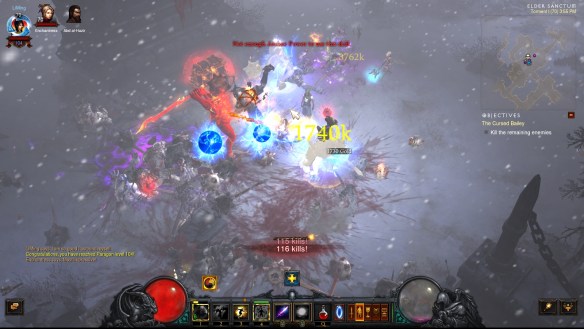
This is of course nonsense. The vast field of non-MMO multiplayer games without the traditional trinity (at least as we see it in MMOs) quite thoroughly debunks such a notion. ARPGs like Diablo are an especially good example — they share much of the same DNA as MMOs, have nothing resembling a rigid trinity, and offer fun and satisfying group play.
 What I am sick of is the trinity being the default setting. I don’t mind that it exists, but I do mind that there’s almost no escape from it. It’s one option among many, and it doesn’t need to be as stiflingly omnipresent as it is. If you take nothing else from my trinity of trinity posts, let it be this: I want variety.
That’s not to say the trinity doesn’t have its virtues. The biggest, in my mind, is offering a variety of playstyles. It gives classes and builds clear identities and sharply distinct ways of operating. That’s a good thing.
But the trinity also has many flaws. Let’s go over some of the biggest:
It spreads responsibility disproportionately:
This is possibly the biggest issue. Under the traditional trinity, there is a wild disparity in the responsibility placed on different roles.
With only a single tank or healer in the average group, those two individuals face tremendous pressure. A single mistake by either can not only get themselves killed, but the entire group.
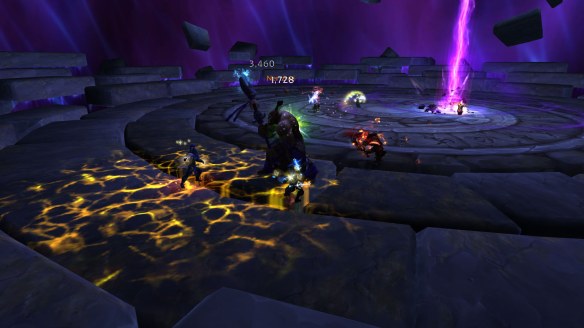 And the MMORPG community is not forgiving. One mistake, and you run the risk of being verbally raked over the coals and/or summarily kicked from the group. Even when things are going well, the pressure is constant. It’s very hard to relax while playing as a tank or healer, and that’s not a good thing for a game, or any form of recreation.
Meanwhile, damage dealers have no such worries. It’s possible for them to screw up badly enough to wipe the group, but the odds of that happening tend to be a lot lower. If a DPS dies, it’s an inconvenience, but rarely crippling. It’s far less stressful.
I firmly believe this is the main reason why DPS tends to be overwhelmingly the most popular role. I know it’s why I spend so much more time playing DPS than anything else, even though I like the mechanics of the other roles.
This ties into the next issue…
It makes finding groups difficult:
We’re all familiar with this. Because DPS outnumber tanks and healers so utterly, it makes finding groups as a DPS far more difficult. You can end up waiting twenty minutes or more, and that’s if your game has auto-grouping. Heaven help you if it doesn’t.
 Meanwhile a tank can find a group as quickly as they click the queue button or type the words, “Tank LFG.”
It’s unrealistic:
Immersion is very important to me. It’s the great strength of the RPG genre, the ability to fully inhabit another life, another world. The trinity, however, is an absurdly gameified system that shatters said immersion. It could not be more divorced from real combat, and it rips you right out of the experience, forcibly reminding you this is merely a game.
The purpose of the trinity is to bring order to combat, but combat isn’t orderly. It’s anything but, especially in a pseudo-Medieval setting. Do you have any idea how often soldiers in the old days ended up stabbing their own allies because things were just that chaotic?
“But they’re fantasy games! Realism doesn’t matter!”
Yes, and no.
Nobody’s expecting a highly realistic experience from an MMORPG. I doubt anyone truly wants one. But there is the issue I love to raise: verisimilitude. A game need not be true to life, but it should create a convincing illusion of truth. I should be able to suspend my disbelief.
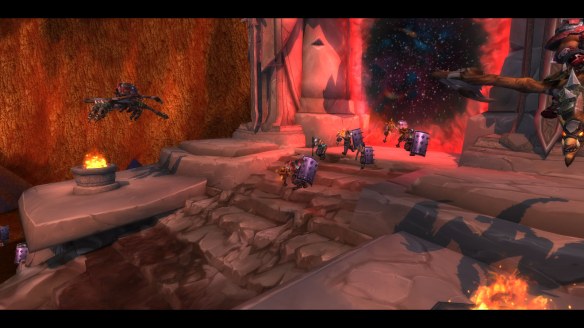 I can’t suspend my disbelief for the trinity. It’s too ridiculous. Every enemy develops tunnel vision on the one person who presents the least threat, magically ignoring everyone else, who just stand around doing their thing unmolested.
It doesn’t even make sense within the fantastical absurdity of a fantasy setting. There is no lore justification for the trinity. Imagine the initial Dark Portal cutscene from Warlords of Draenor under trinity rules. The entire Iron Horde dog-piles Maraad while Thrall stands in the background spamming chain heal and Khadgar just sits perfectly still firing off arcane blasts with impunity.
That would have been one crumby cinematic.
The other thing is that the point of unrealism in games is to make things more exciting than reality. Is it realistic when Anjali leaps into the air and crashes down on her enemies in a blaze of holy fire? Hell no, but it’s awesome, so who cares?
The trinity isn’t awesome. It’s functional, but not awesome. There’s nothing about the trinity that heightens the thrill of battle. Its artificiality is an unpleasant side effect, not a desirable feature.
It compartmentalizes combat too much:
Under the trinity, you only experience a narrow sliver of combat at a time. Only tanks directly interact with enemies, only healers directly interact with allies, and only DPS make a real impact on enemies and have the satisfaction of those big, juicy numbers.
 Yes, you can play multiple roles to get the full experience, but you’re still only seeing one part at a time. In a discussion about this on another blog aways back, I said it was like eating a piece of bread, then a wad of peanut butter, then another slice of bread. It’s the same meal in the end, but it’s more enjoyable in the form of a peanut butter sandwich.
It doesn’t mesh with solo play:
The interesting thing about the trinity is that it can screw things up even when you’re playing alone.
Soloing as a tank or healer is infamously painful, which is probably another reason they tend to be relatively rare. Games have gotten better over the years at making questing as a non-DPS less Hellish, but it’s still significantly sub-optimal.
Similarly, tanking and healing can’t exist outside of a group. You’re essentially a crippled DPS at that point. This is especially true of healers; at least there’s some overlap between tanking in a group and playing as a tank solo.
This means tanks and healers can never really practice their skills without risking a whole group of players. Coupled with the social pressure mentioned above, this presents a massive barrier to entry for these roles. DPS may not play exactly the same in groups as they do solo, but the basics are the same, and if you’re stepping into early content, you can pretty much just do what you would when questing and at least do okay. Tanks and healers have no such luxury.
* * *
So those are the main problems with the trinity, at least as far as I’m concerned. Next time, I’m going to look at some of the best group experiences I’ve had without the traditional trinity to help illustrate that things can work and work well without it.
 For all their flaws, though, each of these developers brings something special to the world of gaming, something exquisite that keeps me coming back for more. I thought it would be interesting to look at these companies and explain why I am so loyal to them, despite everything.
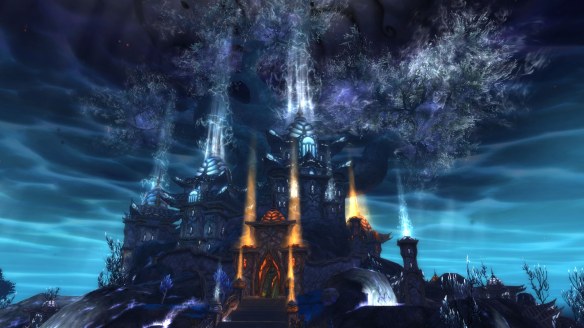 Have you ever seen Chris Metzen talk about the games he’s worked on? He’s the living embodiment of childlike joy and enthusiasm. He has so much passion for Blizzard’s games it’s like he could spontaneously combust at any moment.
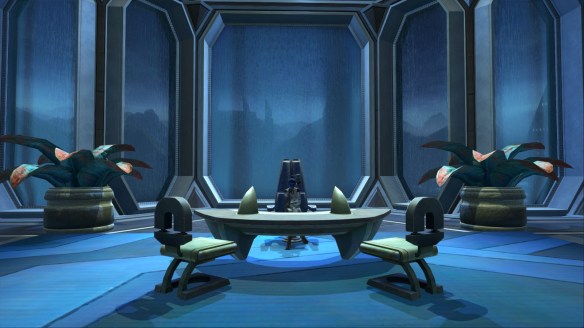 That leaves story-telling as Bioware’s strength, but even that isn’t entirely true. The main storylines in Bioware games are, at best, hit and miss. The only ones that really impressed me on that front are Dragon Age 2 and Mass Effect 3 (yeah, I’m a freak). Origins’ story was just weak, Inquisition and ME2 had potential but became entirely too bogged down with irrelevant side missions, and ME1’s story was okay but not exactly mind-blowing.
 It appeals to me as a writer, too. All the hard work of building a world and characters is done for me, and I can go nuts telling the story I want to.
 But even there, the depth of hatred I have for these characters speaks to their quality and realness.
 I’m already kind of excited about Vampyr, and I don’t even like vampire fiction.
