
After going on the backburner for a few months, The Park and Halloween got my interest in The Secret World revved up to a fevered pitch once again. After yet another night of staying up past midnight reading theories on the lore forums, it occurred to me I’ve never much talked about my own theories surrounding the many mysteries of the Secret World.
 I thought it might be interesting to have a public, written record of them so that I can either crow when they turn out to be right, or laugh at how hilariously wrong they turned out to be.
Be aware that this entire post will contain massive spoilers for the entirety of the TSW mythos to date, including The Park.
Cassandra King is a descendant of King Arthur:
The general instinct of most people in the TSW community seems to be to just assume everyone is a god or a mythological figure in disguise. Most people tend to be of the opinion that Cassandra King is someone from Greek mythology, perhaps the Trojan Cassandra. I’ve also heard her hypothesized to be Artemis, Aphrodite, and a bevy of other ancient fertility goddesses.
I really don’t like the idea of Cassie being an immortal, though. The whole appeal of her story is that she’s an ordinary girl — well, as ordinary as a precocious self-taught sorceress can be, anyway — who managed to outsmart the big three secret societies and the very god of deceivers.
There isn’t really a lot to support the idea, either. Just her first name and her “Do you have any idea who I am” line.
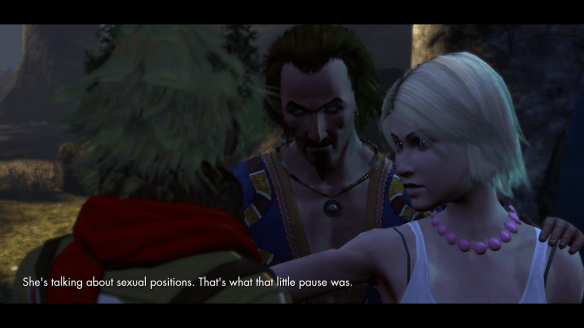 I prefer to focus on the significance of Cassie’s surname, and in so doing, I find a way to explain her importance while mostly maintaining her hook as a “normal” who beat the greats of the Secret World.
What are the odds that a woman named King wound up stealing Excalibur?
I think Cassie is a direct descendant of King Arthur. This is sort of the best of both worlds. It more or less maintains her identity as a normal person who made her way to greatness — Arthur’s line having theoretically languished in obscurity for centuries — while also explaining the line, “Do you have any idea who I am, or what I am about to become?”
If she were already a goddess, what is left for her to become? But if she is an ordinary person from an extraordinary line, regaining Excalibur could make her truly a force to be reckoned with.
This could also explain what she’s doing in Scotland. Perhaps Excalibur will grant her access to further treasures or powers that are the legacy of her family, which have lain hidden in the British Isles for centuries, waiting for the true heir to the king to return.
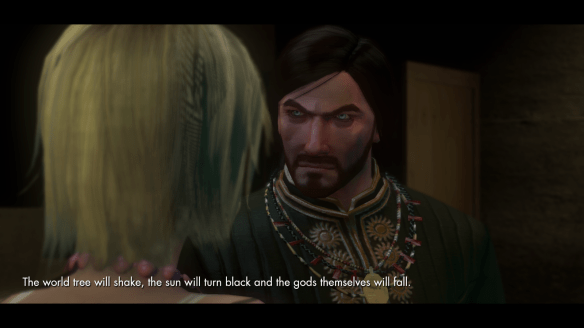 Finally, depending on which version of things we follow, this could also make Cassie a relative or descendant of Morgan le Fay, which would explain her talent as a witch.
There are many Hells:
This one started when I first stepped into the Niflheim holiday dungeon. It was clearly part of the Hell Dimensions, but also totally unlike the Hell dungeons we had explored before.
Then it occurred to me that it’s always been the Hell Dimensions, plural. And there are a lot of references in Tokyo to “the Thousand Hells.”
So I don’t think Hell is a single place. I think there are many Hells, and the one we explored with Wicker was just one of them. Niflheim is another. Who knows how many more there might be?
Emma Smith might be Lorraine Maillard’s daughter:
I’m offering this as an uncertainty because there’s a lot of things about this that just doesn’t add up, but it’s too intriguing not to mention.
 The Park is full of subtle nods to TSW, but one that totally passed me by on the first play through has the potential to be a major revelation. Don’s letter to Lorraine mentions that he wanted to name their child Callum if a boy, or Emma if a girl.
I don’t believe in coincidence where TSW is concerned. I’m sure Joel Bylos knew what he was doing when he put that in there. It might just be a deviously clever red herring, but it’s definitely meant to make us wonder if Emma Smith might somehow be Lorraine’s long lost daughter.
If that’s the case, there are basically two possible scenarios.
One is that Emma is Callum’s twin brother. Perhaps, for whatever reason, when Lorraine was released from the mental asylum, the authorities only gave her back Callum. Perhaps Emma was even abducted by the Orochi Group or one of the secret societies. Lorraine, already somewhat unhinged at this point, repressed all memory of Emma’s existence.
In this scenario, Emma’s powers could be explained as the result of Lorraine’s latent sensitivity to the occult and/or the influence of the dark power in the Atlantic Island Park.
The main problem with this theory is that the timeline doesn’t add up at all. Callum was born thirty years ago, but Emma looks to be around eight years old in TSW. That said, she’s definitely not an ordinary girl, so perhaps she doesn’t age normally.
 The other possibility is that Lorraine had Emma much later, after the Council of Venice implanted the bee in her. Being the child of a bee, especially a unique artificially created bee, could definitely explain where Emma got her power from.
The main issue with this theory is that it’s a bit hard to believe Lorraine would have another child after what happened with Callum, but she is pretty unstable, so her behaviour is difficult to predict.
Both possibilities have the issue that Emma seems to be British, and Lorraine definitely isn’t. This could, however, be explained by Emma not being raised by her biological mother. Certainly no one — not even Lorraine if she was sufficiently lucid at the time — would think letting Lorraine try to raise another child could be a good idea.
The one final flaw is that Emma has made clear her real name is Anima, not Emma. But perhaps this is her own invention, and the name Emma came first?
It’s all a big long shot, for sure. But it’s intriguing.
Consider that the story of Lorraine and her son is constantly being compared to Hansel and Gretel, but if Callum is Hansel, who’s Gretel? And is it a coincidence that both Callum and Emma have a teddy bear as a central part of their story?
Daimon Kiyota is not a god:
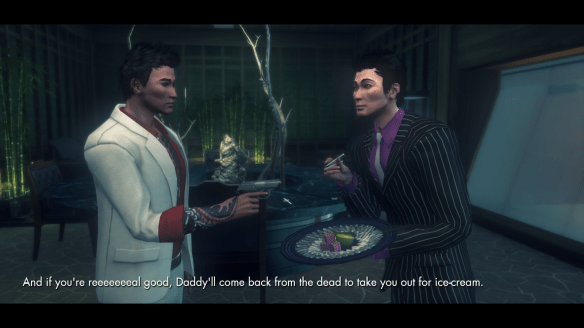 This isn’t so much a theory as a counter to a theory, but I’ll include it anyway.
Daimon Kiyota is another character widely speculated to be a mythological figure in disguise, likely a Shinto deity, but I personally don’t buy it.
As with Cassie, a large part of the appeal of Daimon’s character is that he is (supposedly) a normal person who has managed to make himself a force to be reckoned with in the world of the occult. This is all but confirmed by the turn-in text for The Seven Silences.
Now, I do think Daimon is at this point fairly extraordinary. I’m pretty sure his “father,” who visited New York, was really just him, and if that’s true, that means Daimon hasn’t aged since the 1920s. I’m pretty sure he’s got some funky powers going on, possibly related to the pachinko machine (which wasn’t always a pachinko machine, but it always was). I think Daimon started out human, but he may not be anymore.
But a god? No, I don’t think so.
The woman who came between the brothers in Babel was Lilith:
Pretty much that. We know that the secret society that would become both the Templars and the Phoenicians was ruled by two brothers from the Tower of Babel, but that a woman came between them, sundering their bond and the society they ruled.
 That sure sounds like something Lilith would do, and we don’t have a lot of other strong candidates.
Interestingly, this is another thing that some people want to pin on the supposedly divine Cassandra, but I really think Lilith is our better candidate. It’s not really so much different from what she pulled with Callisto, Mara, and Dracula.
* * *
What say you? Does this tinfoil hat make me look fat? Feel free to add your own theories in the comments.




 Superior Realities