
It may have taken me the lion’s share of three years, but I’ve finally reached level 90 mastery in StarCraft II co-op.
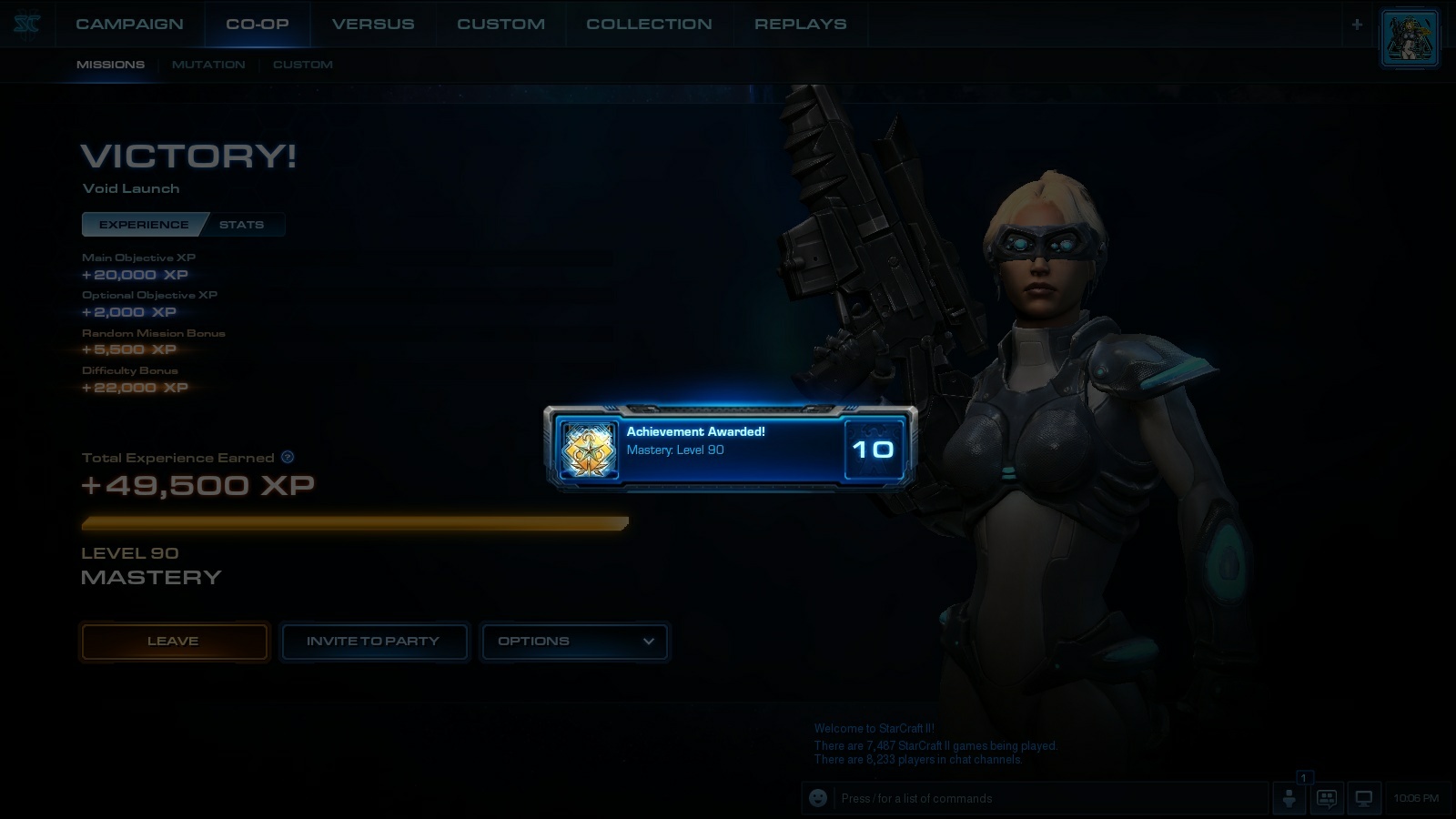 This is essentially the level cap, though that’s become a terribly nebulous concept in co-op. First we just had commander levels, but those run out fast, so account-wide mastery levels were added. Now after mastery you progress past level 90 into “Ascension” levels. But those are purely for bragging rights; your power level ceases to increase after 90.
I wasn’t exactly in a rush to get here. It’s the journey, not the destination, after all, and after about forty to fifty mastery points, it stops making any real difference to your playstyle. Some mastery can make a big difference to some commanders — unit cost reduction really changes how Karax plays, for instance — but after a while you’re just padding the score.
And I must admit that co-op does not hold the same thrill it once did in the heady days when Legacy of the Void was new and we still had hope for ongoing story DLC. Partly this is just the inevitable fatigue that comes with playing largely the same maps for three years. Partly, it’s down to questionable decisions on Blizzard’s part.
By far the biggest issue is that power creep is absolutely out of control. Nova, Stukov, and Dehaka were so absurdly over-powered they effectively broke the game, rendering even brutal difficulty almost trivial.
The real problem comes from the fact that rather than nerfing these outliers, Blizzard has decided to buff everyone else up to their level.
 You might think this is okay. Co-op is, after all, a non-competitive mode based around stomping the AI. Players are supposed to be over-powered. Rigorous balance and serious challenge were never the point of co-op. Certainly I would not have seen a problem with balancing the game by making everyone god-tier until I actually experienced it.
Unfortunately, this has turned out to be a master class in why nerfing things, while viscerally distasteful, is still necessary for the health of a game.
Between the absurd heights of power commanders have been buffed to and the fact pretty much everyone has high mastery now, very little outside of mutations requires any real effort now, and even those aren’t what they used to be. To have anything resembling a challenge, I need to play on brutal now, even though I dislike the increased game speed.
A more minor but still irritating issue is the fact we still don’t have a map veto option. The map pool is big enough now that there’s really no excuse not to let us veto at least one map. Personally I never want to see Lock and Load again.
I also must say I’m very disappointed in the addition of Tychus Findlay as the latest commander. It’s true that co-op was never a particularly story-driven mode, but I did like having it as a sort of “story adjacent” mode to fill in gaps in the lore. The addition of a character who was long dead at the time of the End War completely breaks that and makes the whole thing feel like a bit of a farce.
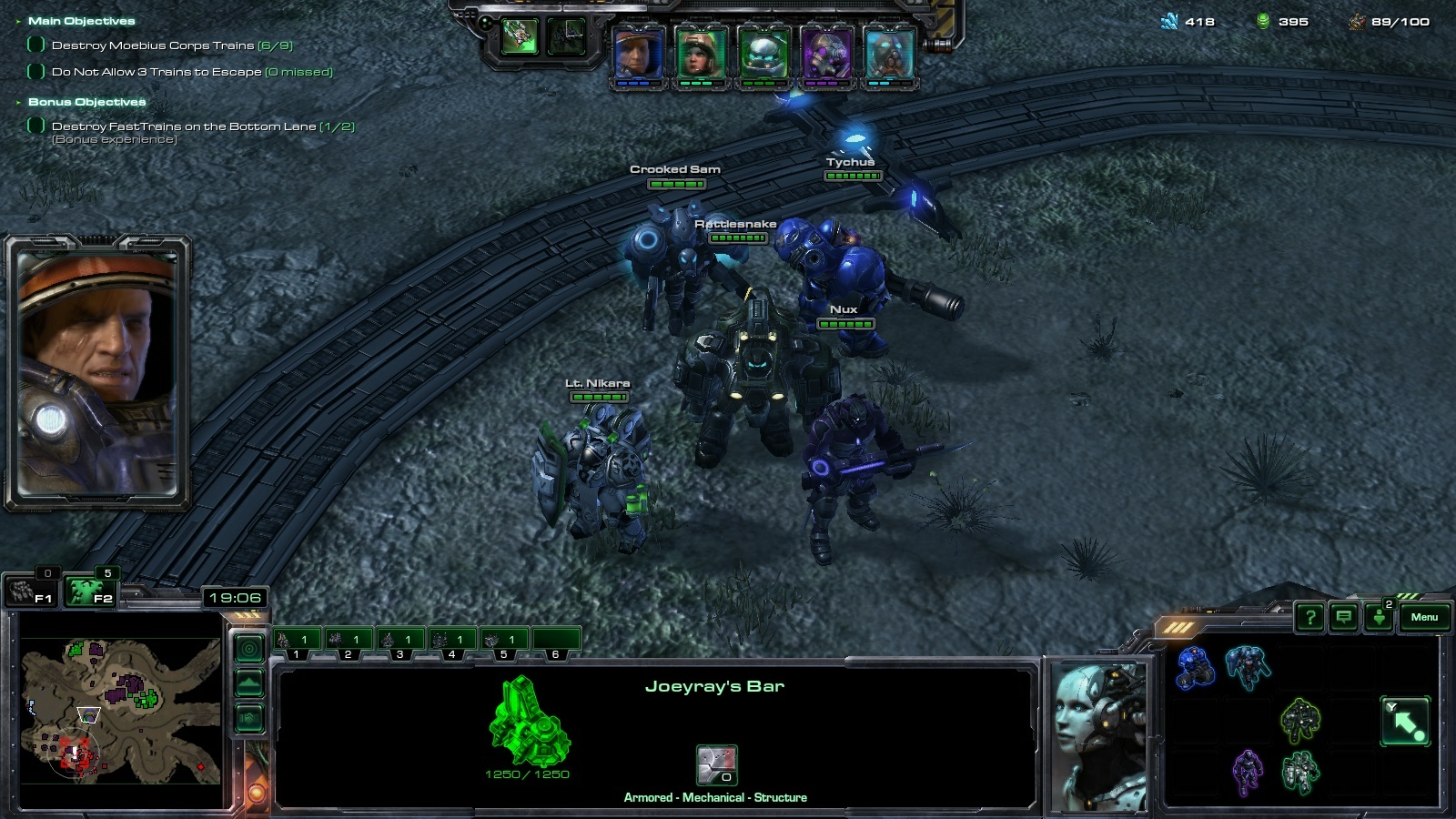 Not to mention Tychus is arguably the worst character in StarCraft history, contributing nothing but Wings of Liberty’s biggest and most glaring plothole while being an annoying git on top of it all.
Perhaps most importantly, though, he’s just not interesting to play at all. Now, I like hero units a lot, and I prefer smaller armies, but having just five hero units and nothing else is just not how StarCraft was meant to be played, and it shows.
For starters, like Karax, he straight up doesn’t work at low levels. Oh, you can still win, but you’re sure not going to be having any fun. You have no choices on what outlaws to hire and thus no meaningful decisions to make whatsoever. You’ve got no map presence, crap mobility, and nothing to spend resources on in the late game.
I don’t doubt he gets a lot better at higher levels (I’m definitely not spending money on him), but some issues are going to persist. He’s always going to be an incredibly basic commander to play, with no economy to speak of and very little micro.
In theory, he’s meant to be a micro-intensive commander, but the power of the outlaws is weighted very heavily toward their raw stats, so their abilities never feel that impactful. Even if they did, at the end of the day you have at most five active abilities, which isn’t that much compared to what other commanders have to juggle. Fact is you’re mostly just a-moving.
 There’s a lot of other weird hiccups in his design, too. His Reaper outlaw’s ability is a bomb that deals high damage, but it has such a long wind-up that whatever you’re going to blow up will be long dead before it detonates. There’s an upgrade at high levels to reduce the wind-up, but it feels like you shouldn’t have to pay for an incredibly expensive upgrade just to make his ability not worthless against anything that isn’t a train or a Void Thrasher.
Meanwhile, the Medic outlaw’s pathfinding is just terrible. StarCraft 1 Dragoon terrible. Half the time she’s running ahead and getting herself killed, and the other half she just randomly stops moving and ends up way behind the rest of your troops.
Pathfinding in general is a problem for Tychus. The hitboxes for all of his outlaws are quite large, and they’re always getting in the way of each other and your ally — or your ally is getting in their way.
Also, the Hercules who drops his bar at the start of the game is obnoxiously loud, for both players. That is going to get old fast.
It’s not that he’s weak. He’s plenty strong. He’s just terribly unfun to play. He feels half-baked and unpolished.
Fact is he needed an army, even a small one. One time my ally (an Artanis) DCed, and I got to control his base and army along with Tychus’. And it was great fun. With an army and a real economy to manage in addition to the outlaws, he’s really enjoyable. The outlaws feel really good as the support to a larger force.
But as designed, it’s a very empty experience.
 All that being said, for all my complaints about Tychus and about the direction of co-op generally, I am still playing. StarCraft II is one of the best games I’ve ever played, and co-op is the best way to keep playing it indefinitely. The variety of maps, enemy compositions, and commanders gives it near infinite replayability, and the quick matches are ideal for whenever I want some low stress virtual slaughter.
Onward to level 1000, I suppose.


 Superior Realities