
I continue my (spoiler-filled) journey through the new leveling zones in Mists of Pandaria, bringing my rogue and warlock through the first zone of Pandaria proper…
 The Jade Forest:
Like most people, I have something of a love/hate relationship with World of Warcraft. The Jade Forest is a good example of why.
The Jade Forest starts spectacularly. It’s one of the best intros to a new expansion in WoW’s history. Immediately, one of my main concerns for the expansion was dispelled; we’re going to Pandaria with a clear goal in mind. We’re after Anduin.
This rapidly leads into a pulse-pounding battle that is every bit as epic as I expect from Warcraft. But what’s actually more impressive than the excitement of it is the depth and maturity of the story.
 For the first time a long while, things don’t feel entirely black and white. The Horde is still pretty much evil, which I’m not happy about, but at least we’re showing that the Alliance isn’t all fairytale heroes, either. We see the Alliance massacring unarmed Orcs and enslaving Pandaren children.
I can’t tell you what a relief this is for me. Please, Blizzard, more of this! This is what I loved so much about Warcraft III. Please keep this complexity.
I enjoyed the way the Jade Forest portrays the brutality of the war, and the way it contrasts that with the beauty and tranquility of Pandaria. There’s one particular location that summed it all up really well. Facing on direction, I’m treated to this vision of serenity:
 If I turn around, it’s D-Day:
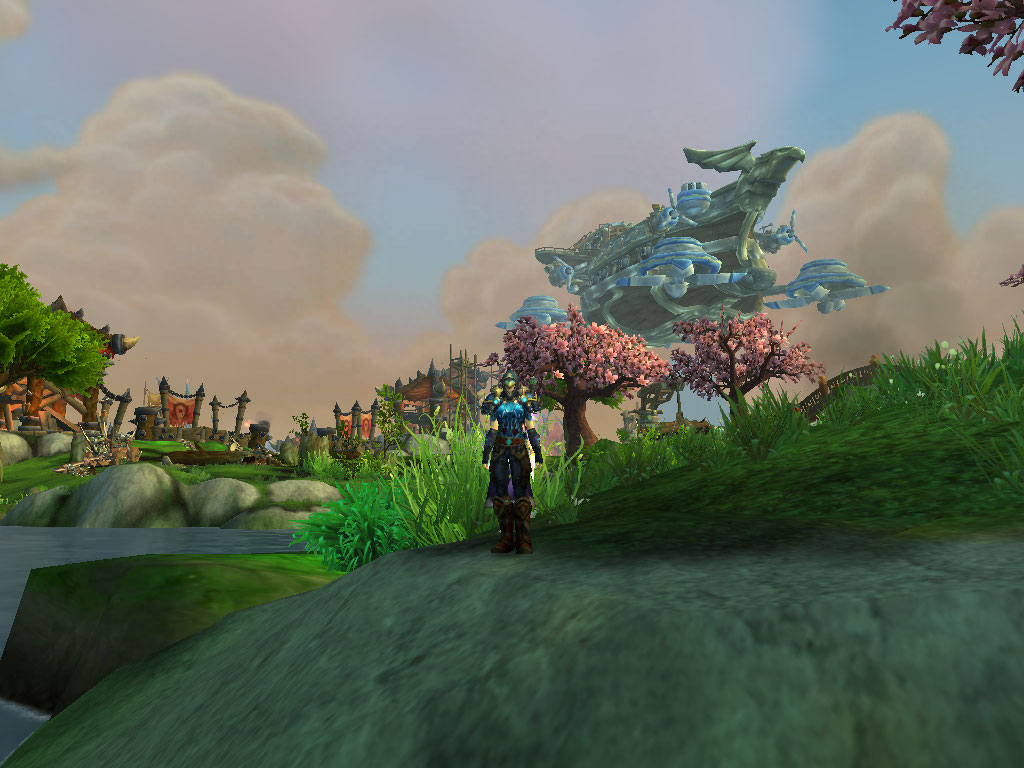 I like this juxtaposition. It forces us to reexamine the Fourth War and whether it’s really worth all the bloodshed. It can even apply to the real life conflict that exists between Horde and Alliance players, and whether it’s really healthy for the game.
I also continue to be pleasantly surprised by how well the Pandaren are being portrayed. They really aren’t just a joke race. I greatly enjoy the characters of Lorewalker Cho and Taran Zhu, particularly how they clearly come from the same culture and philosophy but are also clearly very different people.
But as the zone progresses, the Jade Forest’s quality becomes more inconsistent. In particular, there’s a sharp divide between the two factions.
Both Horde and Alliance seek allies in the wilds of Pandaria. The Alliance chooses the Jinyu, a wise and spiritual race with a deep and unique culture. By contrast, the Horde allies with the Hozen, a degenerate race of perverted monkeys whose entire culture is based on feces.
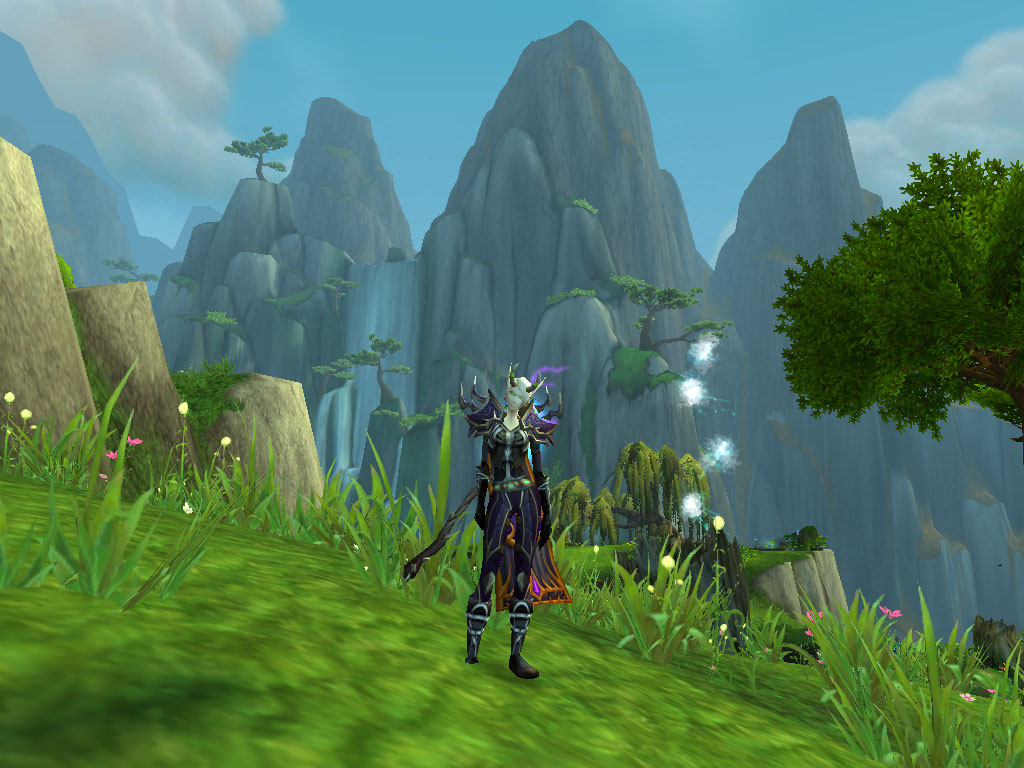 Seriously, so many monkey crap quests.
I hate the Hozen. I hate questing for them; I hate fighting them. They’re a horrible, lowbrow, immersion-breaking race seemingly designed not just for kids, but specifically for the kind of kids who think it’s the most hilarious thing ever that you can spell “boobs” on a calculator. If the opening of the Jade Forest is the epitome of Warcraft’s storytelling at its finest, the Hozen are the epitome of Warcraft’s storytelling at its worst.
And yet everyone’s convinced Blizzard favours the Horde. Uh huh.
As you get farther into the zone, the story becomes less focused, as well. You end up helping the local Pandaren kind of out of the blue. Many of these quests are enjoyable, but they feel a bit like they came out of left field. It makes a bit more sense in the context of the Alliance story, but if you’re Horde, it really does come across as, “Okay, drop everything and go help pandas for no reason at all.”
 Things are also confusing in regards to Anduin’s plot if you play both factions. I’m not sure if this is some kind of old school Warcraft scenario where each faction has a unique plot, and the opposing faction’s story doesn’t exist to you, or if the Alliance events take place at a different time than the Horde quests, or what. Anduin is free at the end of the zone if you’re Alliance, and captured if you’re Horde, and I’m just confused.
But then the ending of the Jade Forest rolls along, and the quality jumps back up again. We’re treated to a spectacular cinematic that tells us in no uncertain terms what the consequences of our war in Pandaria will be.
The ending still leaves a little to be desired. Things come to a close too abruptly, and I feel Yu’lon should be more pissed at us for the atrocities we visited upon her and her home, but these are relatively minor complaints.
From a gameplay perspective, I found the quests in the Jade Forest to be very enjoyable, but not spectacular. Honestly, Cataclysm was the golden age of quest design, and there’s not much Mists of Pandaria could do to top it.
 There’s only one mechanical improvement of note, and that’s the introduction of a new class of mobs. I haven’t seen a particular name given to them, but they’re essentially the opposite of elites: weaker than normal mobs.
This kind of variety is something I’ve wanted forever, but while it is an improvement, it doesn’t actually make as big a difference as I’d hoped. I just use AoEs a little more, which is something I’m doing anyway since both my classes are so indestructible right now that it’s not worth fighting mobs one at a time anymore.
(Seriously, why do rogues now have some of the best off-tanking and self-healing in the game? How does that make sense? Ah, but that’s a rant for another day.)
Aesthetically, the Jade Forest is spectacular. The music is, as always, absolutely stellar, and unusually well-varied, which makes it even more interesting. Normally, I don’t like “pretty” zones — give me Icecrown over Teldrassil any day — but the Jade Forest is just too colourful and exotic not to appreciate.
 The Jade Forest has some great moments, and it’s almost a brilliant zone. But it’s that “almost” that’s driving me crazy.
And ultimately, that’s where my love/hate relationship with WoW comes from. Unlike most, I don’t think Blizzard is no longer capable of great things. They are, and they frequently do produce great experiences, but now there’s always that one stupid little mistake that keeps them from really getting to the next level. I can no longer just relax and enjoy the content; I’m constantly waiting for the inevitable stumble.
New article:
My latest WhatMMO article is 5 Ways People Take MMOs Too Seriously. Something we’re all familiar with, I’m sure.

 Superior Realities