
Shadows of the Apt is a beast. Adrian Tchaikovsky has now released the ninth book in the series, War Master’s Gate, and to Tchaikovsky’s credit, the series doesn’t feel as though it’s over-staying its welcome or being milked.
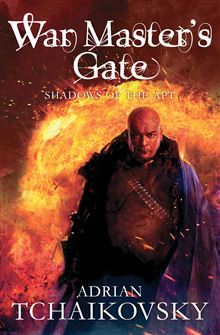 With War Master’s Gate, it does feel as though the end is near. I’m not exactly sure how many more books the author has planned, but it feels like events are drawing to their climax.
War Master’s Gate picks up where The Air War left off with the Wasp Empire and the forces of the Lowlands in a state of uneasy stalemate. The Wasps have been beaten back, but they’re still pressing forward, and the war balances on a razor’s edge as they prepare to lay siege to Collegium.
The war might not be decided on the field of battle, though, but in a dark and forgotten Mantis-kinden forest in the north of of the Lowlands. An ancient and terrible power of the Days of Lore has been discovered there, and the race to claim it is on between Empress Seda of the Wasps and unlikely Beetle sorceress Cheerwell Maker.
Something that I liked about War Master’s Gate better than the previous book is that Tchaikovsky seems to be getting a better handle on his now bloated cast of characters. There were still a few that I feel deserved more attention than they got — like Tynisa and Thalric — and a I few that I just couldn’t bring myself to care about — like the Wasp fighter pilot Bergild — but for the most part, everyone got their time in the sun and managed to play a role in the greater story.
There were also some characters I didn’t care about before that managed to get more interesting this time around. I quite enjoyed the story of the student-soldiers Eujen Leadswell and Straessa the Antspider this time around — though I swear they need to be locked in a room and not let out until they kiss. We all know they want to make little BeetleAntSpider babies together; just get it over with already.
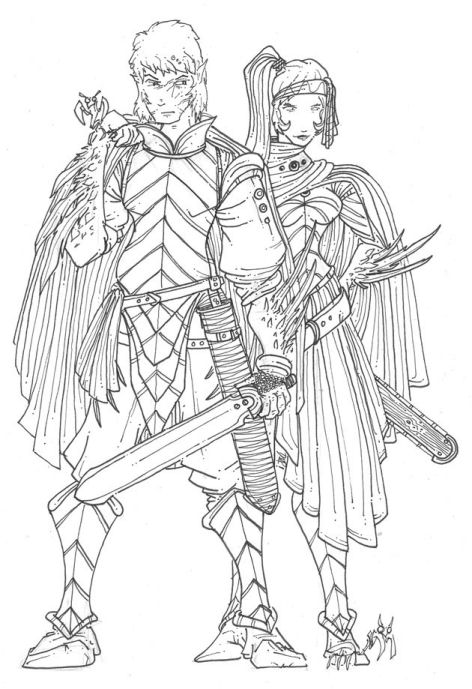 One pleasant surprise in War Master’s Gate was the large role of the Mantis-kinden. After Heirs of the Blade, I sort of figured their role in the story was done, but clearly, this is not the case, and I couldn’t be happier.
As regular readers of my blog and its reviews will know, the Mantids are my favourite race in this series. They’re like bitter, bloodthirsty, Spartan Elves. They’re awe-inspiring, tragic, and terrible.
War Master’s Gate sees Mantis society in the final stage of its centuries-long decline. They have finally realized that the Days of Lore are never returning, and they find their ancient society has no place in the modern world of the Apt. Thus, they have face an impossible decision: Adapt their ways to cope with the new reality, thus abandoning their sacred traditions, or end their race of in a blaze of bloody glory in the finest Mantid tradition.
It’s the sort of beautifully fatalistic story that you can only get in epic fantasy, and it was probably my favourite part of the book.
All that being said, I do have one big complaint about War Master’s Gate, and it’s a bit of a spoiler, so skip ahead past the asterisks if you don’t want to hear it.
Ultimately, War Master’s Gate suffers from the same issue that dogged The Air War: The Wasps just win everything.
 I enjoy grim stories, and my own books have gone to some pretty dark places, so it may seem a bit hypocritical for me to criticize another book for being so bleak. But I think it’s very important in an epic story to have good along with the bad. Even if it’s just small little moments of peace, there needs to be some hope, some joy, some happiness to refresh the reader.
I hate the phrase “emotional roller coaster” because it’s such an overused cliche, but it really is the best way to describe how an epic book should be. What’s important to remember, though, is that a roller coaster includes highs as well as lows.
The problem with the last few Shadows of the Apt books is that the series is no longer a roller coaster. It’s become an emotional flatline. All darkness and no light.
It probably doesn’t help that I’ve been pretty depressed in my real life lately, so reading an incredibly bleak book maybe wasn’t the best idea.
* * *
Overall rating: 7.8/10 A brilliant book in many ways, but not the best thing to read if you’re already in a bad mood.
New article:
My latest contribution to WhatMMO is a rundown on the Upcoming MMOs for 2014.
 It’s funny. 2014 is getting lauded as a big and exciting year for MMOs — certainly much less dull than 2013 — but I just don’t find myself interested in any of the upcoming games. WildStar screams “trying too hard,” Destiny is console-only, and most of the other offerings are sandboxes, which just don’t appeal to me overmuch.
I actually like a lot of what I’m hearing about Elder Scrolls Online, but I’ve never played any of the other games in the series, and it seems a bit late to jump in now. And I’m definitely not paying a subscription, so that killed the last of my excitement for it.
EverQuest Next may be interesting, but it’s still a ways off, and Landmark just seems too directionless for my taste.
On the plus side, I’m reasonably happy with my current crop of MMOs. The Secret World is still plenty of fun, and Neverwinter is a decent supplement. I do wish I could get more excited about Warlords of Draenor, though.
How about you? Anything coming down the pipe in the MMO-verse that excites you, or are you as blase as I?



 Superior Realities