
Given that I’ve been spending so much time playing D&D in the real world, I decided it was finally time to give the Dungeons and Dragons MMO — er, not that D&D MMO, the other one — a try.
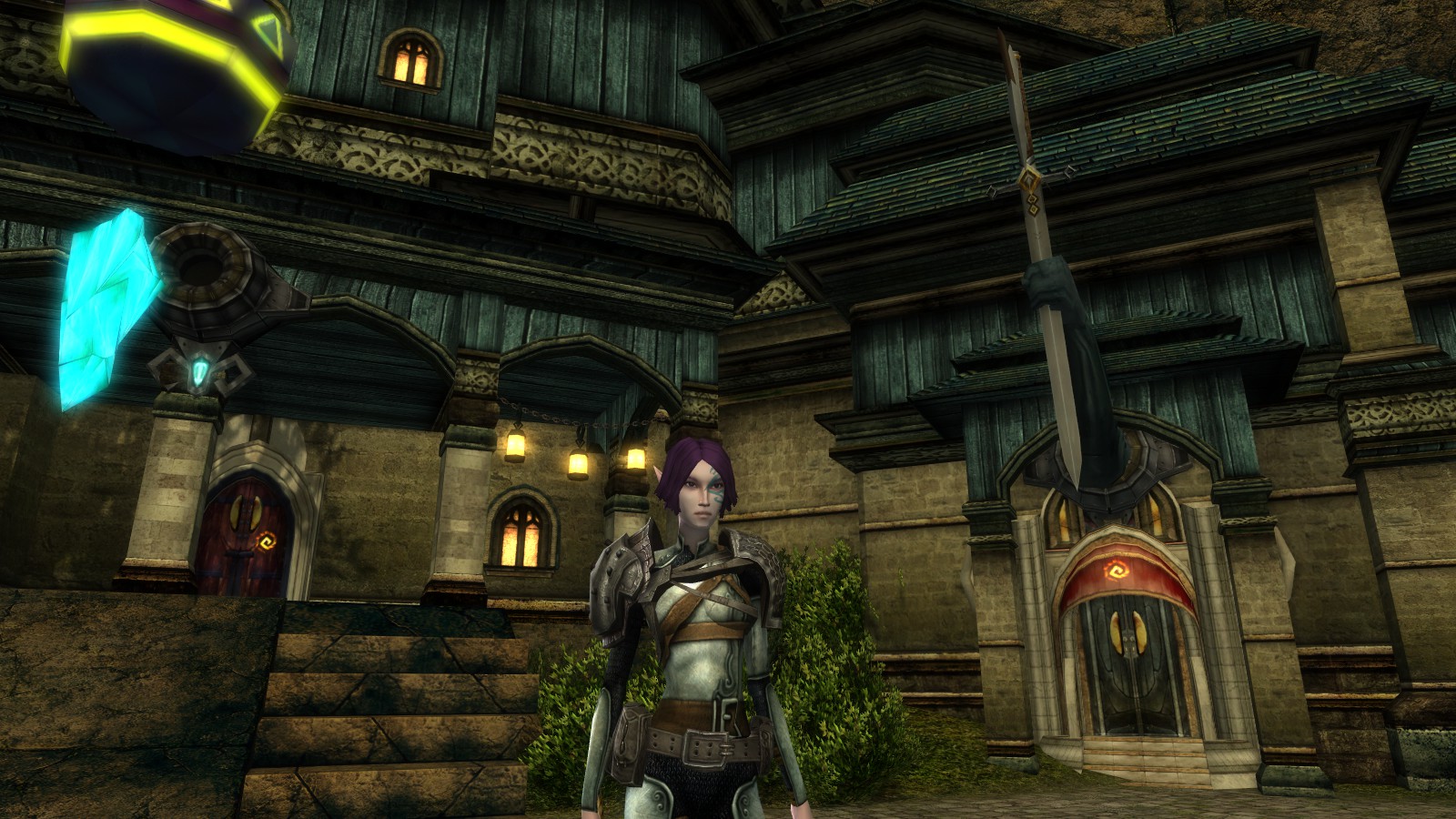 Dungeons and Dragons Online is one of the few well-known MMORPGs that I had not played up until now. The badly dated graphics coupled with a poorly regarded free to play model left me with the impression of a low-budget, low-effort sort of game, and I was intimidated by its reputation as an unusually complex title. But since D&D has been on my brain so much lately, curiosity won the day.
DDO is a very odd game. Playing it feels like I stepped through a portal into some alternate reality where MMO design evolved along entirely different lines.
In some ways, DDO is a staunchly traditional RPG hewing very closely to classic tabletop mechanics. Character creation involves not just the usual racial, class, and visual options, but also rolling your stats and picking feats. And this commitment to old-school character building and intense mechanical depth continues throughout the game. Some of the item tooltips are practically novel-length, even at low levels.
There’s also a greater richness to quest mechanics that harkens back to older RPGs. In addition to combat, there’s also simple puzzles, as well as hidden rooms to sniff out and traps to dodge.
But then you also have the fact that this is actually an action combat game, or an early ancestor thereof, so in that sense it feels quite modern. There’s no auto-attacking here; moment to moment combat feels more like Diablo than traditional CRPGs.
 You do have an action bar, but there’s not the same reliance on rotations of active abilities you’d expect from an old school MMO. At least as a paladin, my active class abilities were few in number and very limited in their use, with the focus of combat on simply swinging my axe. The action bar is therefore as much devoted to consumables and swapping weapon sets as it is to class abilities.
Most of my time in DDO, my attention was held simply by how unusual the game design is compared to other MMOs. As a student of the genre, it’s fascinating.
I do also admire the commitment to staying true to D&D mechanics. I didn’t have to look up what stats do because I already knew from table-top, and my paladin had much the same abilities as her pen and paper equivalent.
However, for all the ways DDO is unique, I ended up drifting away from it for much the same reasons most MMOs fail to hold my attention.
One is that the game is simply too easy. Going in I was worried such a group-centric game would be too punishing to the solo player, but I spent all my time killing enemies in one or two hits from my axe, while never in the slightest danger of dying. The addition of cheaply available (and seemingly quite overpowered) NPC followers makes the quests even more braindead.
 DDO does have a variety of difficulty settings for every quest, which is a design I very much admire, but as non-subscriber, I was only ever able to do each quest on “normal” during my first playthrough, and “pay to make the game not suck” is never an enticing business model.
The other issue is that the story is very bland. The dungeon master narration in each quest is a nice touch of ambiance, but it fails to entirely cover the fact that there’s very little plot here. In my time with the game I encountered no memorable NPCs, and ultimately most quests are just of the blandest “kill ten rats” fare.
There are other issues, too. As mentioned, the graphics are painfully dated, and the game is just straight up unpleasant to look at. Leveling is very slow (probably another F2P restriction), and I don’t know the Eberron setting very well, so I felt little connection to the world.
If you’re a fan of MMO game design and the history thereof, DDO is probably worth checking out at least in brief. It’s very unique, and it’s fun to fantasize how MMOs might have evolved differently if DDO had been more successful. Otherwise, though, I’m not sure it’s worth your time.

 Superior Realities