
It has been my experience that the majority of Trekkies consider Deep Space Nine to be the peak of the franchise. Ever the outsider, I have tended to hold the opposite view. It’s always been my least favourite of all Trek shows; I’ve found it mediocre at best, unwatchable at worst.
 I’m not sure what came over me, but recently I decided to give it yet another try. This time I would sit down and try to watch the series from beginning to end, to give it an honest shake.
Well. Sort of.
I knew from experience there was no way I’d make it through the whole series watching every episode. There’s just too much cringe. Therefore I watched in order, but only episodes that were important to the plot or that seemed especially interesting to me (the latter category consisting almost entirely of Dax episodes). I knew from experience that anything focused on Quark and the Ferengi would send me screaming for the hills, so I avoided those episodes like the plague.
With this strategy of selective watching, I managed to make it through the series. I noted that while my choices for what to watch didn’t change, I watched more of each subsequent season — in other words, it got better with time.
I still have a lot of problems with this show, and it will never be my favourite, but I did find a lot more to appreciate than I had in the past, and I will acknowledge some parts are truly excellent. Rather than viewing it as irredeemable, I now see it as a bit of a Jekyll and Hyde experience. At times it approaches true brilliance. At others it’s just painful to watch. Even being selective, I still came across some true stinkers.
I think perhaps the worst thing about DS9 is how it can reach such depths of true offensiveness, arguably beyond what any other incarnation of Trek has achieved. I don’t mean offensive in terms of poor writing or bad story-telling (though it’s got plenty of that), but truly awful messaging that no one should be putting out, least of all the supposedly inspiring universe of Star Trek.
One obvious example is the second season episode “The Alternate.” In it, we meet the Bajoran scientist who is effectively Odo’s father. The entire episode makes it brutally clear the doctor is an abusive narcissist who has left Odo with deep emotional scars, culminating in Odo having a full on psychotic break, and the “happy” ending is for Odo to… apologize for acting out and try to repair his relationship with the monstrous doctor.
 My reaction to that ending is best summarized in this YouTube clip. It may be possible to have a worse take on emotional abuse, but it would require a greater imagination than mine to think of how.
Odo in general makes me uncomfortable. There’s always this underlying feeling that he’s “the good one” because he tries to behave like a human rather than embracing his identity as a Changeling. Or maybe I’m just disappointed one of the most alien characters in Star Trek history thinks, feels, and behaves pretty much exactly like a human. Such wasted potential.
But it gets worse. I know this may be a controversial opinion, but I’m going to go on record as saying that I think “For the Uniform” is probably the single worst episode of Star Trek ever filmed.
It’s just forty-five minutes of Sisko committing actual war crimes without any consequences at all, capped off with him and Dax joking around like it was just another day at the office.
Star Trek has dabbled with the “captain as Ahab” story at other times, but it’s generally a cautionary tale. First Contact makes the point that Picard is wrong to endanger his crew by obsessing over taking revenge on the Borg, but DS9 is over here like, “Isn’t it great that Sisko went on that deranged murder spree? Revenge is so great.”
It is a complete and total betrayal of everything Star Trek is supposed to stand for.
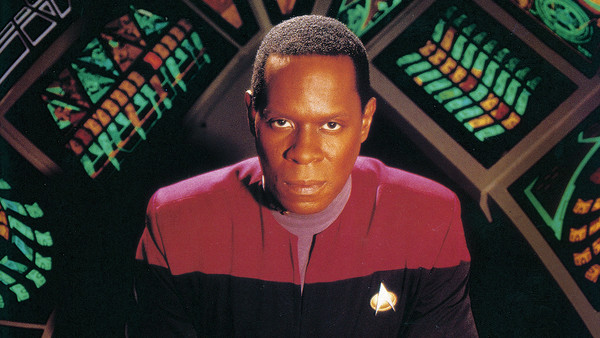
One final point on DS9’s problematic stories: Sisko as the Emissary. Now, in general I find the story around the Prophets and Bajoran mysticism one of the greatest flaws of the series. Star Trek has always been about science and skepticism, and then DS9 comes along and is all like, “lol, jk, magic is real.”
 (And not only is it a fantasy story shoe-horned into a sci-fi setting, it’s also bad fantasy that wouldn’t work very well even in a magical setting.)
But what makes this relevant to my point about DS9’s offensive stories is the idea of a human as the Bajoran messiah.
I really like what Star Trek stands for, and I really believe in the message of a hopeful future it tries to spread, but Star Trek’s morality has always had one Achilles heel. Most of the time, moral issues are explored via corrupt or misguided alien cultures, with the (overtly Western) Federation swooping in to teach them the error of their ways. Even when the message is worthwhile — and it usually is — there is a subtle whiff of colonialist condescension in Star Trek’s formula.
It gets less subtle in DS9. Of course the Bajorans can’t be their own saviours. Of course these simple aliens need an enlightened human to show them the way. Ick.
To be fair, though, DS9 was also a lot braver than its predecessor when it came to showing the Federation as less than perfect. The results may have been mixed, but the intention is commendable.
Believe it or not this post was intended to make the point I’ve developed a new appreciation for DS9, and it’s kind of gotten away from me. I swear I do have good things to say, but I’ve been holding my tongue about all it does wrong for years, so bare with me as I continue to tear it a new Bajoran Wormhole for a few more paragraphs.
DS9 ruined Gowron as a character. He was always a bit morally ambiguous, but DS9 made him a full-blown villain. That’s not the problem, though. Gowron making a heel-turn isn’t what I would have chosen, but it’s not far-fetched. The trouble is DS9 makes him an idiot. His schemes are cartoonishly, self-destructively villainous and obviously doomed to blow up in his face. He was never a saint, but he was always smart. DS9 made him a complete buffoon for the sake of some cheap drama.
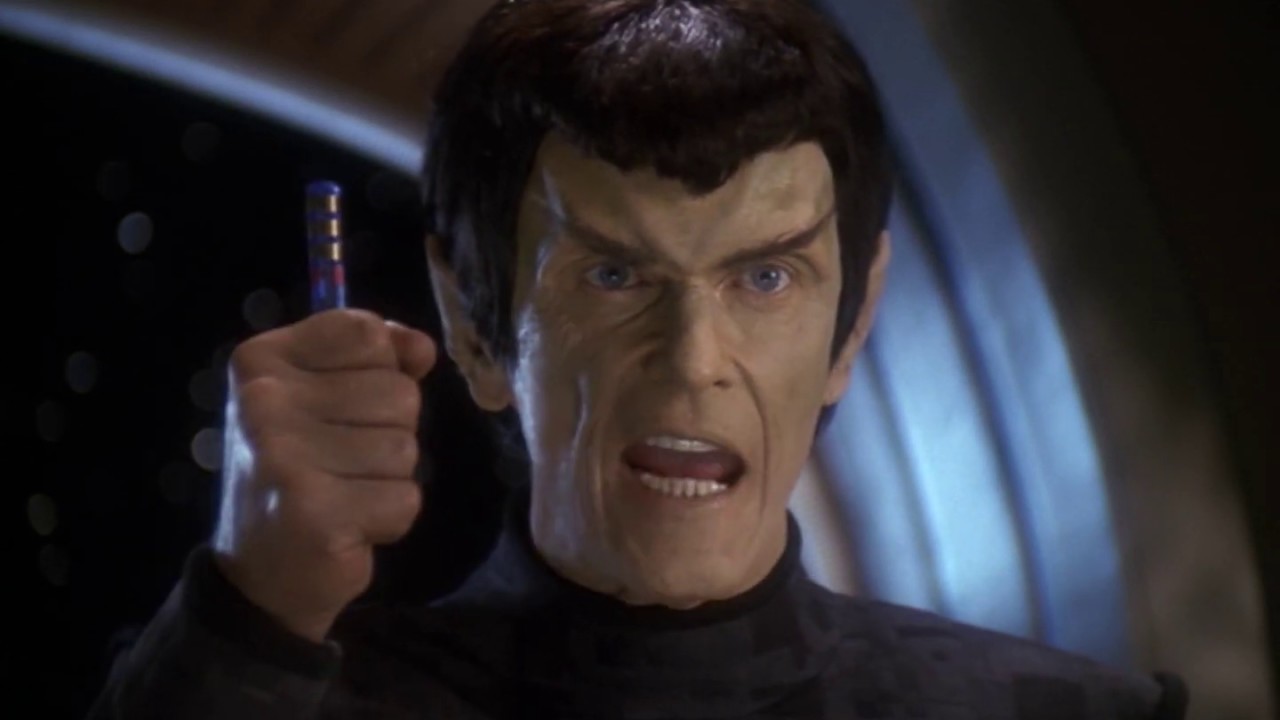 Similarly, the Romulans on DS9 are morons. They’re supposed to be the galaxy’s master manipulators, but throughout DS9 Sisko and Section 31 just keep playing them like fiddles. As a major Romulan fan, I’m honestly glad DS9 didn’t do more with them. If it had, I think it would have killed their mystique in much the same way Voyager robbed the Borg of their fear factor.
Finally, I will say that as much as this viewing improved my opinion of the series in many ways, it actually lowered my opinion of the two things I’ve always praised about Deep Space Nine: Sisko and Dax.
Mind you, I still like them, but I definitely like them less having gotten to know them better.
The whole “I massacred a whole bunch of Maquis without trial and poisoned some planets cause Eddington hurt my feelings” thing notwithstanding, my real issue with Sisko is that, like Janeway, I don’t feel they ever really established a clear identity for Sisko as a captain. Kirk is a man of action, Picard is a wise but somewhat cold moral paragon, and Archer is the lovable idiot who made all the mistakes so those that followed could be better, but what is Sisko (or Janeway) about?
I realized that what I really like isn’t Sisko. It’s Avery Brooks. He imparts such a fiery passion to the role that it’s easy to overlook how thin and inconsistent the character actually is.
I think that’s true of a lot of characters on DS9, actually. Gul Dukat is a paper thin mustache-twirler. The only thing that makes him work is the sleazy yet undeniable charisma that Marc Alaimo imparts to the role. Garak isn’t really that original of a character, either, but he still manages to steal every scene he’s in purely on the basis of Andrew Robinson being absolutely and utterly delightful.
As for Dax, I realized it isn’t Jadzia I like so much as just the concept of Joined Trill. The pseudo-reincarnation idea is a really fascinating concept for an alien race, but the execution is rough.
 The trouble is they never really seemed to define a clear identity for Jadzia. She just kind of ricochets between a few different personas for a while, until about halfway through the series when the writers appear to just give up and turn her into a clone of Curzon, who for whatever reason seems to be the only Dax host the writers were interested in fleshing out.
I hate to say it, but I actually like Ezri a lot better. They did a much better job of making her feel like a complete person, rather than just a vessel for past lives.
On that note, one thing that surprised me is that at no point is any personality ever established for the Dax symbiont itself. I eventually came to the conclusion that Trill symbionts must not have personalities — and perhaps not even true sentience — and are just vessels for memories. Which is fine — actually a cool idea — but they could have communicated that better.
So what did I like? Well, as I already touched on, there’s some great acting on this show. I do think Garak deserves the universal acclaim he receives, and that is almost entirely down to the talents of Andrew Robinson.
DS9 clearly tried to be a more mature take on Star Trek (an attempt that many subsequent incarnations of the franchise have made, with varying degrees of success), and the results are hit and miss, but I admire the effort.
DS9’s most successful attempt at showing a darker side of the Federation was Section 31, I think. The Starfleet coup d’etat earlier in the series was too sudden to be believable, but Section 31’s existence as a secret society allows it to exist in Roddenberry’s utopia without breaching credibility, and the stories with Section 31 are all quite enjoyable.
There are some great standalone episodes, too. “Duet” is an obvious one, but the best has to be “Rejoined.”
 I had read about this episode before, but never actually watched it. I’d heard it was another attempt at an allegory for the struggles of queer people, and I’d assumed that it was as limp-wristed as The Next Generation’s half-hearted take on conversion therapy in “The Outcast.”
Boy, was I wrong. It’s an incredibly powerful episode, and quite brave for the climate of the time. As a straight man, I’m an outsider to the issue, but from my perspective at least this seems a nearly perfect metaphor for the struggles of the often stigmatized LGBT community, and quite heartbreaking. All the more so because you can’t really blame Lenara for being too scared to stand up to her people’s taboos. She would lose so much in doing so.
Of course, Deep Space Nine is most memorable for the Dominion War. I find the war itself as inconsistent as the rest of the series. At times it feels genuinely epic and thrilling, but most of the time the show seems scared to show the real impact of war. Aside from Nog losing his leg (which is basically forgotten after just one episode dealing with the fallout), there’s never really an impact on the main characters. The war feels distant and abstract.
The Dominion themselves are very interesting, though. The fact that they are three races (plus many vassal peoples) adds a lot of depth and makes them feel more convincing as rivals to the Federation. I particularly enjoy the chilling inhumanity of the Jem’hadar.
And of course, Jeffrey Combs is always delightful in everything he does.
They’re a useful foil for some good stories, too. Much as the TNG fan in me doesn’t want to admit it, Worf fighting the Jem’hadar in prison is probably that character’s finest hour.
Finally, while I’m not a particular fan of the Cardassians generally speaking (they’re pretty much just Romulan knock-offs with a weaker backstory), I do enjoy how their arc ended.
I can’t help but compare it to Shadows the Apt (spoilers for those books ahead — beware). When that series at last drew to a close, the Wasp Empire — cruel imperialists very akin to the Cardassians — never face any punishment for their long history of war crimes. They lose a few of their conquered territories, and their pride is injured, and that’s about it.
 I reckon the intention was to avoid glorifying revenge by having the heroes sack the Wasp homeland, and I can respect that, but it also feels like the villains got off scot-free. It was very frustrating and unsatisfying.
By contrast, having Cardassia leveled by the Dominion was a masterstroke. It gives us the comeuppance we’ve all wanted to see the Cardassians get virtually from their introduction, without the need for the Federation to compromise their merciful values. Instead of glorifying revenge, it feels more like it’s sending the message that evil actions inevitably bring evil consequences.
So having said all that, what do I think of Deep Space Nine now that I’ve finished it? Well, it’s a great show… as long as you ignore about 60% of it.
Season seven was really good. By then it felt like the show had finally found its footing, and I can’t help but wonder if all the people heaping praise on the series are mostly just remembering that final leg.
I’m still never going to agree that it’s the best Trek show, not by a long shot, but I think I am prepared to stop calling it the worst. All apologies to Discovery, which takes over that slot, but hey, you’re still not as bad as the Abramsverse, so that’s something!


 Superior Realities