I had a lot of skepticism going into Amazon’s new Lord of the Rings series, The Rings of Power, based on some truly bizarre plot leaks (at least some of which have now been confirmed) and a lot of cringe-worthy quotes by the showrunners.
 Still, I would really like more good Middle-Earth content, so I tried my best to keep an open mind. Going in, I had the feeling it wouldn’t be very faithful to Tolkien, but it would at least be an entertaining fantasy adventure series.
Unfortunately, so far it’s not even living up that standard.
I was right that it’s not faithful to Tolkien’s writings. Galadriel has had her backstory and motivations altered so radically she’s essentially a completely new character. Meanwhile Durin is being portrayed as just another Dwarf, with so far no mention of his past lives or great significance to the Dwarven people.
But perhaps more importantly, it’s just not that interesting of a show so far.
The pacing is glacial, for one thing. Now I know a lot of people will say that’s also true of Tolkien’s original writings, and that’s technically accurate, but the depth and beauty of Tolkien’s writing carries it through. Rings of Power doesn’t have that same skill in its story-telling that allows the slow pace to work.
There are a lot of moments that clearly attempt to emulate the beauty and heart of Tolkien’s legendarium, but the writing isn’t strong enough to deliver, resulting in a lot of pseudo-spiritual babble that doesn’t actually mean anything. See Finrod’s word-salad about boats and rocks.
The acting is mostly competent, but none of it’s quite good enough to cover up how dull the writing is.
 There’s a number of mysteries introduced by the show, but I find them more frustrating than anything. There’s a new character whose identity is a big question mark, and the show spends all of his scenes telegraphing that he’s either Gandalf or Sauron in extremely blatant ways. Obviously he can’t be both, so half of his scenes exist just to be unsubtle red herrings, and gods know how long it will be before we know which half. It’s one of the most transparent attempts to string along an audience I’ve ever seen, and after just two episodes, I’m already utterly exhausted by it.
But perhaps my biggest issue is that the version of Galadriel they present is an absolute blithering idiot. Her entire story so far consists of nothing but suicidally stupid decisions, and the only reason she survives the first two episodes is because she has impenetrable plot armour.
(None of this is an indictment of Morfydd Clark, who is doing the best she can with the meager hand she was dealt. From what I’ve seen of her in interviews, she seems like an incredibly sweet person, and I don’t want to direct any hate toward her. Honestly, she deserved better.)
So far, the only plot in the show I find myself at all invested in is that of Bronwyn and the other people living in what will eventually be Mordor. Maybe because it’s a blank slate and thus free of expectation, but it’s the only part of the show that’s held my attention so far.
Rings of Power has not yet reached the irredeemable depths of something like the last season of Picard, but what we’ve seen so far doesn’t give much cause for optimism. Simply put, it’s just kind of boring.
 Of course, much of the controversy around Rings of Power so far has centred around its racial and gender politics, because absolutely everything has to turn into a culture war brawl these days. I gave serious thought to simply not addressing it all because I’m so tired of it, but I’d like to try and present a nuanced take on the issue, as nuance is pretty lacking in most of the discussions I’ve seen.
First of all, I have no respect for those who are offended by the very concept of black people existing in Middle-Earth. The one change to Tolkien’s work that is definitely worthwhile is trying to improve the diversity of the setting. I don’t feel that Tolkien himself was a particularly bigoted or hateful person at heart, but he was a product of his time and culture, and elements of his work do not hold up well in a modern context.
But that doesn’t mean Rings of Power is approaching it the right way.
For all the wailing and gnashing of teeth over how excessively “woke” the show is, the actual number of people of colour appearing in it is very small, and the cast is still overwhelmingly white. I’ve noticed that the extras in crowd shots are mostly, if not entirely, Caucasian, and that all combines to make the few PoC on the cast really stand out. To me it makes them feel like tokens rather than a genuine effort to diversify the setting.
A cynical part of me wonders if they just threw in a few PoC knowing it would make the racists rage so that they could then write off all criticism of the show as rooted in bigotry and nothing else. I know that’s the narrative I’ve seen advanced by most vocal fans of the show.
The frustrating thing is that there are already entire cultures of PoC in Tolkien’s writing, and Rings of Power is completely ignoring them. I don’t know if the people of the newly invented realm of “Tirharad” are meant to be related to the people of Harad, so I can’t say if making them mostly pale-skinned is technically white-washing, but it definitely feels like it. Regardless of whether the people of Tirharad are related to the Haradrim, Rings of Power is ignoring a culture that would have allowed them to massively increase the diversity of the cast while also exploring an underdeveloped part of the lore.
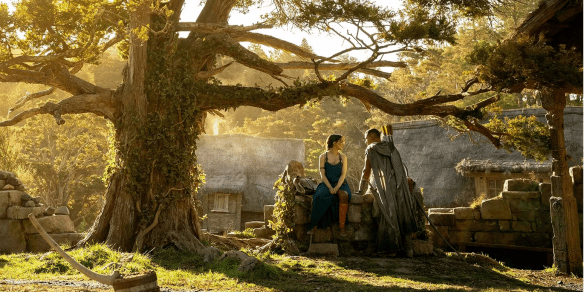 I’m similarly disappointed by the missed opportunities in Galadriel’s story. I’m not upset by the show presenting her as a military leader (and those who are betray the fact they don’t actually know Middle-Earth’s history very well at all), but I am very bothered the fact they’ve written her family out of the story. I think it would have been a much bigger win for feminism if Rings of Power had depicted Galadriel as a badass warrior and a loving wife and mother.
The more time goes on, the more I appreciate how special Continuum was…
(To be fair, Bronwyn does feel like she’s embodying this concept at least a little bit, but that just further raises the question of why Galadriel couldn’t get the same treatment.)
My point is this: I think Rings of Power holding up ideals of diversity and feminism would be a good thing, but I don’t believe it’s actually doing that. I think it’s paying lip service to those concepts in a cynical attempt to profit off our current culture war.
And that really tells you a lot about what kind of show it is. It covers itself in the trappings of Tolkien’s timeless stories of hope and heroism, but it’s only skin deep.

 In contrast to my raves, overall reception for the first season of Warrior Nun seem to have been a little lukewarm, with particular criticism given to the first half of the season, where Ava is simply learning to adjust to her new life after being confined to a hospital bed since childhood.
 Now, in her case she literally couldn’t feel a lot of these things prior to her transformation, but even in my case, I feel like I’ve had similar experiences. If you live most of your life trapped by disability, feeling like you’ve overcome it, even briefly, changes your entire view of reality. Colours shine brighter, food tastes better, you find yourself awestruck by the beauty of sights you see every day.


