I can’t decide if that’s my best headline ever, or my worst.
 Another class storyline is now under my belt in Star Wars: The Old Republic. This time, the Sith warrior is on deck, and it turned out to be a good one.
Chirp! Chirp! Chirp!
The interesting thing about the warrior storyline to me was that the companions really ended up stealing the show. Especially one companion in particular.
As you can probably tell by now, for me the warrior story was pretty much The Vette Show, and everything else came second.
Vette is just so funny, so charming, so endlessly delightful in every way that she just eclipses everything else. Rare is the time Vette opens her mouth without making me laugh.
Yet she’s not just comedy relief, either. As you get to know her, you learn how harsh and painful her life has been — and how incredibly strong she most be to maintain her cheerful, defiant, and kind-hearted nature in the face of all she’s suffered.
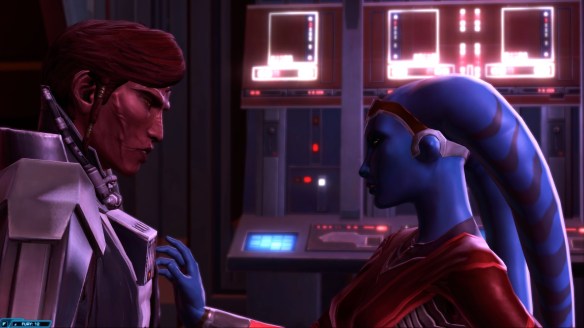 Vette isn’t the best Bioware character I’ve seen, but she is possibly my favourite character in SW:TOR to date.
Vette isn’t the only strong companion for the warrior, though. I also quite liked Jaesa. I admire how earnest she is, and her disdain for fake or dishonest people.
It’s actually rather a shame she’s a warrior companion. With almost any other class, she might have become my go-to companion, but she just can’t compete with Vette.
Of course, it’s not all good news. Broonmark is a literal monster, and Pierce is a disgusting goon.
And then there’s Quinn.
Well, if you’ve played the story, you know what happens. It’s actually a shame, because I rather liked him before that. And honestly… I understand why he did what he did. I don’t condone it, but it was something of an impossible situation he was put in. Try as I might, I can’t bring myself to hate him as much as most people seem to. Mostly I’m sad our bromance had to end.
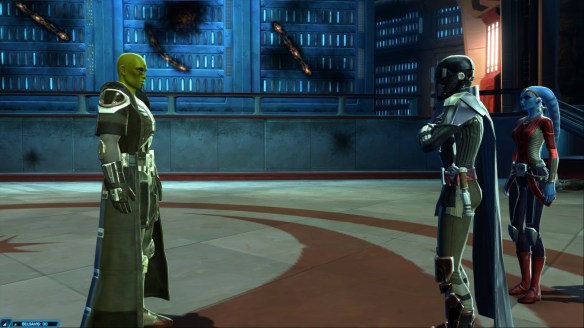 That said, you better believe I Force-choked the crap out of him.
All in all, though, warrior still has the best companions of any class I’ve yet played. No doubt about that.
I also liked that you unlock companions a little quicker as a warrior than the other classes I’ve played. Usually the game is all but over before you have a full team. Warriors have much less waiting to do.
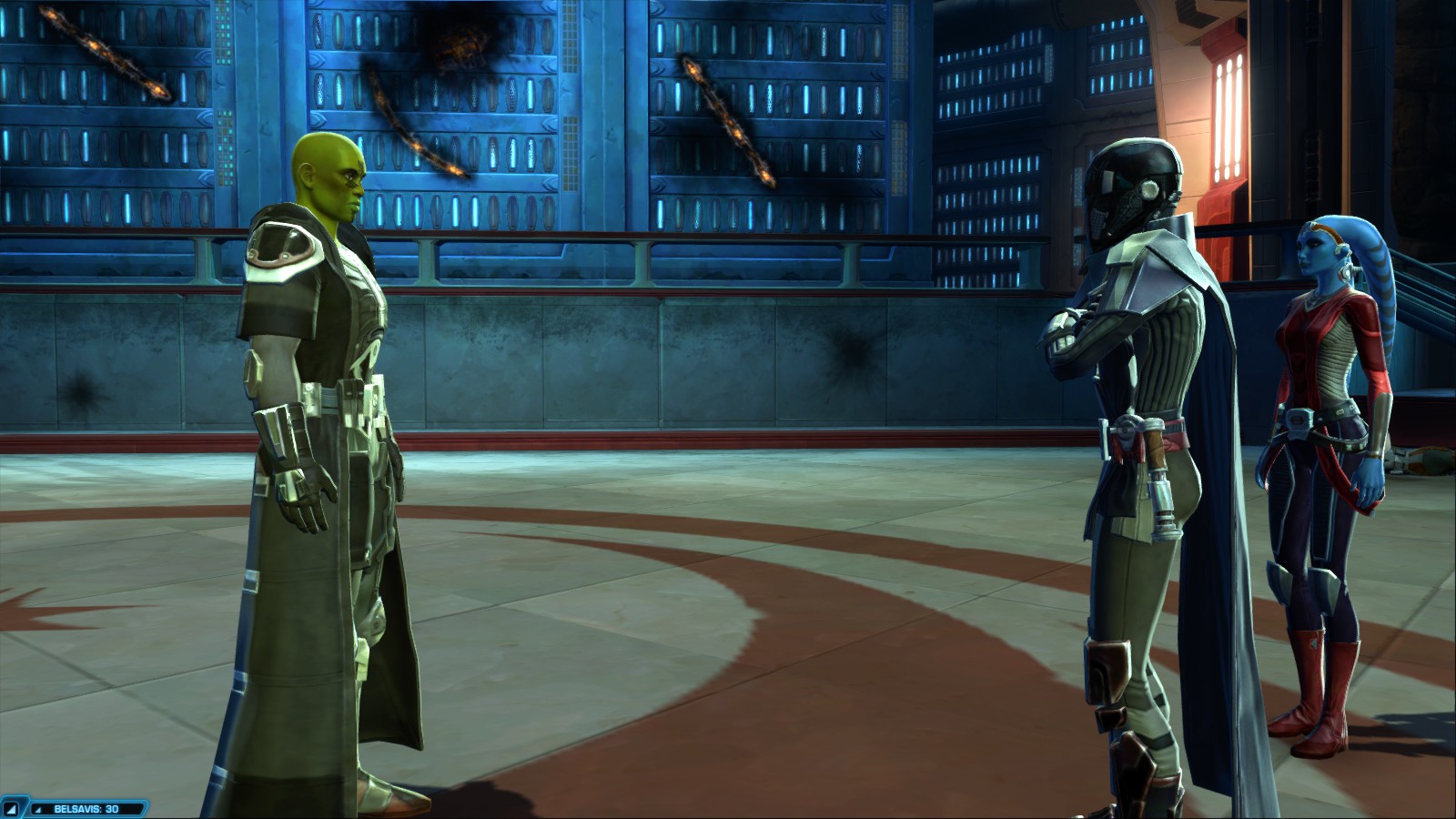
Companions aside, the warrior story also features some great incidental characters. I want a mission that’s just the warrior, Darth Vowrawn, and that Jedi from Belsavis going out for beers. Those are some cool dudes.
All right! Back to Sith business. Grr!
But while the companions were most memorable this time, that’s not a knock against the actual storyline itself. The warrior story does not equal the agent story by any means — and at this point I doubt anything in the base game will — but it was a good ride while it lasted.
The thing I found most surprising about the warrior story is how much humour it has. Vette’s obviously a big contributor to that, but even aside from her, the amount of snark, sarcasm, and silliness you can engage in is staggering, and I found myself laughing out loud many times throughout the story. The voice actor for male warriors does deadpan incredibly well.
 This is especially surprising given that Bioware’s writing, though good, has generally struck me as rather stiff and humourless (drunk Tali and offering to appoint Sera the next Divine notwithstanding). The Sith warrior story is very out of character, but in a most welcome way.
The other positive thing about the warrior story is that it’s very consistent. Every other class story — even the agent — has had at least one slow leg where not much interesting happens. The warrior story doesn’t have a lot of stand-out moments, but it also doesn’t have any significant stumbles or slow patches. It has a good flow and a consistent theme from beginning to end.
It’s very similar to the inquisitor story in some ways, but the villain in this case is a lot better. He’s truly vile, and I spent the entire time longing for the day when he would meet his end at the tip of my lightsaber.
It also does better job than usual of not presenting the divide between the Republic and Empire as entirely black and white. Being able to take the moral high ground versus the Jedi is simply delicious.
And while it may not be as galaxy-shaking as the agent story, the warrior storyline does have much less of a “side quest” feeling than most other classes. Some of what happens does have some major relevance to the game’s main story and overall lore.

I have no idea how this quest got past the censors.
The one other noteworthy thing about how this particular class story is how mature it is. In general I’ve been impressed by how much SW:TOR is able to get away with in terms of sex and violence, given the usually family friendly nature of the Star Wars universe, but the warrior story takes it to a whole other level. Your warrior can get up to some impressively kinky stuff.
On a darker note, I was quite disturbed by a mission in which you have the option to abduct a woman and deliver her to a man who clearly intends to rape her. I of course did not do so, opting instead to have the wannabe rapist killed, but damn, that’s about as dark as I’ve seen video games get.
As for gameplay, I enjoyed playing the warrior a lot, even despite SW:TOR’s innate flaws.
Of all the classes in The Old Republic, warrior (and its Republic equivalent, knight) is the only one that even comes close to capturing the extravagance of the action sequences in the Star Wars movies. The animations are both fluid and flashy, and the acrobatic agility of the class is a joy to behold.
The downside of that is it makes me hate SW:TOR’s button bloat all the more. My warrior had a perfect, satisfying rotation at around level thirty. I had enough abilities to give some depth to the rotation, but it was still relatively simple, and everything flowed beautifully.
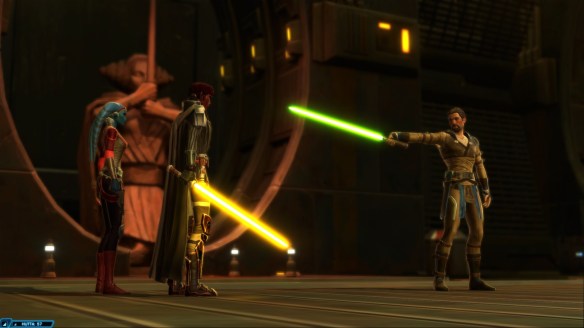 But they just kept dumping new skills onto me after that. Having to spend half my time watching cooldowns and twisting my fingers into knots with shift modifiers bogged down the once beautiful flow of the class. Being a mainly solo player, I can mitigate this a lot by simply not bothering with a full rotation — most things don’t live that long anyway — but it’s such a shame to see a class get less fun as you level.
On the whole I still had fun playing a warrior — maybe more so than any other class — but it does perfectly encapsulate my core issue with traditional tab target/button bloat games. It’s not that I can’t have fun in such a system, but I always feel that I’m enjoying myself despite the core mechanics rather than because of them. It’s more about mitigating annoyances than capitalizing on strengths.
Um, so, what happens now?
I’ve said it before, but this time I think I mean it: I’m going to take a little break from SW:TOR now. Probably not a long break — my backlog being what it is, it might already be over by the time this post is published. But at least a couple weeks.
But I’ll be back.
I think part of the reason I’ve felt compelled to provide these little “what’s next” segments in my SW:TOR posts is that I’ve still been thinking of it as a temporary investment. Something I’ll play once, and then forget. But now I’m starting to think this might be a long-term game after all.
 I’m very surprised (and perhaps a little embarrassed) by that, given all the trash I’ve talked about Star Wars over the years, but then this game is a very different beast from the movies.
So there will be more.
As for what’s next, I want to play through Knights of the Fallen Empire on my agent as soon as all the chapters are out.
I’ve also been weighing whether to bring any other characters into expansion content. Given how fun the class is and the fact Vette shows up in KotFE, my warrior is probably the best candidate for that.
The consular is also tempting. I’d see the Republic side of things, and I do sort of miss that character. But I don’t enjoy the class’s gameplay much (really regret not picking the melee subclass), and really the main thing I miss is Nadia, and her story isn’t continuing for the foreseeable future, so…
As for alts, I plan to finish my bounty hunter’s story at some point, but I’ll probably wait for the next double XP event. The completionist in me says I should play more Republic classes, but I don’t like the subclass I chose on my trooper, and the knight story seems pretty dull from what I’ve seen so far. Never saw much appeal in smuggler.
 Maybe I should just embrace being an Imperial loyalist.

 “I’ve Seen the Other Side of You” isn’t quite the rollercoaster of the last two episodes, but it does maintain Dark Matter’s record of (almost) always delivering a decent hour of entertainment.
 Instead we’re given just a random “crisis of the week” story. I could see this episode having some repercussions eventually, but right now it doesn’t seem to have any significant relevance to the ongoing storyline.