Review: Dragon Age: Inquisition

I desperately want to make a Monty Python joke here, but it’s already been done so many times that I would just feel like a hack.

My inquisitor with Solas and Cassandra in Dragon Age: InquisitionFirstly, let me say that Inquisition is probably the single biggest and most content-packed single-player game I’ve ever played. Half the MMOs I’ve tried don’t feel this vast or overwhelming.

As of this writing, I have spent more time playing Inquisition than Mass Effect 3, despite the fact that I played through Inquisition once and I’ve finished ME3 three separate times. And ME3 was a pretty big game.

That sheer scale makes this a difficult game to review because there’s just so much to talk about, but I’ll try and put this all down in something resembling a coherent order.

Overhauls and improvements:

Out of the gate, I felt that Inquisition was a huge improvement over previous Dragon Age games.

I’ve often said that Bioware makes awesome choose your own adventure novels, but no one ever told them they’re a game developer. Inquisition is the first game of theirs I’ve played that’s actually, well, a game.

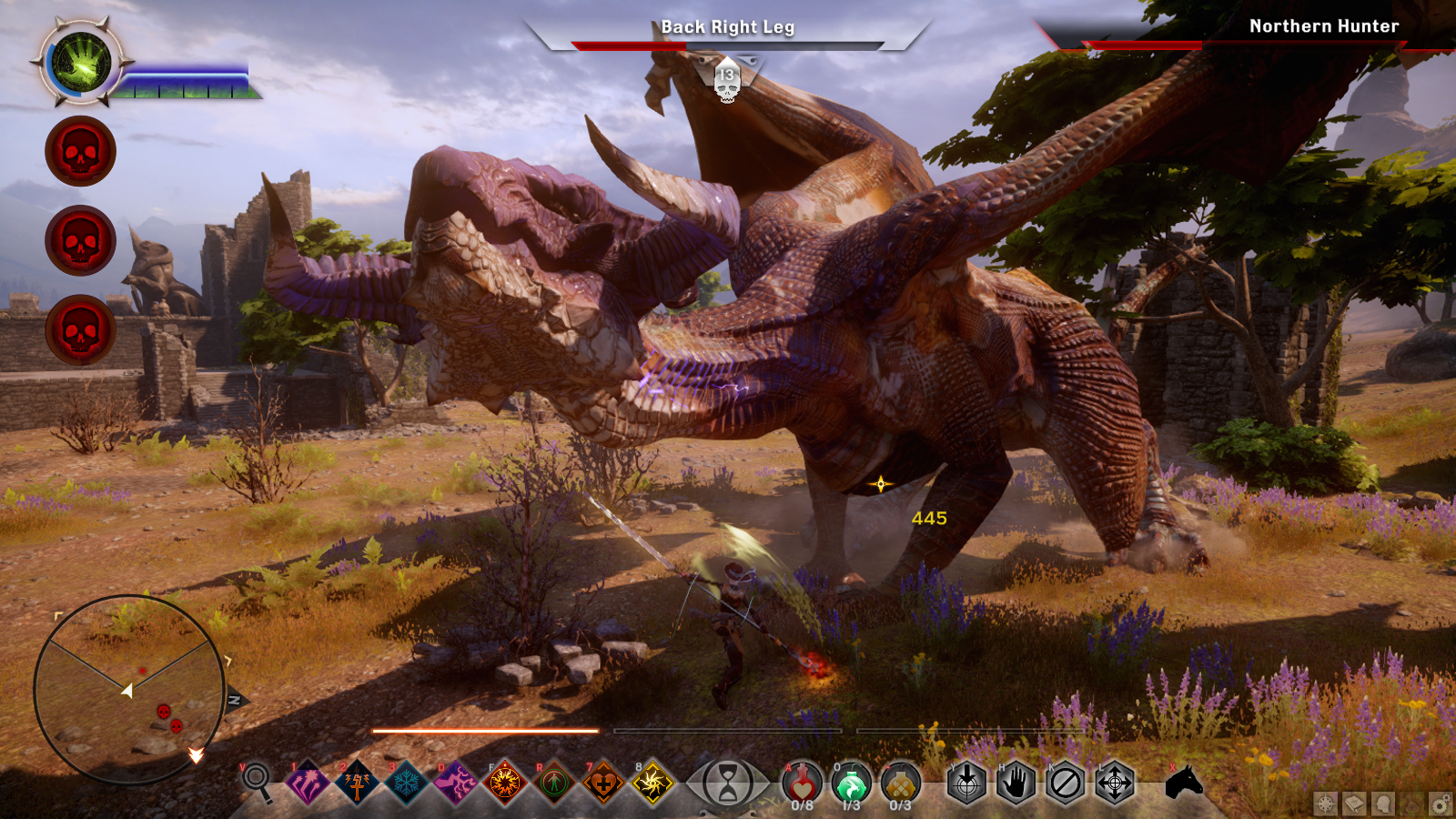
My inquisitor showing off her skills as a knight-enchanter against a dragon in Dragon Age: InquisitionFirstly, auto-attack is gone, and thank God for that. Auto-attack has no place in a single-player game — it’s questionable whether even MMOs should have it at this point. The only virtue it ever had was compensating for slow Internet connections back before high-speed Internet was common place.

So for the first time in the franchise, combat is something the player actively engages in rather than a glorified QuickTime event where you just watch the game play itself.

That is a very, very good thing.

There are some other subtle changes to combat, as well. Boss fights feel a bit more complex, with varied and interesting mechanics. Dragon fights, in particular, are epic and thrilling struggles — it’s just a shame the game didn’t include more encounters like that.

Oh, and you can throw jars of bees at people.

Jars of bees.

Also, the tiny and ultra-linear maps we’re familiar with from previous Mass Effect and Dragon Age games are gone, replaced with vast and largely non-linear zones and sprawling dungeons.

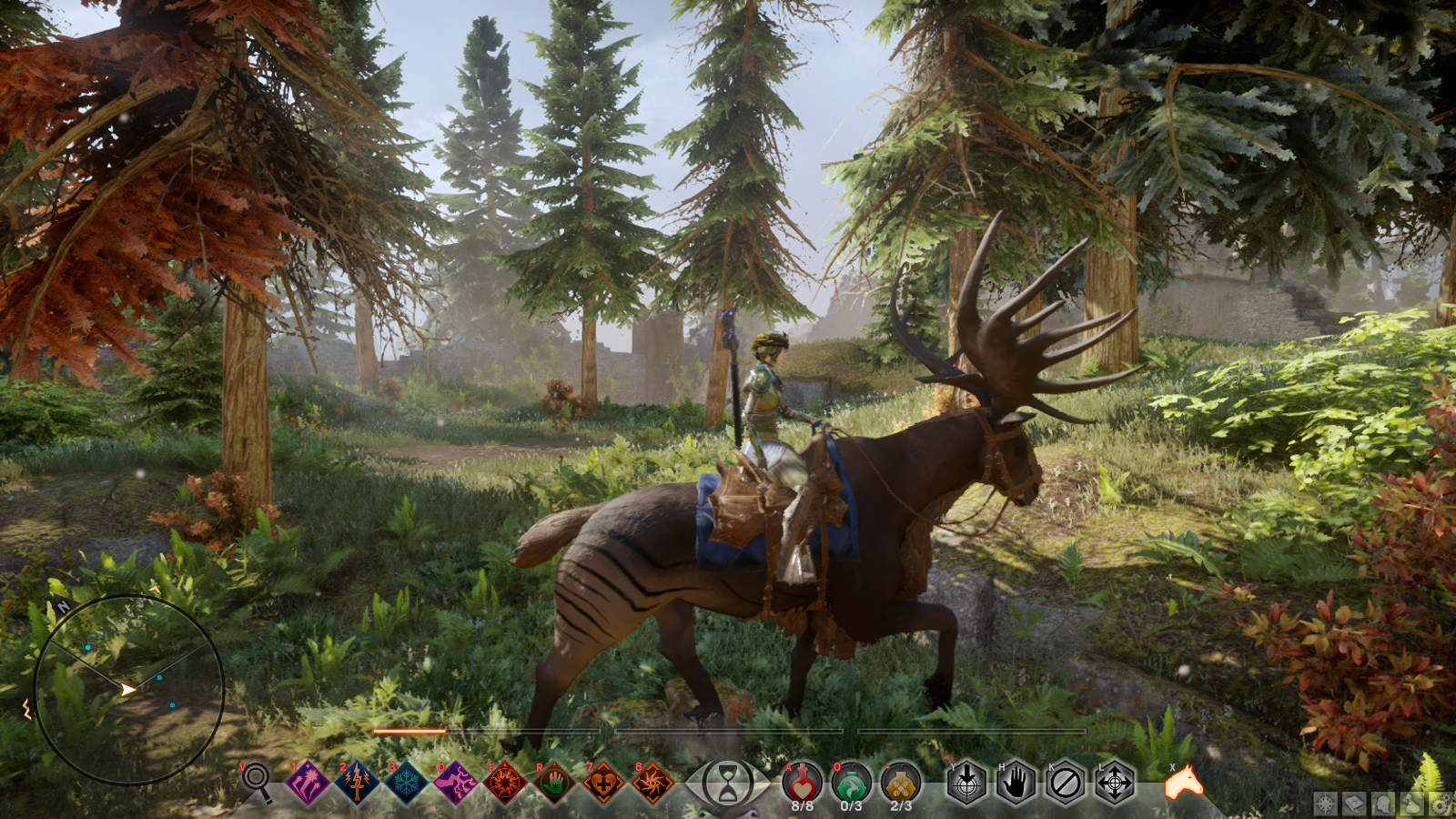
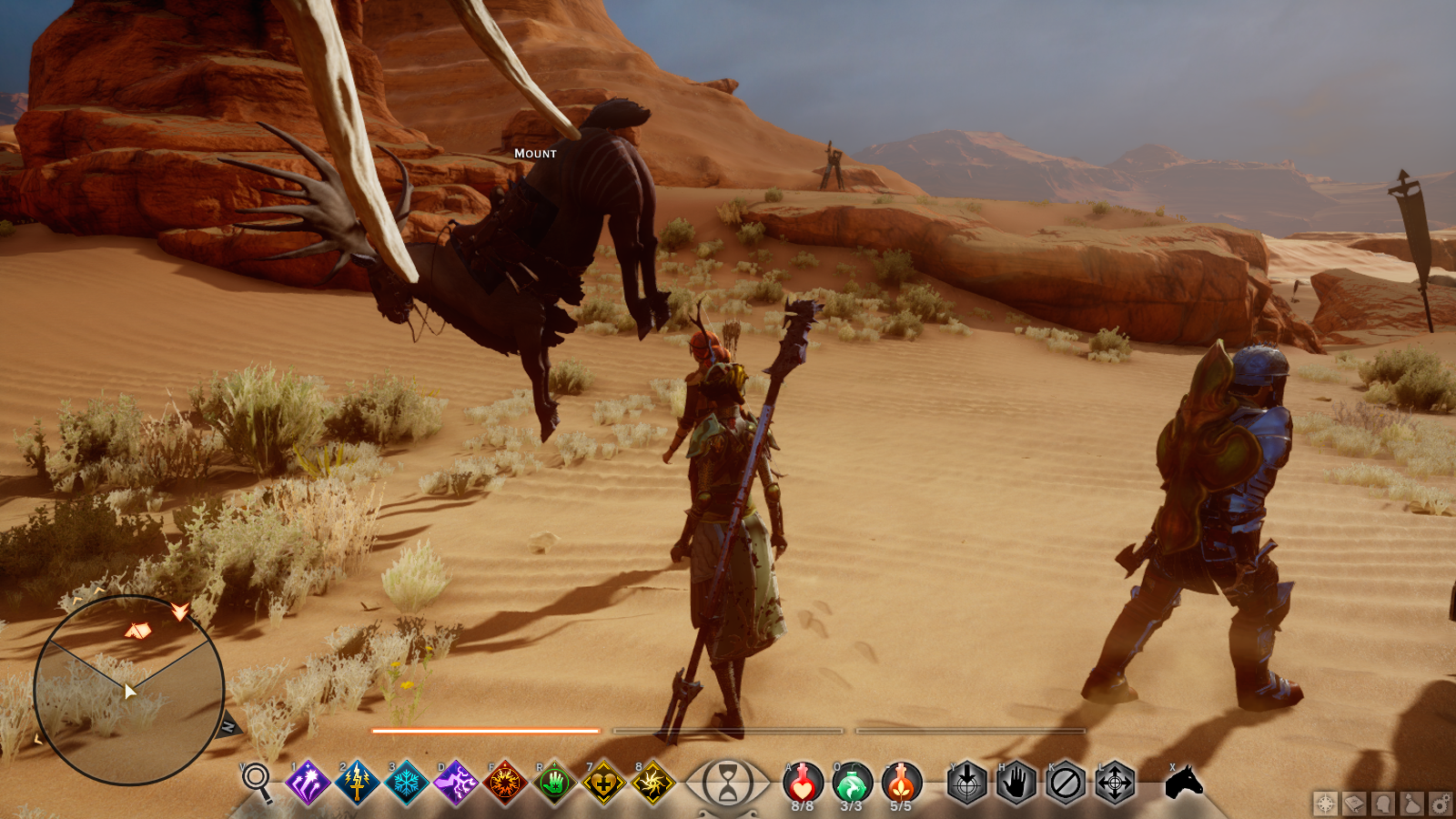
My inquisitor riding her Pride of Arlathan stag mount in Dragon Age: InquisitionInitially, I enjoyed this a lot. It’s great to be able to just ride off in any direction and find something to do, and the zones are absolutely overflowing with quests, lore, and goodies. It’s overwhelming at times.

Playing Inquisition reminded me of nothing so much as a single-player version of Guild Wars 2. There’s the same sense of exploration, the same ability to go in any direction and find some activity almost immediately.

I found this very liberating.

And you can jump now. As a proud jump-spammer, I welcomed this.

But you may have noticed I’m using the past tense a lot.

Quantity over quality:

Unfortunately, while Inquisition feels like an MMO in many positive ways, it also becomes clear after a while that it has inherited the bad habits of its multiplayer cousins, as well. Specifically, a preference for breadth over depth, quantity over quality, and busywork over memorable experiences.

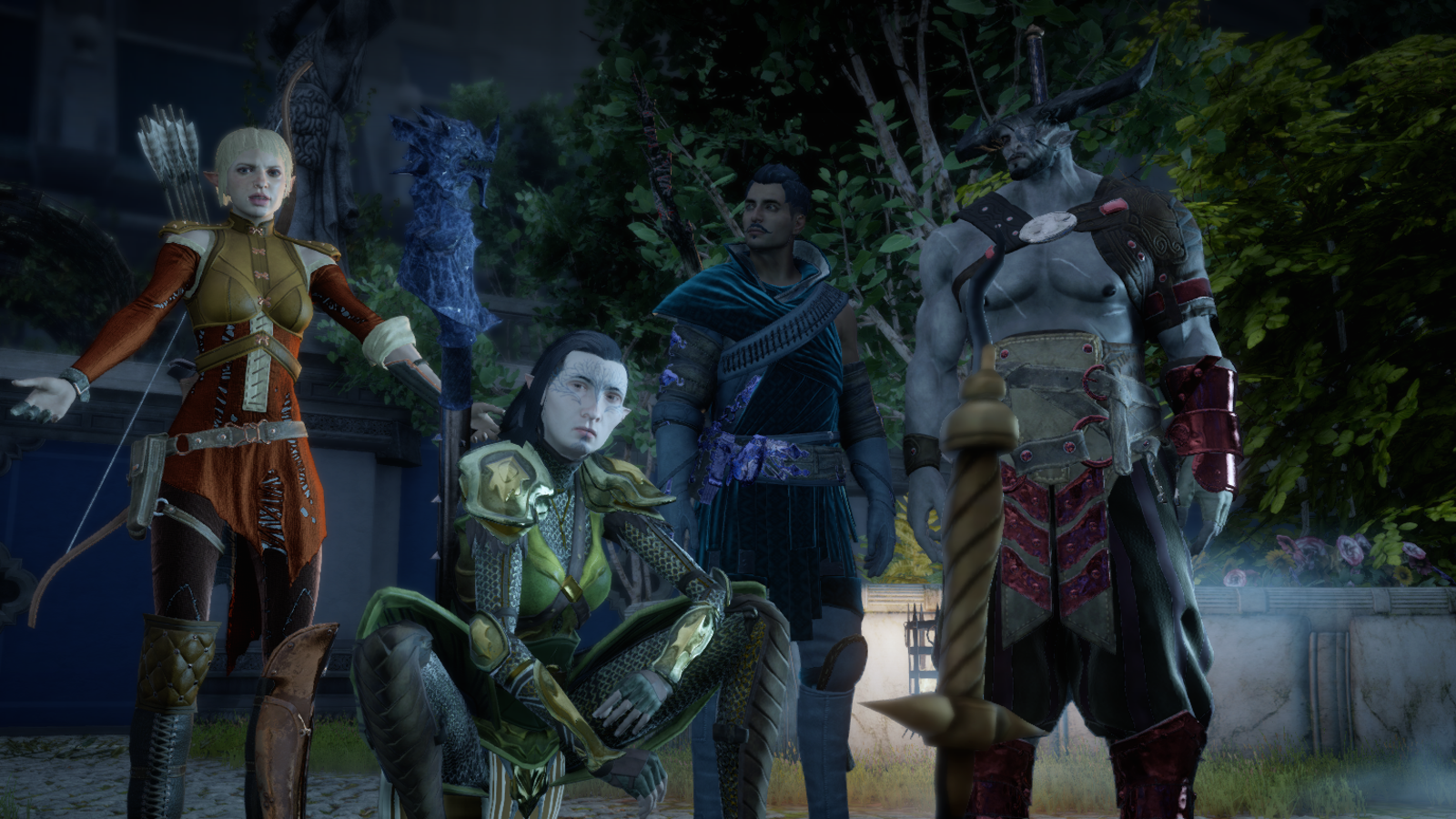
My party in Dragon Age: InquisitionAs with ME2 and Origins, this is Sidequest: The Game.* The main and character storylines — the whole reason anyone in their right mind plays a Bioware game — became something of an afterthought compared with picking flowers, sightseeing, collecting shards, putting together mosaics, and other random tasks.

*(This phrase shamelessly stolen from one of my readers.)

A shocking number of quests are just bland kill and collect tasks with nothing but a short text intro, such as you would see in your average WoW clone MMO — which is even more surprising coming from a company whose MMO sold itself on its lack of text-based questing.

The same endless potential for exploration that initially delighted me eventually began to feel more like a burden. There is very little variation other than cosmetic differences between the many zones, and they all start to feel the same after a while. There are a few exceptions — such as the Fallow Mire, a thoroughly enjoyable zone featuring several unique mechanics such as undead rising to attack you if you ever touch a body of water — but mostly it just felt like repeating the same tasks endlessly.

Infinite exploration is only a good thing if you can consistently provide the player with new and interesting things to discover. Otherwise, each new zone ceases to be an exciting new frontier and instead becomes a checklist of chores to complete.

This still isn’t as bad as it could have been. The gameplay improvements kept things at least somewhat interesting — I don’t think I could have even finished the game if it was still using the mechanics from Origins.

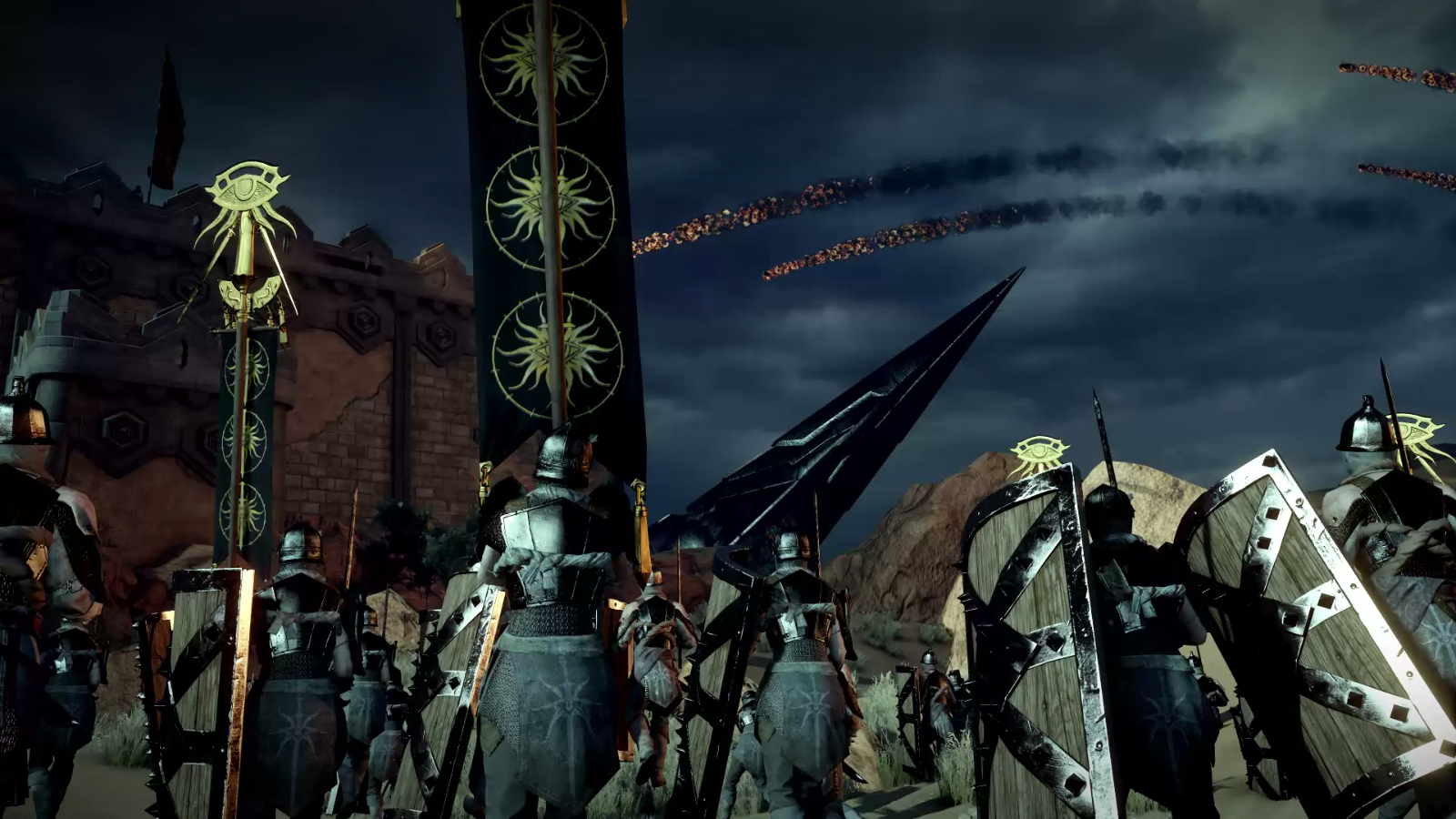
The armies of the Inquisition in Dragon Age: InquisitionBut certainly this is a game that was longer than it needed to be. I’m of the opinion most games these days are too short, but padding things out with mountains of busywork isn’t an improvement.

Character, story, world:

The character and story elements — the real meat of the game — also seemed to take a step backwards in Inquisition. The ability to tell when a character has new dialogue options  — one of the best innovations of Dragon Age 2 — is gone, bringing back the need to visit every single one and check for yourself.

The character development is also surprisingly weak for a Bioware game. There is much less character-specific content than I’ve grown used to, and many characters feel sadly underdeveloped. Iron Bull, especially, is a huge case of wasted potential — no pun intended.

The writing seems a bit dodgy in places, as well. Sera’s inconsistency I can accept because I think that’s sort of the point of Sera, but I don’t think Cassandra was supposed to be bipolar, yet that’s how she came across. Half the time she hates my guts, and the other half the time she thinks I’m the most awesomest person ever, and there’s no apparent rhyme or reason for the shifts.

The shame is that a lot of the characters are very interesting. I wanted to learn more about them, but I just didn’t get the chance.

My inquisitor and Sera in Dragon Age: InquisitionOn the plus side, this does show that the characters were mostly of a high quality. Dorian, Solas, and Sera were my favourites — each of them thoroughly awesome in a different way — but Iron Bull, Blackwall, Varric, and Cole were also quite enjoyable.

There are even some weighty contributions from characters from the past games — including some that totally surprised me — and those were very cool, if a bit bizarre in some cases. Meeting your in-game son — except he’s not your son because you’re playing a different character this game — is weird as all Hell.

I do regret we didn’t get to see Anders, Merrill, or Fenris again, though.

The main storyline was mainly enjoyable yet also oddly disappointing. Mostly, it feels unfinished. It deals with all sorts of incredibly important things related to the very foundations of Thedan history, but most of the questions raised by it are left unanswered, and the feeling the game left me with was less “Wow!” and more “Huh?”

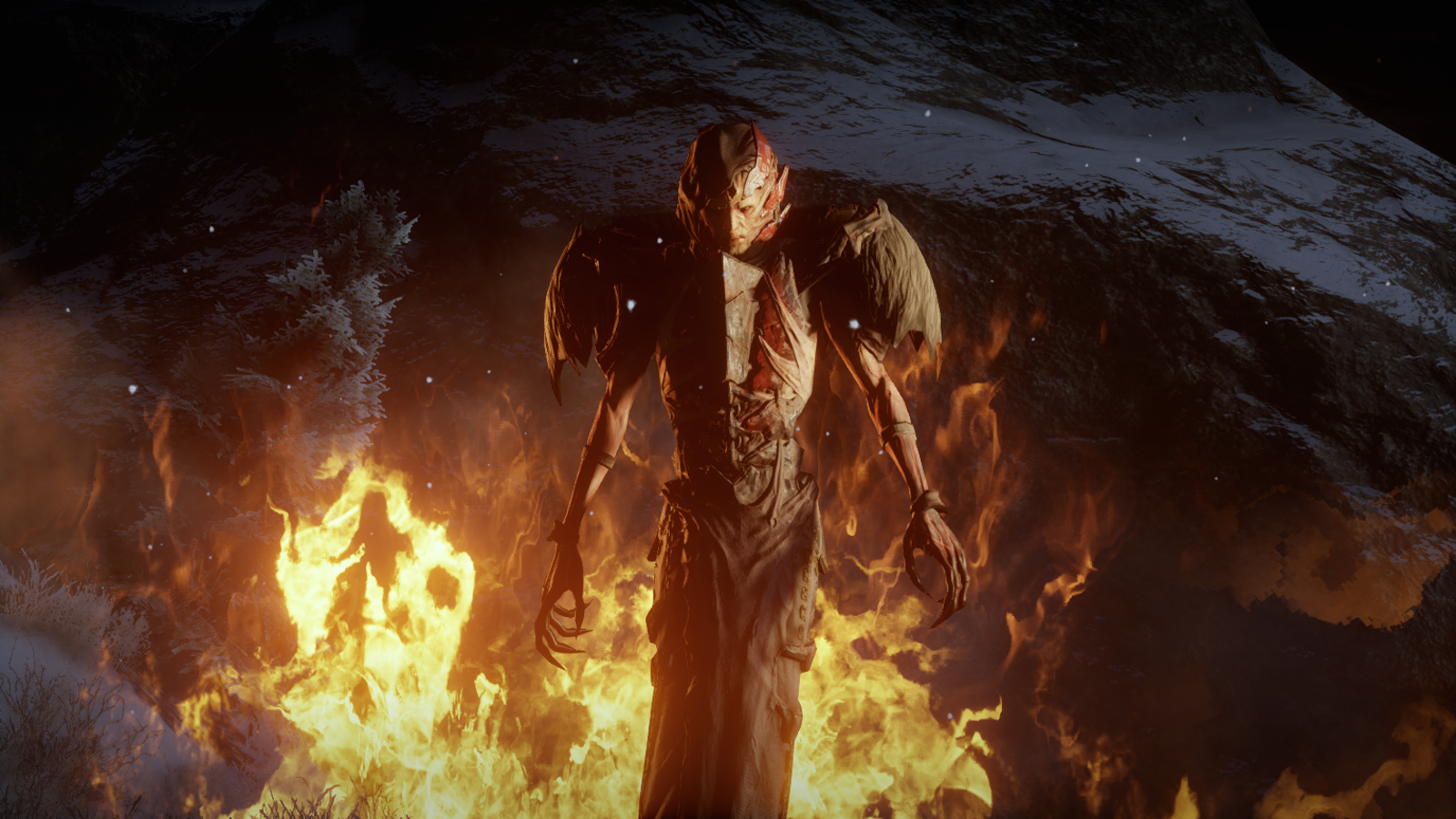
The villain is probably the coolest and scariest antagonist Bioware has yet produced, but his role in the game is infinitesimally small, and it’s another case of what feels like wasted potential.

And the ending was stupendously underwhelming. I just kind of sat there thinking, “That’s it? Seriously? Did I miss something?”

Corypheus in Dragon Age: InquisitionOn the plus side, while I didn’t feel quite as free to do as I choose as I did in DA2, I was able to have a lot of control over the direction of the world, and I was mostly able to achieve the goals I set myself at the outset. Life in Thedas is now much better for mages and Elves and much worse for Templars and Chantry traditionalists. That’s a good feeling.

As always, there are still some issues with story decisions being more obtuse than they ought to be. This time, I accidentally got my whole clan killed. I guess the Inquisition is my clan now…

On the aesthetic front… Well, I feel like I should be heaping praise on Inquisition’s stunning, ultra-realistic graphics, but despite their obvious beauty and technical splendour, I found myself vaguely underwhelmed by the game’s visuals.

They made things so realistic that the graphics lost any semblance of style or personality, and Inquisition suffers from the same problem as Origins: Every single environment looks like it could have come from any high fantasy setting anywhere ever. By comparison, Kirkwall was a setting that exuded a very distinctive history and personality.

On the other hand, the music is fantastic. I’m almost tempted to upgrade to the deluxe edition just to get the soundtrack.

Bugs (and I don’t just mean the jars of bees):

A bizarre bug in Dragon Age: Inquisition

Most of the bugs weren’t this hilarious.

One other thing needs to be mentioned before I wrap up this review, and that is that Inquisition is a surprisingly buggy, unstable, and unpolished game, especially for such a big budget title.

Bugs are extremely common and run the gamut from the minor and hilarious to the catastrophic. The game crashes frequently, and there are all kinds of minor hiccups and irritants. There was a mystery quest marked on the mini-map but never found. Sometimes the landscape randomly turned neon green. The list goes on.

Even when it wasn’t bugging out, the game often ran sluggishly or with an excess of lag, despite my having a very powerful computer and not even running it at the highest settings.

That’s really not acceptable, especially for such a prestigious brand as Dragon Age.

* * *

On the whole, I did enjoy my time with Inquisition, but after over a hundred hours and nearly a month, I’m kind of glad it’s over, and as much as I would love to experience the game as a different class and/or while making different choices, I’m not sure I’ll ever have the patience to play it again.

My party in Dragon Age: InquisitionOverall rating: 7.3/10 As with all previous Dragon Age titles, Inquisition could have been an amazing game but fell just a little short of the mark, and despite some major improvements, I didn’t find it as satisfying as Dragon Age II.

I really miss Merrill.

Retro Review: Once Upon a Time, Season One: Episodes 1-6

As someone with a craving for quality high fantasy television, I’ve long had an interest in Once Upon a Time, but for one reason or another, I didn’t find the time to give it a shot when it premiered. I did see a few episodes here or there in my final months in Toronto, but they were all out of order.

The logo for Once Upon a TimeWhat I saw left with me with some mixed feelings. At times, the show seemed very clever and offered a great portrayal of old school fantasy, but at other times it was so smarmy it made me want to puke. I didn’t much care for Emma, the main character, but I loved many of the peripheral characters.

Overall, the good seemed to outweigh the bad, and now that I’ve finally signed up for Netflix, I’m going to start watching the series properly and in order.

As with previous binge watches, my individual episode reviews may be a bit more truncated and spoilery than usual.

Pilot episode:

Once Upon a Time wastes very little in establishing the format and overall arc of the series. Like the other episodes I’ve seen, the pilot jumps between scenes in our world and flashbacks to a fantasy kingdom to tell a cohesive story.

Our hero is Emma Swan, a bail “bondsperson” who is contacted out of the blue by the son she gave up for adoption, Henry. She is forced to take him back home to a small town called Storybrook, and along the way, he regales her with outlandish stories about how Emma and everyone in Storybrook are actually exiles from a fairytale land, and how it’s Emma’s destiny to save them all.

The wedding of Snow White and Prince Charming in Once Upon a TimeExcept they’re not just stories.

As this is happening, the pilot also illustrates the final days of the fantasy kingdom as an evil queen unleashes a terrible curse to end all happy endings. The imprisoned black magician Rumpelstiltskin* foresees the only hope will come from the daughter of Snow White and Prince Charming , and they call upon their allies to save the newborn Emma at all costs.

*(Played by Robert Carlyle, who is awesome.)

The rest of the episode deals with Emma attempting to wash her hands of Henry, and largely failing. As this happens, the seeds of a rivalry between her and Regina, Storybrook’s mayor and the evil queen in truth, are sewn.

The pacing is good, and there’s an emotional punch without it being too overwrought. A lot of the actors already seem very comfortable in their roles, and the characterizations come through strongly — though it probably helps that I already have some familiarity with the characters.

Something I really enjoy about Once Upon a Time is all the clever little ways events and characters in our world mirror the fantasy world, and that’s already on full display. Regina offering Emma some apple cider, for instance.

Emma and her son, Henry, in Once Upon a TimeIf I have a complaint, it’s the pilot ended too soon and left me wanting more… but that’s not really a complaint.

Overall rating: 8/10 A strong start.

“The Thing You Love Most”:

As with most shows, the second episode of Once Upon a Time is a little on the slow side.

In Storybrook, Regina does everything in her power to drive Emma away. If I was coming in fresh, I’d find this all very unreasonable and a bit strange, but based on later episodes I’m seen, I’m of the impression Regina still knows who she is and thus likely knows what Emma represents.

On the fantasy end of things, we learn the backstory of Regina’s use of the curse, and the terrible cost she had to pay for it.

I don’t really have any major complaints about this episode. It’s just not terribly memorable. Also, again, I don’t much care for Emma. The actress just doesn’t feel authentic. She’s trying too hard to seem tough.

Lana Parilla as Regina Mills in Once Upon a TimeThe one interesting thing to come out of this — that was news to me — is that Regina’s father’s name was Henry. Hmm…

Overall rating: 6.9/10

“Snow Falling”:

As the name might imply, this episode focuses heavily on Snow White. Specifically, the start of her relationship with Prince Charming — which turns out to be a mocking nickname she gave him.

On the fantasy side of things, Snow is a brigand living in the woods for fear of being caught by the evil queen. She robs Charming as he passes by, and he hunts her down and blackmails her into helping him retrieve what she stole.

It starts out as one of those “trying so hard not to be cliche it feels terribly cliche” things, but the plot evolves well, and it has a lot of action and excitement. It’s perhaps a bit hokey, but hokey in a way that’s more endearing than irritating — which based on my experience to date is probably an apt description of Once Upon a Time as a whole.

Meanwhile, in Storybrook, a field trip to the hospital leads to Henry learning that Prince Charming is in that reality a comatose John Doe. He gets it in his head that if Mary Margaret — Snow White in truth — were to read their story to him, he might wake up, and an in an attempt to not hurt Henry’s feelings, she and Emma choose to indulge him.

Snow White and Prince Charming in Once Upon a TimeBut as is often the case, Henry’s ideas aren’t so crazy after all.

The most interesting thing about the Storybrook side of “Snow Falling” is once again all the subtle ways it mirrors the events of the fantasy world, like David/Charming being drawn to the toll bridge and Mary Margaret waking him with mouth-to-mouth resuscitation.

Also, the normal world versions of the Seven Dwarfs really crack me up.

On the whole, I do find Snow White a much more compelling protagonist than Emma. She’s got the perfect balance of spunk, toughness, and humanity, along with a healthy dose of charisma, and the actress seems to be having almost too much fun with the role.

Overall rating: 7.6/10 Less Emma makes for a better episode.

“The Price of Gold”:

We continue to run down the list of classic fairytales. Today, Cinderella’s up to bat.

But there’s a twist. In this version of things, Cinderella won her grand life not through the blessing of a faerie godmother, but through a deal with Rumpelstiltskin, and as he is so fond of reminding people, all magic has a price. In this case, the price is a child.

Events in the real and fantasy worlds mirror each other as Rumpelstiltskin/Mr. Gold attempts to claim ownership of Cinderella/Ashley’s soon to be born child. In the real world, Emma travels across town to try to save Ashley and the child as the circumstances shine an uncomfortable light on Emma’s own past.

This was one of those times where Once Upon a Time just felt a little too smarmy for my taste. They tried so hard to make Cinderella sympathetic that it felt cloying, and the episode just hammered home the whole redemption/anyone can change angle a little too heavily.

Robert Carlyle as Rumpelstiltskin in Once Upon a TimeAlso, it was a very Emma-heavy episode, and I think my feelings on her are clear at this point.

On the plus side, the nod to the darker side of fairytales and the terrible price of magic was quite cool, and there was a lot of Robert Carlyle in this episode, and that’s always a good thing.

Overall rating: 6.8/10

“That Still Small Voice”:

And now it’s Jiminy Cricket’s turn.

In Storybrook, he’s Henry psychologist, Dr. Hopper — I see what you did there, Once Upon a Time.

When a sudden earthquake exposes an old mining tunnel, Henry becomes convinced Regina is keeping a secret there key to uncovering Storybrook’s true nature. He’s determined to explore the mine despite the dangers, so Regina coerces Dr. Hopper into denouncing Henry’s “fantasies.”

Naturally, Henry doesn’t take this well, and he runs off to explore the mine on his own, becoming trapped. The race is then on for Emma, Regina, and Dr. Hopper to save him.

Jennifer Morrison as Emma Swan in Once Upon a TimeOn the fantasy side of things, we learn how Jimmy became a cricket in the first place. Perhaps not surprisingly, it involves Rumpelstiltskin. And it gets surprisingly dark.

I really do hope that some definitive proof of Storybrook’s true nature is uncovered soon, because the inevitable “you’re crazy, Henry” speech is getting very tiresome. It’s good the show acknowledges how preposterous the whole situation is, and it makes sense for Emma to be skeptical, but it’s the same scene every episode, and we as viewers know Henry’s right, so it feels quite redundant.

Otherwise, I felt this was a solid episode. One thing that was particularly interesting was seeing some nuance added to Regina’s character. This is the first time it’s been clear that she really does care about Henry, and seeing her put aside her loathing for Emma for his sake was a powerful moment.

I may not be a particular fan of Emma, but her interactions with Regina can sometimes be quite interesting. They’re so at odds, but they’re united in wanting to protect Henry.

…I can only imagine the slash fics that must exist involving those two.

Overall rating: 7.5/10

“The Sheperd”:

This is one of those times when I have very mixed feelings on Once Upon a Time. There’s much I like about this episode, and much I don’t.

Josh Dallas as Prince Charming in Once Upon a TimeThis time, the focus is on Prince Charming… who turns out to not be such a prince after all. He just plays one in real life. On the Storybrook side of things, he’s torn between his feelings for Mary Margaret, and his loyalty to his wife, who is notable for not being Snow White in any reality.

Snow White and Prince Charming are one of the highlights of the show. They’re very likable characters, and the actors who play them have a lot of charisma. It’s very hard not to like them. So any episode that focuses on them earns some points.

And the fight with the dragon was quite cool, if a bit brief for my taste.

But this another case of laying the emotion on a bit thick, and having David/Charming go back to his wife is disappointing, and not for the reasons the show intended. I don’t need to have seen later episodes to know he’ll end up with Mary/Snow; why waste our time pretending that’s in doubt?

It also doesn’t make a lot of sense for Charming to have been able to pull off all his feats of martial prowess if he was really just a shepherd. The overall impression is it was a very short amount of time between his being ushered off the farm and meeting Snow. How’d he become an expert archer and swordsman in that time?

Overall rating: 7/10